Sovi.AI - AI Math Tutor

Scan to solve math questions

QUESTION IMAGE

(b) what is a central focus of positive psychology? replacing tradition…

Question

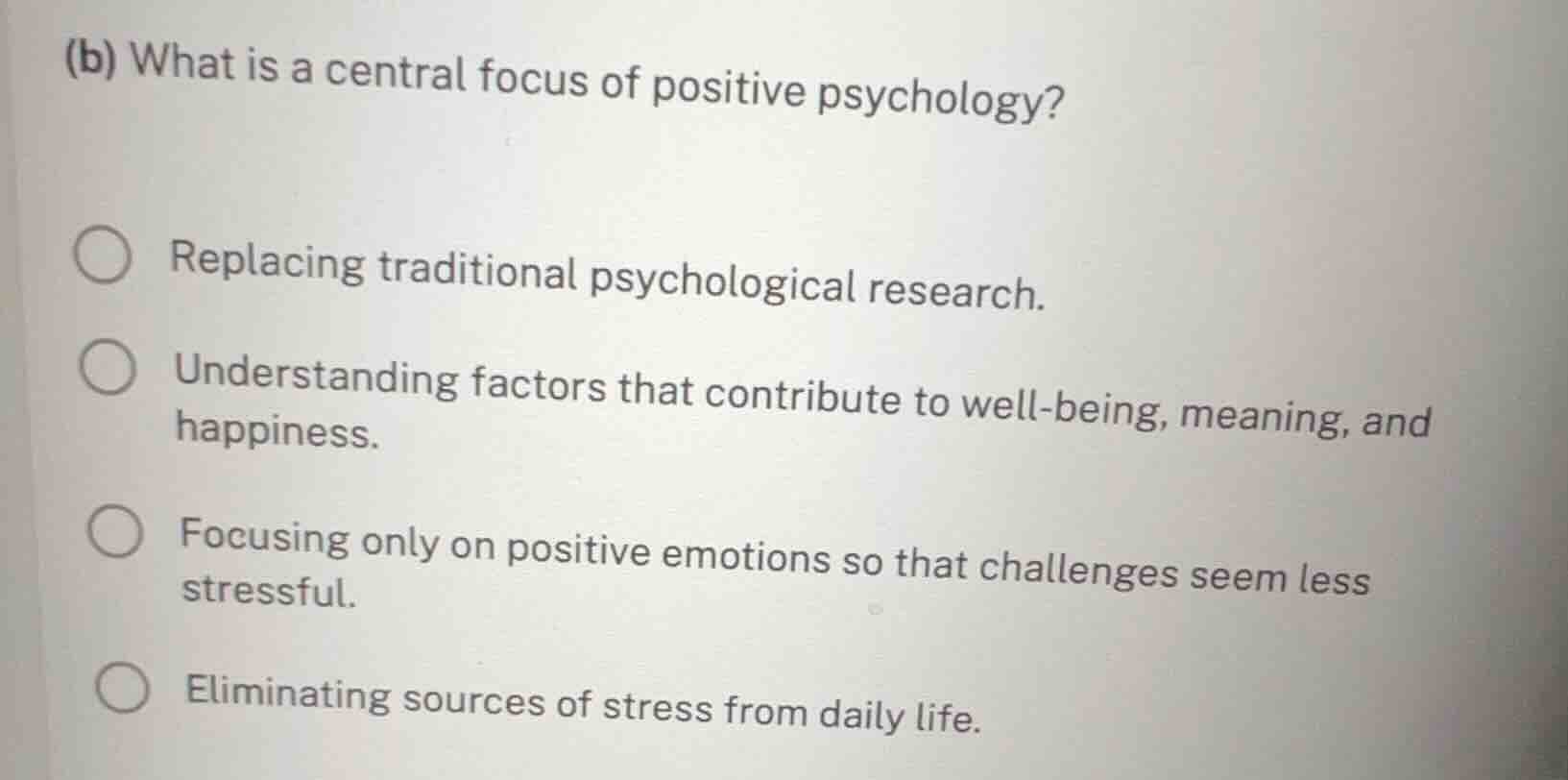
(b) what is a central focus of positive psychology?

replacing traditional psychological research.
understanding factors that contribute to well-being, meaning, and happiness.
focusing only on positive emotions so that challenges seem less stressful.
eliminating sources of stress from daily life.

Explanation:

Response

<pre_analysis>
{
"quality": "clear",
"question_count": 1,
"skills_matched": [
"direct_cot",
"multiple_choice_formatter",
"explain_then_answer",
"tutor",
"mastery_adaptive_brevity"
],
"needs_drawing": false,
"concepts_used": [
"Positive Psychology"
],
"new_concepts": [],
"current_concepts": [
"Positive Psychology"
]
}
</pre_analysis>

<reasoning>

Define positive psychology

Using the Positive Psychology knowledge point
Positive psychology is the scientific study of human flourishing and the factors that enable individuals and communities to thrive, rather than focusing solely on treating mental illness or pathology.

Evaluate the options

  • Replacing traditional psychological research: Incorrect. Positive psychology is designed to complement, not replace, traditional psychology by adding a focus on strengths and well-being.
  • Understanding factors that contribute to well-being, meaning, and happiness: Correct. This directly aligns with the core mission of positive psychology to study and promote optimal human functioning.
  • Focusing only on positive emotions so that challenges seem less stressful: Incorrect. Positive psychology does not advocate for ignoring negative emotions or challenges, but rather building resilience and strengths.
  • Eliminating sources of stress from daily life: Incorrect. Stress is an inevitable part of life; positive psychology focuses on how individuals can cope, grow, and find meaning despite stressors.

</reasoning>

<answer>
<mcq-option>Replacing traditional psychological research.</mcq-option>
<mcq-correct>Understanding factors that contribute to well-being, meaning, and happiness.</mcq-correct>
<mcq-option>Focusing only on positive emotions so that challenges seem less stressful.</mcq-option>
<mcq-option>Eliminating sources of stress from daily life.</mcq-option>
</answer>

<post_analysis>
{
"subject": "Social Science",
"question_type": "Multiple Choice",
"knowledge_point": [
"Social Science",
"Psychology",
"Positive Psychology"
]
}
</post_analysis>

Answer:

<pre_analysis>
{
"quality": "clear",
"question_count": 1,
"skills_matched": [
"direct_cot",
"multiple_choice_formatter",
"explain_then_answer",
"tutor",
"mastery_adaptive_brevity"
],
"needs_drawing": false,
"concepts_used": [
"Positive Psychology"
],
"new_concepts": [],
"current_concepts": [
"Positive Psychology"
]
}
</pre_analysis>

<reasoning>

Define positive psychology

Using the Positive Psychology knowledge point
Positive psychology is the scientific study of human flourishing and the factors that enable individuals and communities to thrive, rather than focusing solely on treating mental illness or pathology.

Evaluate the options

  • Replacing traditional psychological research: Incorrect. Positive psychology is designed to complement, not replace, traditional psychology by adding a focus on strengths and well-being.
  • Understanding factors that contribute to well-being, meaning, and happiness: Correct. This directly aligns with the core mission of positive psychology to study and promote optimal human functioning.
  • Focusing only on positive emotions so that challenges seem less stressful: Incorrect. Positive psychology does not advocate for ignoring negative emotions or challenges, but rather building resilience and strengths.
  • Eliminating sources of stress from daily life: Incorrect. Stress is an inevitable part of life; positive psychology focuses on how individuals can cope, grow, and find meaning despite stressors.

</reasoning>

<answer>
<mcq-option>Replacing traditional psychological research.</mcq-option>
<mcq-correct>Understanding factors that contribute to well-being, meaning, and happiness.</mcq-correct>
<mcq-option>Focusing only on positive emotions so that challenges seem less stressful.</mcq-option>
<mcq-option>Eliminating sources of stress from daily life.</mcq-option>
</answer>

<post_analysis>
{
"subject": "Social Science",
"question_type": "Multiple Choice",
"knowledge_point": [
"Social Science",
"Psychology",
"Positive Psychology"
]
}
</post_analysis>