QUESTION IMAGE
Question
what can cause the following weld defect to occur?
weld bead depth to width ratio too high, bead too small
travel speed too fast, root opening too wide
breezes or drafts, not enough gas flow/leaks
too much inductance and stick out, poor work connection
travel speed too high, voltage too high, amperage too high, not enough dwell time on edges of weld
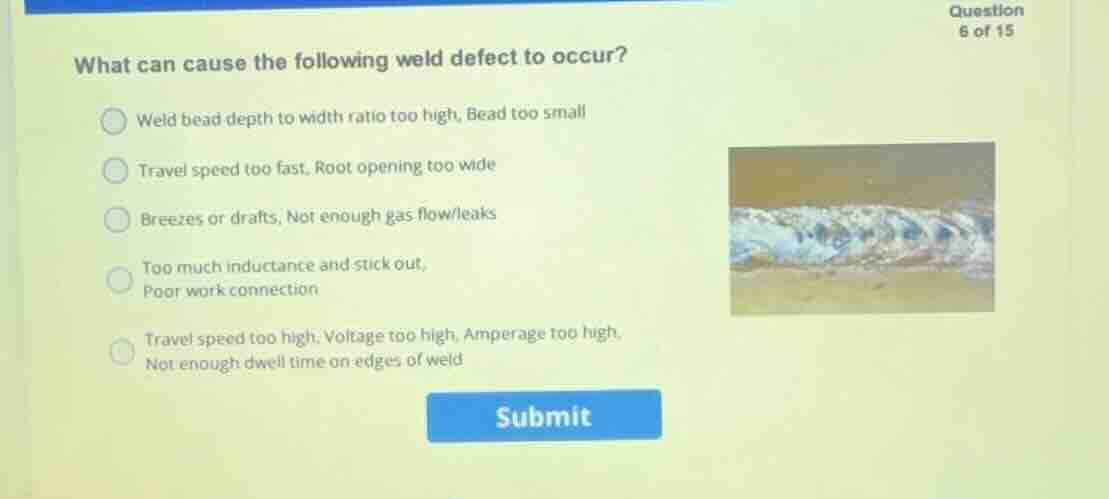
Identify the weld defect in the image
Using the Welding Defects knowledge point, we examine the visual characteristics of the weld bead shown in the image. The surface of the weld bead exhibits a highly porous, spongy texture with numerous small cavities, holes, and pockets. This characteristic appearance is a classic representation of surface porosity.
Determine the causes of porosity
Using the Porosity knowledge point, we analyze what causes this specific defect. Porosity occurs when gas becomes trapped in the solidifying weld pool. The primary cause of porosity in gas-shielded welding processes (like GMAW or GTAW) is the loss or disruption of the protective shielding gas envelope. This allows atmospheric gases (nitrogen, oxygen, and hydrogen) to contaminate the molten weld pool. Common causes include:
- External wind, breezes, or drafts blowing away the shielding gas.
- Insufficient gas flow rate or gas leaks in the delivery system.
- Spatter buildup in the gas nozzle restricting flow.
Match with the multiple-choice options
We evaluate the given options to find the one that matches the identified causes of porosity:
- Option 1: "Weld bead depth to width ratio too high, Bead too small" (associated with solidification cracking).
- Option 2: "Travel speed too fast, Root opening too wide" (associated with lack of penetration or burn-through).
- Option 3: "Breezes or drafts, Not enough gas flow/leaks" (directly causes loss of shielding gas, leading to porosity).
- Option 4: "Too much inductance and stick out, Poor work connection" (associated with arc instability and spatter).
- Option 5: "Travel speed too high, Voltage too high, Amperage too high, Not enough dwell time on edges of weld" (associated with undercut).
The third option is the correct match.

Snap & solve any problem in the app
Get step-by-step solutions on Sovi AI
Photo-based solutions with guided steps
Explore more problems and detailed explanations
- (A) Weld bead depth to width ratio too high, Bead too small
- (B) Travel speed too fast, Root opening too wide
- (C) Breezes or drafts, Not enough gas flow/leaks (Correct answer)
- (D) Too much inductance and stick out, Poor work connection
- (E) Travel speed too high, Voltage too high, Amperage too high, Not enough dwell time on edges of weld