QUESTION IMAGE
Question
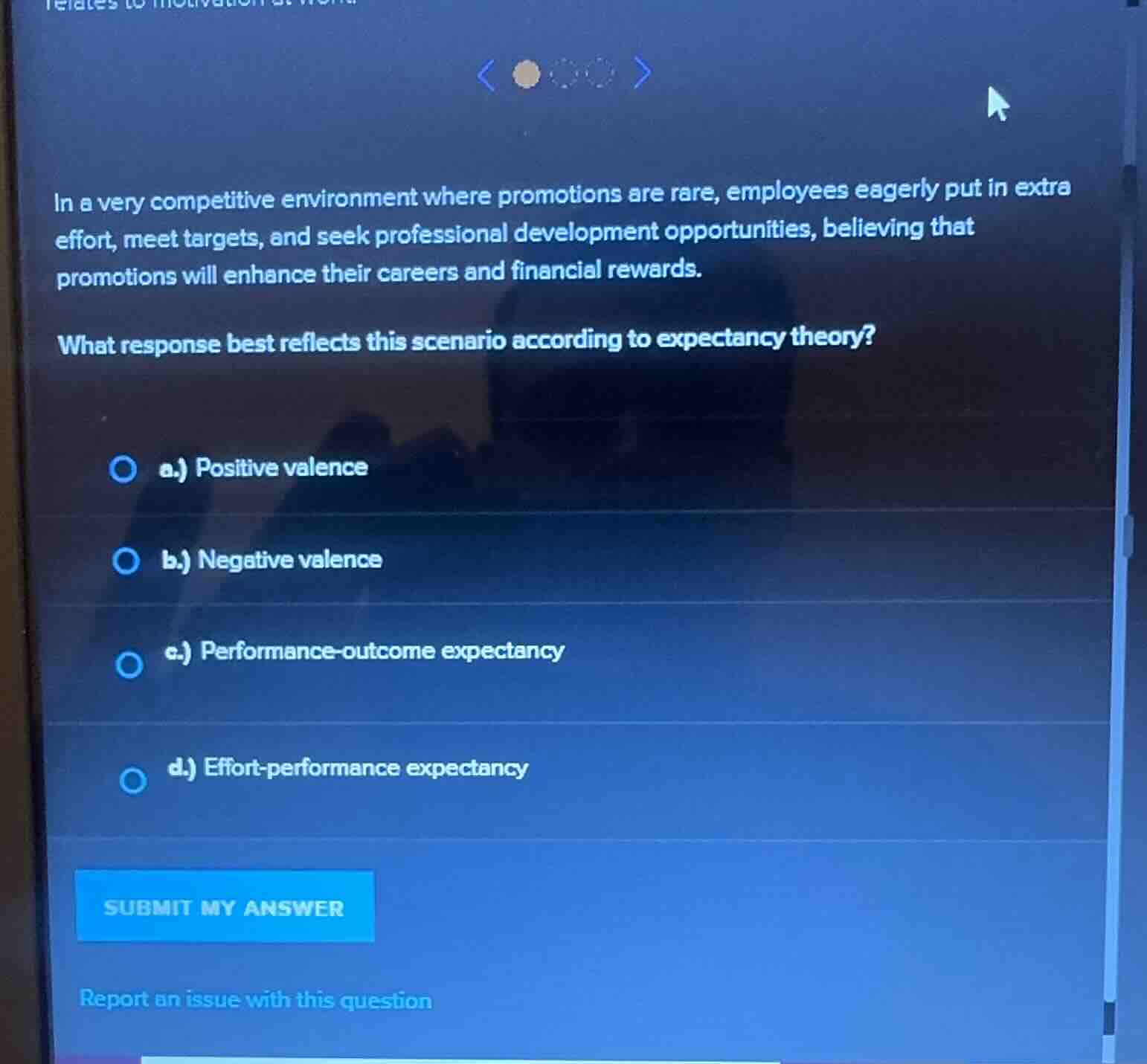
in a very competitive environment where promotions are rare, employees eagerly put in extra effort, meet targets, and seek professional development opportunities, believing that promotions will enhance their careers and financial rewards.
what response best reflects this scenario according to expectancy theory?
a.) positive valence
b.) negative valence
c.) performance-outcome expectancy
d.) effort-performance expectancy
Analyze the scenario details
The scenario describes employees who "eagerly put in extra effort, meet targets, and seek professional development opportunities" because they believe "that promotions will enhance their careers and financial rewards."
We need to identify which core component of Victor Vroom's Expectancy Theory is best highlighted by this specific belief.
Define Expectancy Theory components
Expectancy Theory posits that motivation is a function of three key beliefs:
- **Effort-to-Performance Expectancy (\(E
ightarrow P\))**: The belief that putting in effort will lead to successful performance (e.g., "If I work hard, I will meet my targets").
- **Performance-to-Outcome Expectancy (\(P
ightarrow O\))**: The belief that successful performance will lead to a specific outcome or reward (e.g., "If I meet my targets, I will get a promotion").
- Valence (\(V\)): The value or attractiveness that an individual places on the expected outcome/reward (e.g., "I highly value career advancement and financial rewards").
Map the scenario to the correct component
The scenario states that employees are working hard and meeting targets because they believe "that promotions will enhance their careers and financial rewards."
Here, the "promotion" is the performance-related milestone or immediate outcome, and "career enhancement and financial rewards" are the ultimate outcomes/rewards. The belief that a specific outcome (promotion) will lead to highly valued personal rewards (career growth, money) directly represents positive valence. Valence refers to the anticipated satisfaction or value associated with an outcome. Because they believe the promotion will positively enhance their careers and financial rewards, the promotion holds positive valence for them, driving their motivation.
Let's double-check the other options:
- Negative valence would mean they find the outcome undesirable, which is incorrect.
- Performance-outcome expectancy (Instrumentality) is the belief that performing well leads to the promotion itself. While present, the specific clause "believing that promotions will enhance their careers and financial rewards" focuses on the positive value/utility of the promotion itself.
- Effort-performance expectancy is the belief that effort leads to performance, which does not capture the value of the promotion.
Therefore, the belief that promotions will bring desirable career and financial benefits is a direct reflection of positive valence.

Snap & solve any problem in the app
Get step-by-step solutions on Sovi AI
Photo-based solutions with guided steps
Explore more problems and detailed explanations
- a.) Positive valence (Correct answer)
- b.) Negative valence
- c.) Performance-outcome expectancy
- d.) Effort-performance expectancy