QUESTION IMAGE
Question
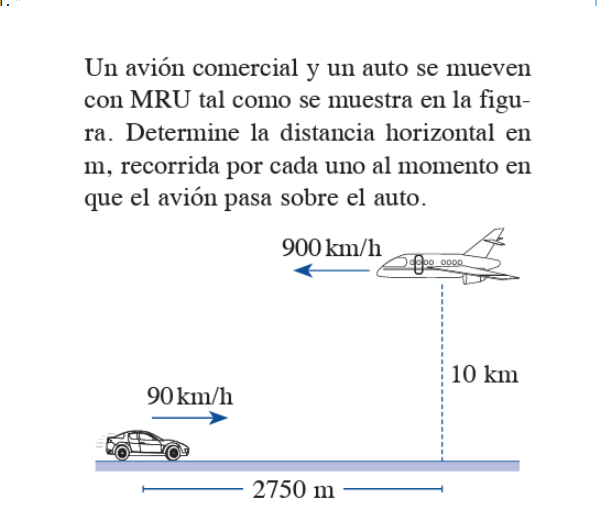
un avión comercial y un auto se mueven con mru tal como se muestra en la figura. determine la distancia horizontal en m, recorrida por cada uno al momento en que el avión pasa sobre el auto.
🆕 New Concept Discovered: Relative Motion in MRU
Solving problems where two objects move toward each other.
Step 1: Convert speeds to SI units
To work with the horizontal distance given in meters (\(2750\text{ m}\)), we convert the speeds of both the airplane (\(v_a\)) and the car (\(v_c\)) from \(\text{km/h}\) to \(\text{m/s}\) using the conversion factor \(\frac{5}{18}\).
For the airplane:
For the car:
Step 2: Determine the time of encounter
The airplane and the car are moving horizontally toward each other. The initial horizontal separation between them is \(d = 2750\text{ m}\). Note that the vertical altitude of \(10\text{ km}\) does not affect their horizontal relative motion.
Since they move in opposite directions, their relative speed of approach is the sum of their individual speeds:
We calculate the time \(t\) it takes for the airplane to be directly above the car:
Step 3: Calculate the horizontal distance traveled by each
Using the encounter time \(t = 10\text{ s}\), we find the horizontal distance covered by each vehicle.
For the airplane (\(d_a\)):
For the car (\(d_c\)):

Snap & solve any problem in the app
Get step-by-step solutions on Sovi AI
Photo-based solutions with guided steps
Explore more problems and detailed explanations
The horizontal distances traveled at the moment the airplane passes over the car are \(2500\text{ m}\) for the airplane and \(250\text{ m}\) for the car.