QUESTION IMAGE
Question
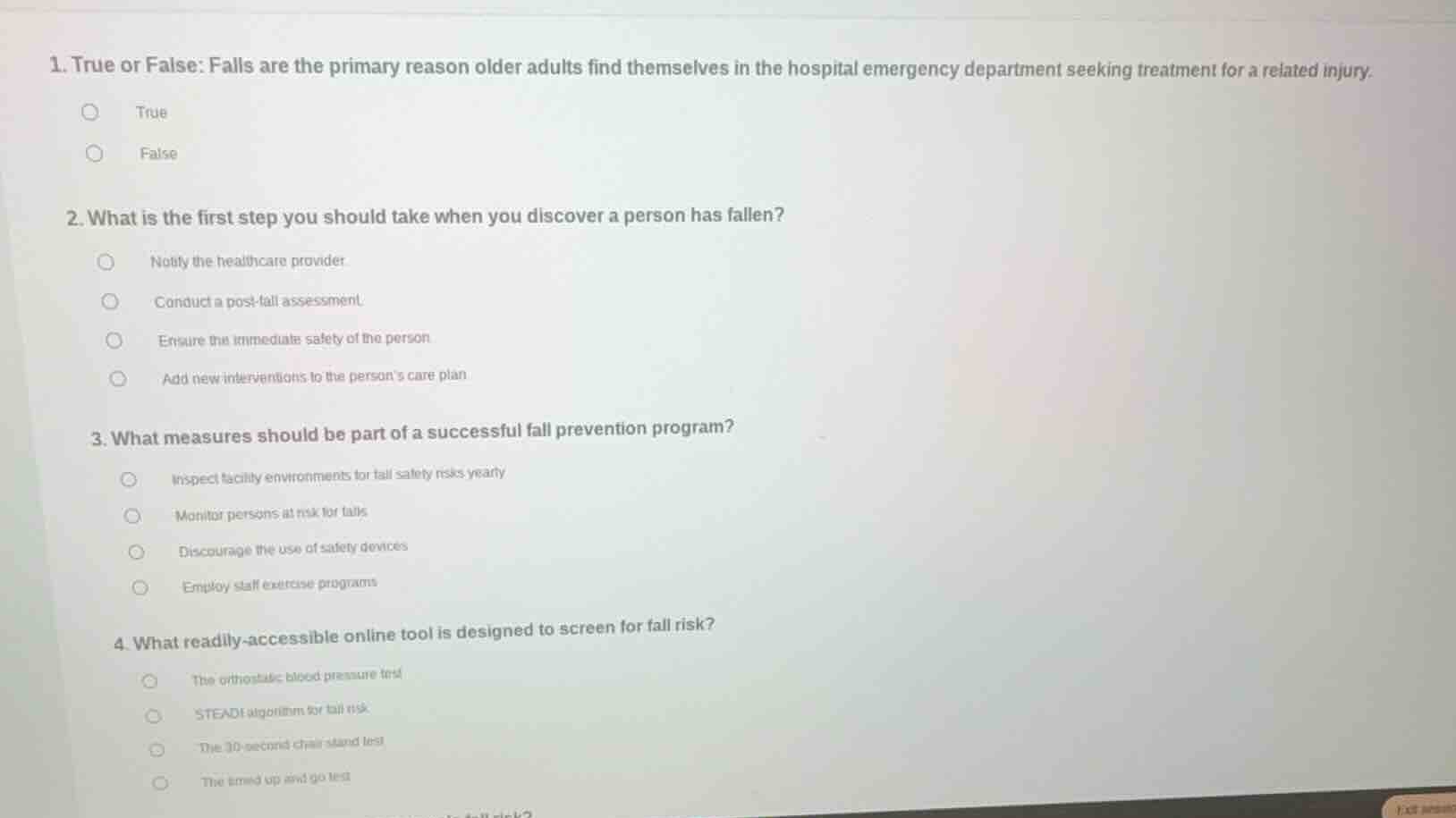
- true or false: falls are the primary reason older adults find themselves in the hospital emergency department seeking treatment for a related injury.
true
false
- what is the first step you should take when you discover a person has fallen?
notify the healthcare provider.
conduct a post-fall assessment.
ensure the immediate safety of the person.
add new interventions to the persons care plan.
- what measures should be part of a successful fall prevention program?
inspect facility environments for fall safety risks yearly.
monitor persons at risk for falls.
discourage the use of safety devices.
employ staff exercise programs.
- what readily-accessible online tool is designed to screen for fall risk?
the orthostatic blood pressure test
steadi algorithm for fall risk
the 30-second chair stand test
the timed up and go test
Analyze the prevalence of falls in older adults
Falls are the leading cause of both fatal and nonfatal injuries among older adults aged 65 and older. According to data from the Centers for Disease Control and Prevention (CDC), millions of older adults are treated in emergency departments each year for fall-related injuries, making falls the primary reason for these emergency visits. Therefore, the statement in Question 1 is True.
Determine the immediate response to a fall
When discovering a person who has fallen, the first priority is always to ensure their immediate safety and prevent further injury. This aligns with standard Post-Fall Response protocols. Before moving the person, calling providers, or conducting a detailed assessment, you must ensure the environment is safe and the person is not in immediate danger. Thus, the correct option for Question 2 is "Ensure the immediate safety of the person".
Identify successful fall prevention measures
A successful Fall Prevention program relies on identifying individuals who are vulnerable and monitoring them closely.
- Yearly environmental inspections are too infrequent to address dynamic risks.
- Discouraging safety devices increases risk.
- Staff exercise programs do not directly prevent patient falls.
Therefore, the most effective measure is to "Monitor persons at risk for falls".
Identify the online screening tool for fall risk
The CDC's STEADI (Stopping Elderly Accidents, Deaths & Injuries) initiative provides a widely recognized, readily-accessible online algorithm and toolset designed specifically for healthcare providers to screen, assess, and intervene to reduce fall risk. While the orthostatic blood pressure test, 30-second chair stand test, and timed up and go test are physical assessments, the STEADI algorithm serves as the comprehensive online screening framework. Thus, the correct option is "STEADI algorithm for fall risk".

Snap & solve any problem in the app
Get step-by-step solutions on Sovi AI
Photo-based solutions with guided steps
Explore more problems and detailed explanations
Question 1
- True (Correct answer)
- False
Question 2
- Notify the healthcare provider.
- Conduct a post-fall assessment.
- Ensure the immediate safety of the person. (Correct answer)
- Add new interventions to the person's care plan.
Question 3
- Inspect facility environments for fall safety risks yearly.
- Monitor persons at risk for falls. (Correct answer)
- Discourage the use of safety devices.
- Employ staff exercise programs.
Question 4
- The orthostatic blood pressure test
- STEADI algorithm for fall risk (Correct answer)
- The 30-second chair stand test
- The timed up and go test