QUESTION IMAGE
Question
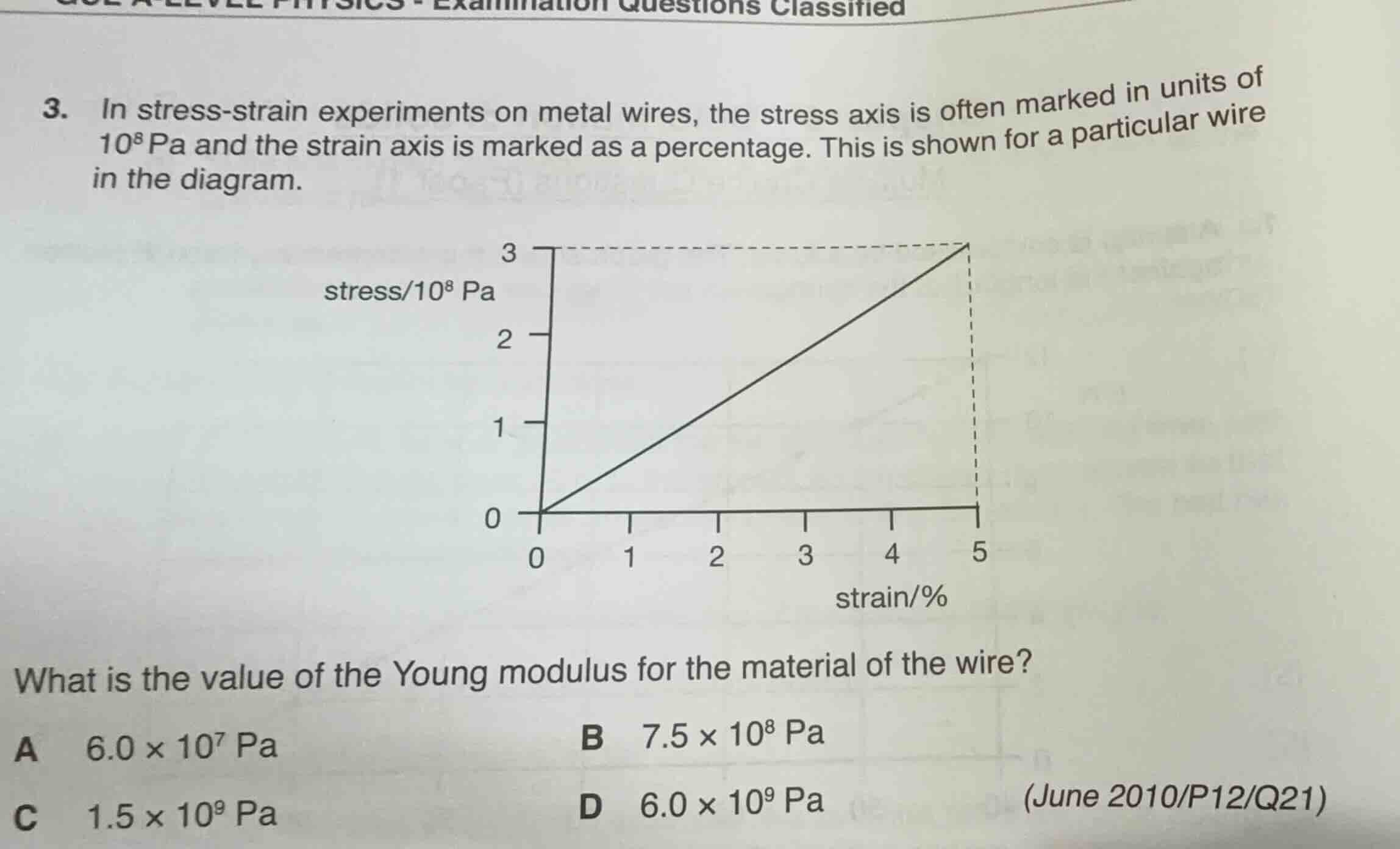
- in stress-strain experiments on metal wires, the stress axis is often marked in units of \\(10^8\text{ pa}\\) and the strain axis is marked as a percentage. this is shown for a particular wire in the diagram.
what is the value of the young modulus for the material of the wire?
a \\(6.0 \times 10^7\text{ pa}\\)
b \\(7.5 \times 10^8\text{ pa}\\)
c \\(1.5 \times 10^9\text{ pa}\\)
d \\(6.0 \times 10^9\text{ pa}\\)
Identify the formula for Young modulus
The Young modulus \(E\) of a material is defined as the ratio of tensile stress \(\sigma\) to tensile strain \(\varepsilon\):
Extract values from the stress-strain graph
From the given linear graph, we can select a point to calculate the gradient. At the maximum point of the line:
- Stress \(\sigma = 3 \times 10^8\text{ Pa}\)
- Strain \(\varepsilon = 5\%\)
Convert strain from percentage to a decimal value
The strain is given as a percentage and must be converted to a dimensionless ratio:
Calculate the Young modulus
Substitute the values into the Young modulus formula:
Match the result with the given options
The calculated value of \(6.0 \times 10^9\text{ Pa}\) corresponds to option D.

Snap & solve any problem in the app
Get step-by-step solutions on Sovi AI
Photo-based solutions with guided steps
Explore more problems and detailed explanations
- (A) \(6.0 \times 10^7\text{ Pa}\)
- (B) \(7.5 \times 10^8\text{ Pa}\)
- (C) \(1.5 \times 10^9\text{ Pa}\)
- (D) \(6.0 \times 10^9\text{ Pa}\) (Correct answer)