QUESTION IMAGE
Question
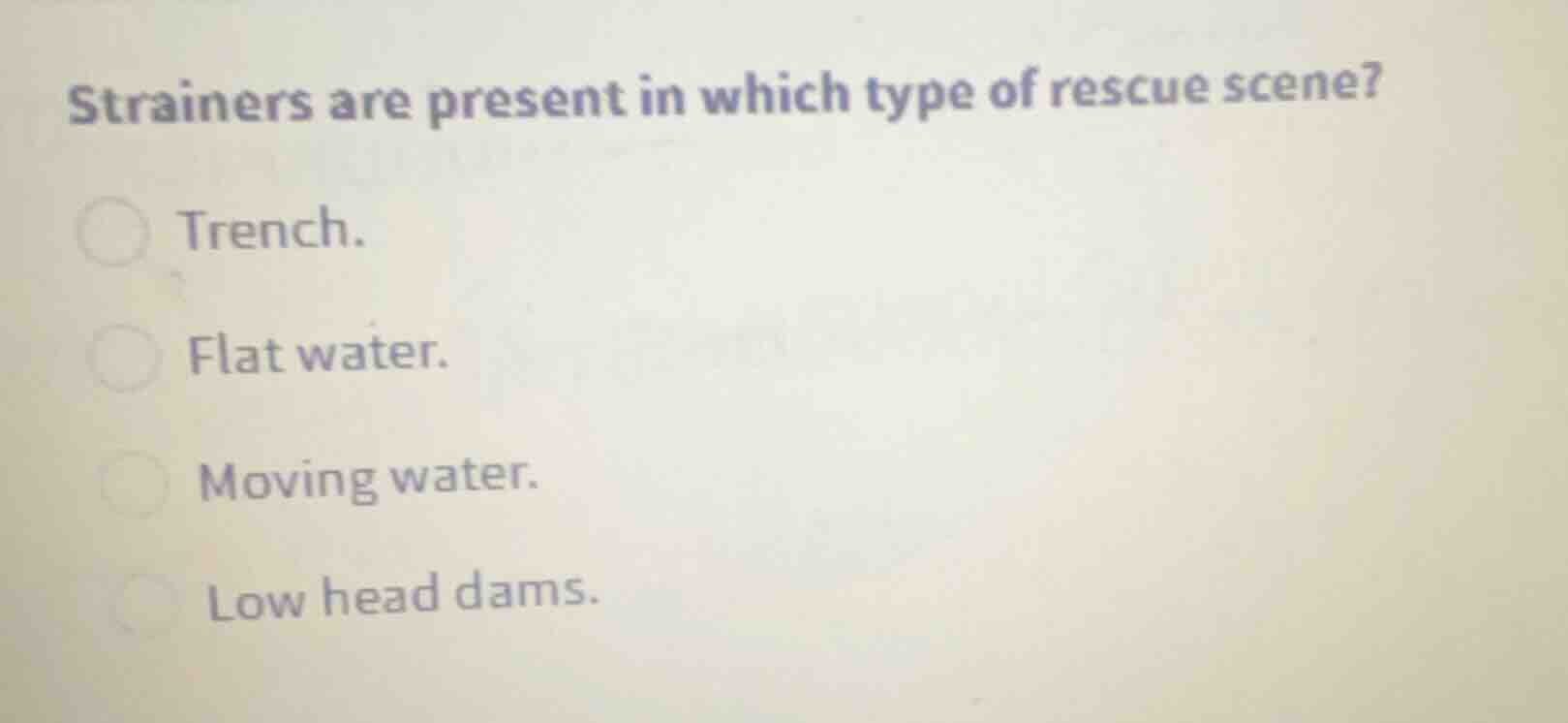
strainers are present in which type of rescue scene?
trench.
flat water.
moving water.
low head dams.
Identify the core rescue term
The question asks about the presence of "strainers" in specific rescue environments. In rescue operations, a strainer is an obstruction in a body of water that allows water to pass through but traps solid objects like boats, debris, or swimmers.
Analyze the rescue environments
- Trench: Trench rescue involves collapsed earth and shoring operations, where water hazards are not the primary defining feature of "strainers."
- Flat water: Flat water (lakes, ponds) lacks the continuous, powerful current required to force a victim into a strainer and hold them against it.
- Moving water: Moving water (rivers, creeks, swiftwater environments) contains natural or man-made obstructions such as fallen trees, branches, rocks, or fences. The force of the moving water creates a highly dangerous strainer hazard by pinning victims against these obstacles.
- Low head dams: While low head dams are extremely dangerous water hazards, they are characterized by a recirculating current (hydraulic or "keeper") rather than acting as a physical strainer.
Connect to water rescue concepts
Using the Water Rescue Sequence knowledge point, rescuers must identify hazards before attempting a rescue. In swiftwater or moving water environments, strainers are among the most lethal hazards because the force of the current makes self-rescue or escape nearly impossible once pinned.

Snap & solve any problem in the app
Get step-by-step solutions on Sovi AI
Photo-based solutions with guided steps
Explore more problems and detailed explanations
- Trench.
- Flat water.
- Moving water. (Correct answer)
- Low head dams.