QUESTION IMAGE
Question
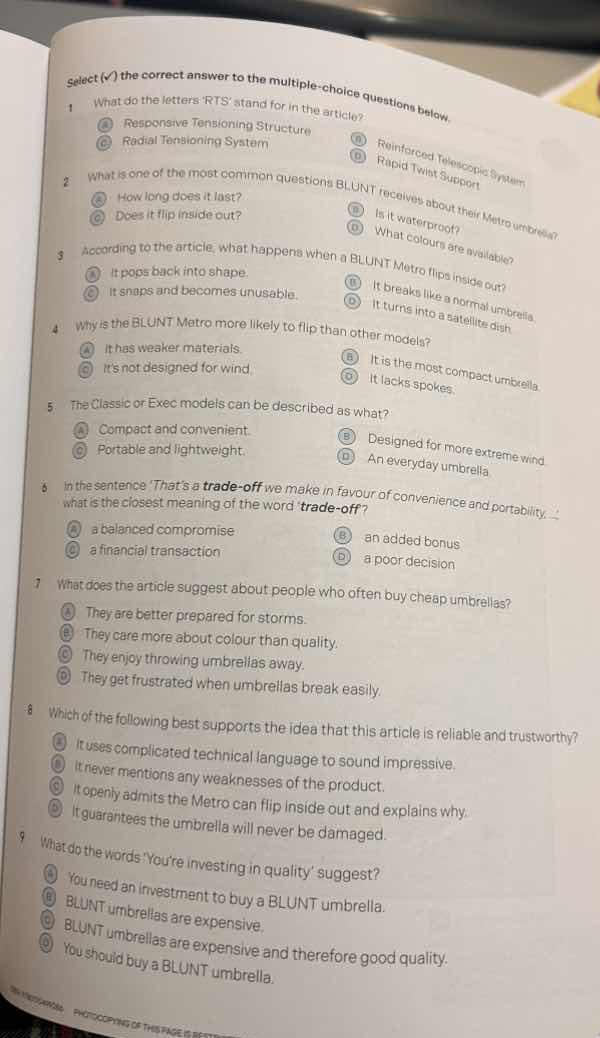
select (\checkmark) the correct answer to the multiple-choice questions below.
1 what do the letters rts stand for in the article?
(a) responsive tensioning structure
(b) reinforced telescopic system
(c) radial tensioning system
(d) rapid twist support
2 what is one of the most common questions blunt receives about their metro umbrella?
(a) how long does it last?
(b) is it waterproof?
(c) does it flip inside out?
(d) what colours are available?
3 according to the article, what happens when a blunt metro flips inside out?
(a) it pops back into shape.
(b) it breaks like a normal umbrella.
(c) it snaps and becomes unusable.
(d) it turns into a satellite dish.
4 why is the blunt metro more likely to flip than other models?
(a) it has weaker materials.
(b) it is the most compact umbrella.
(c) its not designed for wind.
(d) it lacks spokes.
5 the classic or exec models can be described as what?
(a) compact and convenient.
(b) designed for more extreme wind.
(c) portable and lightweight.
(d) an everyday umbrella.
6 in the sentence thats a trade-off we make in favour of convenience and portability..., what is the closest meaning of the word trade-off?
(a) a balanced compromise
(b) an added bonus
(c) a financial transaction
(d) a poor decision
7 what does the article suggest about people who often buy cheap umbrellas?
(a) they are better prepared for storms.
(b) they care more about colour than quality.
(c) they enjoy throwing umbrellas away.
(d) they get frustrated when umbrellas break easily.
8 which of the following best supports the idea that this article is reliable and trustworthy?
(a) it uses complicated technical language to sound impressive.
(b) it never mentions any weaknesses of the product.
(c) it openly admits the metro can flip inside out and explains why.
(d) it guarantees the umbrella will never be damaged.
9 what do the words youre investing in quality suggest?
(a) you need an investment to buy a blunt umbrella.
(b) blunt umbrellas are expensive.
(c) blunt umbrellas are expensive and therefore good quality.
(d) you should buy a blunt umbrella.
Analyze questions 1 to 3
- "RTS" in the context of BLUNT umbrellas stands for Radial Tensioning System, which is their signature technology. This corresponds to option (C).
- The most common question BLUNT receives about their Metro model (the compact, folding model) is "Does it flip inside out?", which is a typical concern for compact umbrellas. This corresponds to option (C).
- When a BLUNT Metro flips inside out, it is designed to pop back into shape without breaking, unlike traditional umbrellas. This corresponds to option (A).
Analyze questions 4 to 6
- The Metro model is more likely to flip than the larger Classic or Exec models because it is the most compact umbrella in their range, meaning it has more moving parts and joints to allow folding. This corresponds to option (B).
- The larger Classic or Exec models are designed for more extreme wind conditions compared to the compact Metro. This corresponds to option (B).
- In the context of "That's a trade-off we make in favour of convenience and portability," a "trade-off" refers to a balanced compromise where you lose one quality to gain another. This corresponds to option (A).
Analyze questions 7 to 9
- The article suggests that people who buy cheap umbrellas get frustrated when those umbrellas break easily, leading them to seek a higher-quality alternative like BLUNT. This corresponds to option (D).
- The reliability and trustworthiness of the article are supported by the fact that it openly admits the Metro can flip inside out and explains why, showing balanced and honest reporting rather than pure marketing. This corresponds to option (C).
- The phrase "You're investing in quality" suggests that while BLUNT umbrellas are expensive, they are of very good quality and worth the higher cost over time. This corresponds to option (C).

Snap & solve any problem in the app
Get step-by-step solutions on Sovi AI
Photo-based solutions with guided steps
Explore more problems and detailed explanations
- (C)
- (C)
- (A)
- (B)
- (B)
- (A)
- (D)
- (C)
- (C)