QUESTION IMAGE
Question
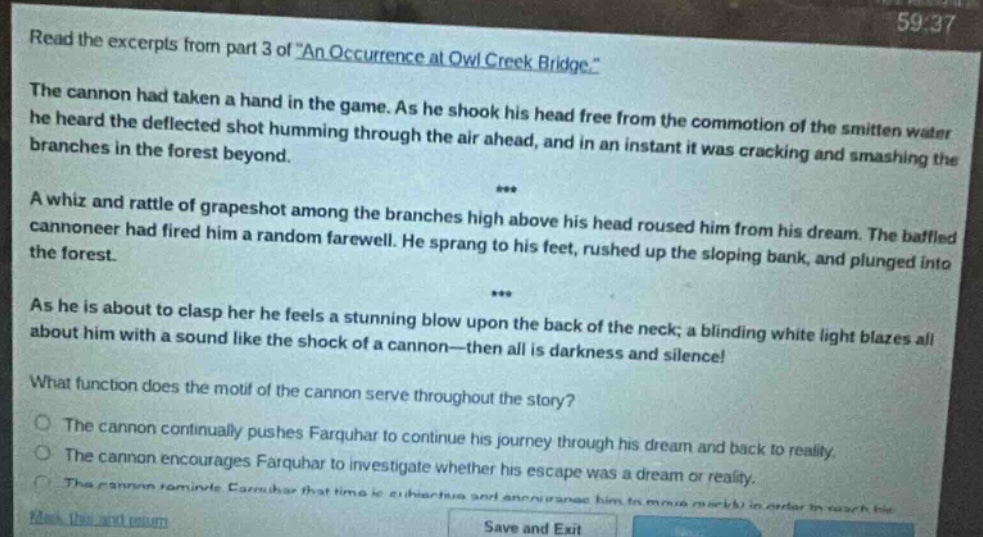
read the excerpts from part 3 of \an occurrence at owl creek bridge.\
the cannon had taken a hand in the game. as he shook his head free from the commotion of the smitten water he heard the deflected shot humming through the air ahead, and in an instant it was cracking and smashing the branches in the forest beyond.
***
a whiz and rattle of grapeshot among the branches high above his head roused him from his dream. the baffled cannoneer had fired him a random farewell. he sprang to his feet, rushed up the sloping bank, and plunged into the forest.
***
as he is about to clasp her he feels a stunning blow upon the back of the neck; a blinding white light blazes all about him with a sound like the shock of a cannon—then all is darkness and silence!
what function does the motif of the cannon serve throughout the story?
- the cannon continually pushes farquhar to continue his journey through his dream and back to reality.
- the cannon encourages farquhar to investigate whether his escape was a dream or reality.
- the cannon reminds farquhar that time is subjective and encourages him to move quickly in order to reach his
⚡ Using what you learned: inferential comprehension and textual evidence
Step 1: Analyze the excerpts and the motif of the cannon
In Ambrose Bierce's "An Occurrence at Owl Creek Bridge," Peyton Farquhar experiences an intense, detailed illusion of escape in the seconds between falling from the bridge and his actual death by hanging.
Throughout this escape sequence, external sensory inputs from the real world break into his subconscious mind, taking on exaggerated forms in his dream:
- In the first excerpt, the sound of the cannon is integrated into his escape narrative: "The cannon had taken a hand in the game."
- In the second excerpt, the sound of the grapeshot rouses him further: "A whiz and rattle of grapeshot among the branches high above his head roused him from his dream."
- In the final excerpt, as he is about to embrace his wife, he feels a blow to his neck accompanied by "a sound like the shock of a cannon—then all is darkness and silence!" This "shock of a cannon" is the physical snap of his neck as the rope goes taut, bringing him abruptly back to the reality of his execution.
Step 2: Evaluate the given options
Let's look at the visible options to see which one accurately describes this function:
- "The cannon continually pushes Farquhar to continue his journey through his dream and back to reality."
- Analysis: This option correctly identifies that the cannon fire serves as a recurring sensory intrusion. It drives him forward through his imagined escape (his dream) while simultaneously acting as a bridge linking his subconscious mind back to the physical reality of his hanging.
- "The cannon encourages Farquhar to investigate whether his escape was a dream or reality."
- Analysis: Farquhar does not actively investigate or question his reality during these moments; he fully believes his escape is real until the very end.
- "The cannon reminds Farquhar that time is subjective..." (partially cut off)
- Analysis: While time is subjective in the story, the cannon itself does not serve to make Farquhar consciously reflect on the nature of time.
Therefore, the first option is the most accurate description of the motif's function.

Snap & solve any problem in the app
Get step-by-step solutions on Sovi AI
Photo-based solutions with guided steps
Explore more problems and detailed explanations
The cannon continually pushes Farquhar to continue his journey through his dream and back to reality.