QUESTION IMAGE
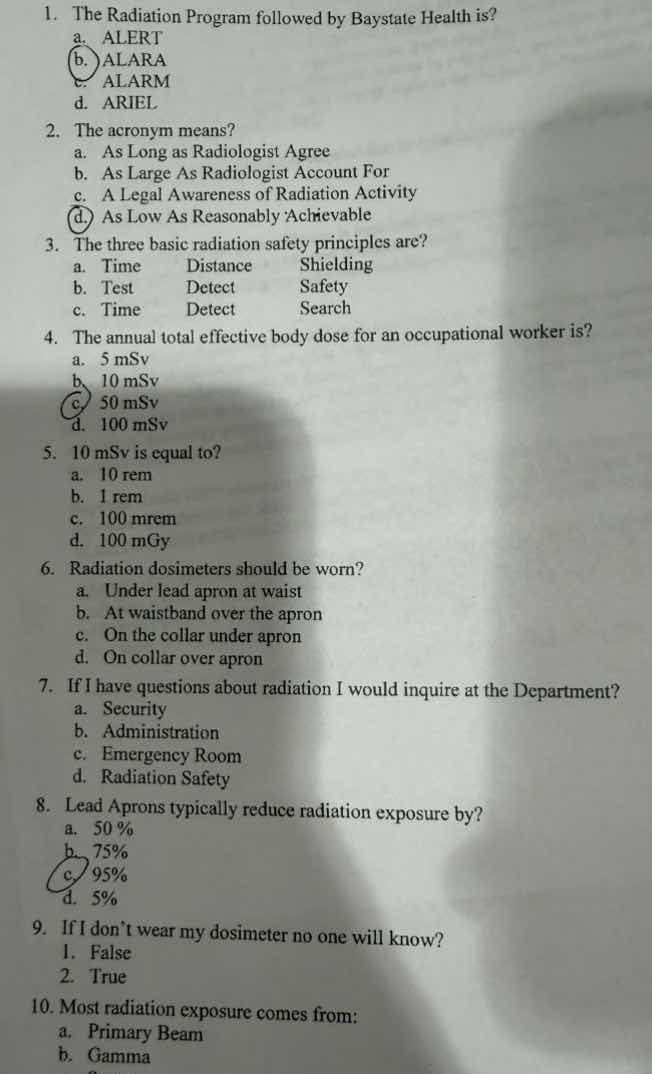
Question
- the radiation program followed by baystate health is?
a. alert
b. alara
c. alarm
d. ariel
- the acronym means?
a. as long as radiologist agree
b. as large as radiologist account for
c. a legal awareness of radiation activity
d. as low as reasonably achievable
- the three basic radiation safety principles are?
a. time distance shielding
b. test detect safety
c. time detect search
- the annual total effective body dose for an occupational worker is?
a. 5 msv
b. 10 msv
c. 50 msv
d. 100 msv
- 10 msv is equal to?
a. 10 rem
b. 1 rem
c. 100 mrem
d. 100 mgy
- radiation dosimeters should be worn?
a. under lead apron at waist
b. at waistband over the apron
c. on the collar under apron
d. on collar over apron
- if i have questions about radiation i would inquire at the department?
a. security
b. administration
c. emergency room
d. radiation safety
- lead aprons typically reduce radiation exposure by?
a. 50%
b. 75%
c. 95%
d. 5%
- if i dont wear my dosimeter no one will know?
- false
- true
- most radiation exposure comes from:
a. primary beam
b. gamma
🆕 New Concept Discovered: Radiation Safety and Dosimetry
Keeping radiation exposure as low as possible using standard safety protocols.
Step 1: Solve Question 1
The radiation safety program followed by healthcare organizations (including Baystate Health) is based on the standard safety acronym.
- Answer: b. ALARA
Step 2: Solve Question 2
The acronym ALARA stands for a fundamental safety principle in radiation protection.
- Meaning: As Low As Reasonably Achievable
- Answer: d. As Low As Reasonably Achievable
Step 3: Solve Question 3
The three cardinal rules of radiation protection to minimize exposure are:
- Time: Minimize the time spent near the radiation source.
- Distance: Maximize the distance from the radiation source.
- Shielding: Use appropriate barriers (like lead) between you and the source.
- Answer: a. Time, Distance, Shielding
Step 4: Solve Question 4
According to occupational safety standards (such as those from the NCRP and OSHA), the annual limit for occupational whole-body radiation exposure is \( 50\text{ mSv} \) (\( 5\text{ rem} \)).
- Answer: c. 50 mSv
Step 5: Solve Question 5
To convert millisieverts (\(\text{mSv}\)) to radiation equivalent man (\(\text{rem}\)), we use the conversion factor:
Therefore, \( 10\text{ mSv} \) is equal to \( 1\text{ rem} \).
- Answer: b. 1 rem
Step 6: Solve Question 6
A radiation dosimeter (badge) measures the maximum radiation dose received by the unprotected parts of the body (especially the thyroid and eyes). Therefore, it must be worn outside of any protective gear at collar level.
- Answer: d. On collar over apron
Step 7: Solve Question 7
Any specific inquiries regarding radiation exposure, safety protocols, or dosimeter badges should be directed to the specialized department handling these matters.
- Answer: d. Radiation Safety
Step 8: Solve Question 8
Lead aprons are highly effective shielding devices designed to absorb the vast majority of diagnostic scatter radiation, typically reducing exposure by approximately \( 90\% \) to \( 95\% \).
- Answer: c. 95%
Step 9: Solve Question 9
Dosimeter records are monitored and audited regularly. Failing to wear a dosimeter results in an anomalous reading (such as an unexpected zero reading or a mismatch with working hours), which is flagged by safety officers. Thus, the statement "no one will know" is false.
- Answer: a. False (Option 1)
Step 10: Solve Question 10
For occupational workers in an imaging environment, the primary beam is directed at the patient, while the main source of occupational exposure to the staff is scatter radiation (primarily Compton scatter) bouncing off the patient.
- Answer: c. Scatter (Note: Option c is partially cut off at the bottom of the image, but "Scatter" is the standard correct answer to this question).
---

Snap & solve any problem in the app
Get step-by-step solutions on Sovi AI
Photo-based solutions with guided steps
Explore more problems and detailed explanations
- b
- d
- a
- c
- b
- d
- d
- c
- 1 (False)
- c (Scatter)