QUESTION IMAGE
Question
question 1/2
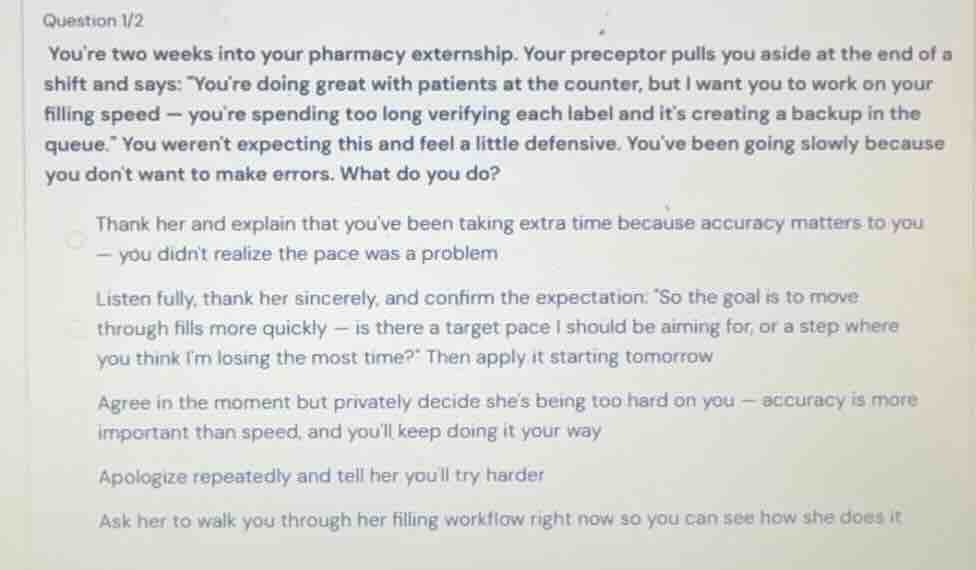
youre two weeks into your pharmacy externship. your preceptor pulls you aside at the end of a shift and says: \youre doing great with patients at the counter, but i want you to work on your filling speed - youre spending too long verifying each label and its creating a backup in the queue.\ you werent expecting this and feel a little defensive. youve been going slowly because you dont want to make errors. what do you do?
thank her and explain that youve been taking extra time because accuracy matters to you - you didnt realize the pace was a problem
listen fully, thank her sincerely, and confirm the expectation: \so the goal is to move through fills more quickly - is there a target pace i should be aiming for, or a step where you think im losing the most time?\ then apply it starting tomorrow
agree in the moment but privately decide shes being too hard on you - accuracy is more important than speed, and youll keep doing it your way
apologize repeatedly and tell her youll try harder
ask her to walk you through her filling workflow right now so you can see how she does it
Analyze the professional scenario
The scenario describes receiving constructive feedback from a preceptor regarding filling speed during a pharmacy externship. The student feels defensive because their slowness is motivated by a desire to avoid errors (accuracy). The goal is to identify the most professional, constructive, and growth-oriented response.
Evaluate the options
- Option 1: "Thank her and explain that you've been taking extra time because accuracy matters to you..." This is somewhat defensive and focuses on justifying the current behavior rather than actively seeking to improve or align with the preceptor's expectations.
- Option 2: "Listen fully, thank her sincerely, and confirm the expectation: 'So the goal is to move through fills more quickly – is there a target pace I should be aiming for, or a step where you think I'm losing the most time?' Then apply it starting tomorrow." This demonstrates active listening, professionalism, and a proactive attitude toward self-improvement. It seeks actionable feedback to resolve the workflow issue while maintaining respect for the preceptor's guidance.
- Option 3: "Agree in the moment but privately decide she's being too hard on you..." This is unprofessional, passive-aggressive, and rejects constructive feedback.
- Option 4: "Apologize repeatedly and tell her you'll try harder." This is overly submissive and does not seek constructive, actionable steps to improve.
- Option 5: "Ask her to walk you through her filling workflow right now..." This is inconsiderate of the preceptor's time, as it is "at the end of a shift" when they may need to leave or close the pharmacy.
Apply professional communication concepts
Using the Professional Ethics and Conflict Resolution concepts, the best response is one that accepts feedback constructively, seeks to understand the standard, and plans a proactive approach to meet that standard without compromising safety. Option 2 perfectly balances these elements.

Snap & solve any problem in the app
Get step-by-step solutions on Sovi AI
Photo-based solutions with guided steps
Explore more problems and detailed explanations
- (A) Thank her and explain that you've been taking extra time because accuracy matters to you — you didn't realize the pace was a problem
- (B) Listen fully, thank her sincerely, and confirm the expectation: "So the goal is to move through fills more quickly — is there a target pace I should be aiming for, or a step where you think I'm losing the most time?" Then apply it starting tomorrow (Correct answer)
- (C) Agree in the moment but privately decide she's being too hard on you — accuracy is more important than speed, and you'll keep doing it your way
- (D) Apologize repeatedly and tell her you'll try harder
- (E) Ask her to walk you through her filling workflow right now so you can see how she does it