QUESTION IMAGE
Question
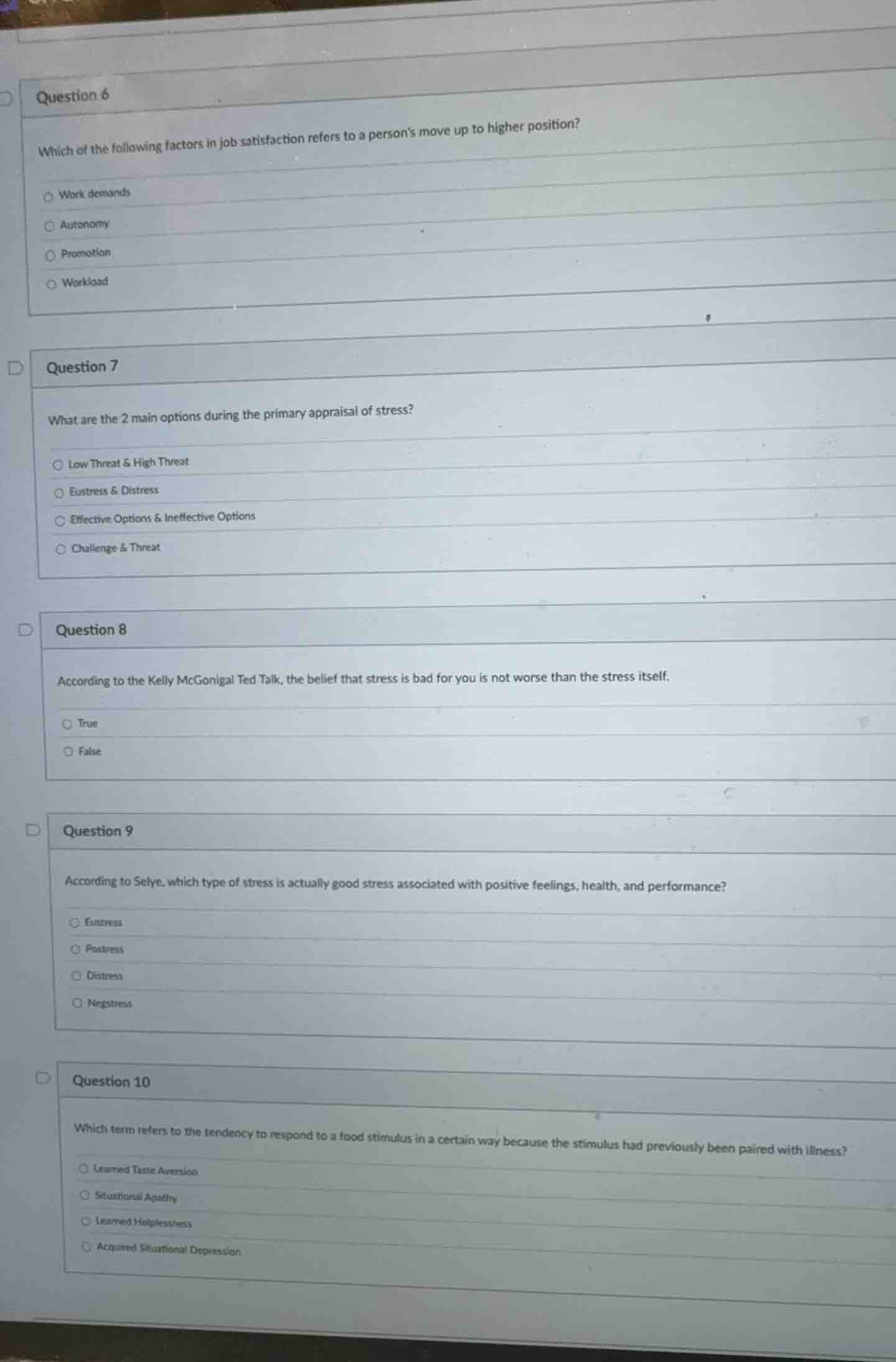
question 6
which of the following factors in job satisfaction refers to a persons move up to higher position?
work demands
autonomy
promotion
workload
question 7
what are the 2 main options during the primary appraisal of stress?
low threat & high threat
eustress & distress
effective options & ineffective options
challenge & threat
question 8
according to the kelly mcgonigal ted talk, the belief that stress is bad for you is not worse than the stress itself.
true
false
question 9
according to selye, which type of stress is actually good stress associated with positive feelings, health, and performance?
eustress
postress
distress
negstress
question 10
which term refers to the tendency to respond to a food stimulus in a certain way because the stimulus had previously been paired with illness?
learned taste aversion
situational apathy
learned helplessness
acquired situational depression
Analyze Question 6
The question asks which factor in job satisfaction refers to a person's upward movement to a higher position.
- "Work demands" refers to the requirements and workload of the job.
- "Autonomy" refers to the degree of freedom and independence an employee has.
- "Promotion" refers to advancement in rank, position, or salary.
- "Workload" refers to the amount of work assigned.
Therefore, "Promotion" is the correct term for moving up to a higher position.
Analyze Question 7
The question asks for the 2 main options during the primary appraisal of stress according to Lazarus and Folkman's transactional model of stress.
- Primary appraisal involves determining whether a stressor is a threat, a challenge, or irrelevant/benign.
- The two primary ways of appraising a stressor that requires coping are as a "Challenge" (potential for gain/growth) or a "Threat" (potential for harm/loss).
Therefore, "Challenge & Threat" is the correct option.
Analyze Question 8
The question asks about Kelly McGonigal's TED Talk ("How to make stress your friend").
- In her talk, she discusses a study tracking 30,000 adults in the US.
- The study found that people who experienced a lot of stress but did not believe stress is harmful had the lowest risk of dying, even lower than those who had relatively little stress.
- Thus, the belief that stress is bad for you is indeed worse than the stress itself (or rather, the belief combined with stress increases mortality, whereas stress alone without that belief does not).
- Therefore, the statement "the belief that stress is bad for you is not worse than the stress itself" is False.
Analyze Question 9
The question asks which type of stress, according to Hans Selye, is "good stress" associated with positive feelings, health, and performance.
- Selye distinguished between two types of stress: "distress" (bad, damaging stress) and "eustress" (good, motivating stress).
- Therefore, "Eustress" is the correct term.
Analyze Question 10
The question asks for the term that refers to the tendency to respond to a food stimulus in a certain way because the stimulus had previously been paired with illness.
- This is a classic conditioning phenomenon known as "Learned Taste Aversion" (or the Garcia effect), where an animal associates the taste of a certain food with symptoms caused by a toxic, spoiled, or poisonous substance.
- Therefore, "Learned Taste Aversion" is the correct term.

Snap & solve any problem in the app
Get step-by-step solutions on Sovi AI
Photo-based solutions with guided steps
Explore more problems and detailed explanations
Question 6
- Work demands
- Autonomy
- Promotion (Correct answer)
- Workload
Question 7
- Low Threat & High Threat
- Eustress & Distress
- Effective Options & Ineffective Options</mcq-correct>
- Challenge & Threat (Correct answer)
Question 8
<mcq-option>True
- False (Correct answer)
Question 9
- Eustress (Correct answer)
- Postress
- Distress
- Negstress
Question 10
- Learned Taste Aversion (Correct answer)
- Situational Apathy
- Learned Helplessness
- Acquired Situational Depression