QUESTION IMAGE
Question
question 1
5 pts
(02.03 mc)
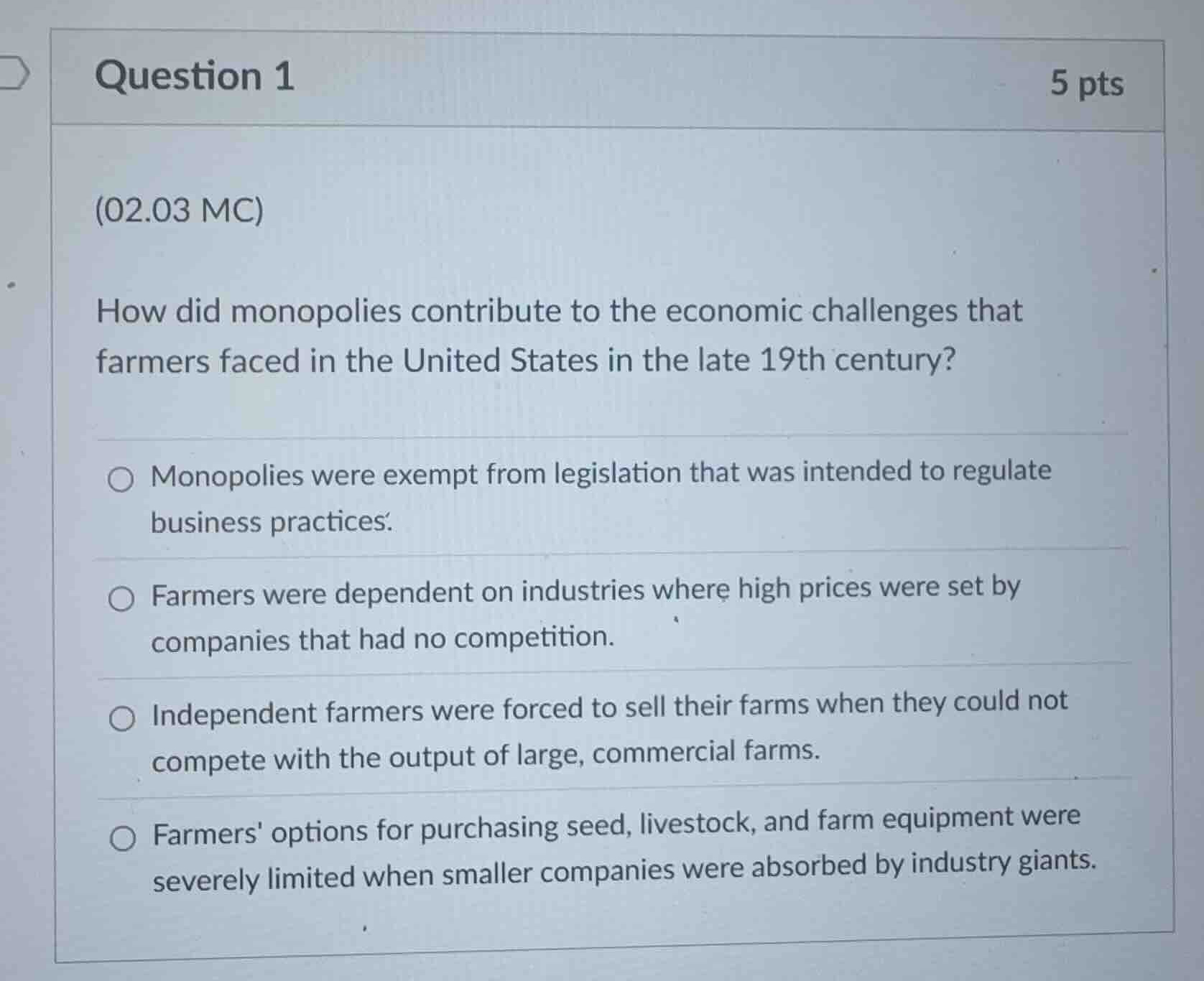
how did monopolies contribute to the economic challenges that farmers faced in the united states in the late 19th century?
monopolies were exempt from legislation that was intended to regulate business practices.
farmers were dependent on industries where high prices were set by companies that had no competition.
independent farmers were forced to sell their farms when they could not compete with the output of large, commercial farms.
farmers options for purchasing seed, livestock, and farm equipment were severely limited when smaller companies were absorbed by industry giants.
Analyze the historical context
In the late 19th century (the Gilded Age), American farmers faced severe economic hardships, including falling crop prices, high debt, and high costs of doing business.
Examine the role of monopolies
During this era, massive corporate monopolies and trusts dominated key infrastructure industries, most notably the railroads and grain elevator operators. Because these companies faced no competition, they could set artificially high shipping and storage rates.
Connect monopolies to farmer dependency
Farmers had no alternative methods to transport their perishable crops to distant urban markets. This absolute dependency on monopolistic railroad lines, which charged exorbitant and discriminatory freight rates, directly squeezed farmers' profit margins and escalated their debts.
Evaluate the given options
- Option 1: Monopolies were not legally exempt from regulation; in fact, laws like the Interstate Commerce Act (1887) and the Sherman Antitrust Act (1990) were passed to regulate them, though early enforcement was weak.
- Option 2: This correctly identifies that farmers depended heavily on monopolistic industries (like railroads and storage facilities) that set high prices due to a lack of competition.
- Option 3: While commercial farming grew, this option describes competition between types of farms rather than how monopolies in other sectors contributed to farmers' challenges.
- Option 4: While consolidation occurred, the primary, systemic economic crisis for most farmers was their dependency on monopolistic transport and storage networks to sell their goods.

Snap & solve any problem in the app
Get step-by-step solutions on Sovi AI
Photo-based solutions with guided steps
Explore more problems and detailed explanations
- Monopolies were exempt from legislation that was intended to regulate business practices.
- Farmers were dependent on industries where high prices were set by companies that had no competition. (Correct answer)
- Independent farmers were forced to sell their farms when they could not compete with the output of large, commercial farms.
- Farmers' options for purchasing seed, livestock, and farm equipment were severely limited when smaller companies were absorbed by industry giants.