QUESTION IMAGE
Question
question 63
1 pts
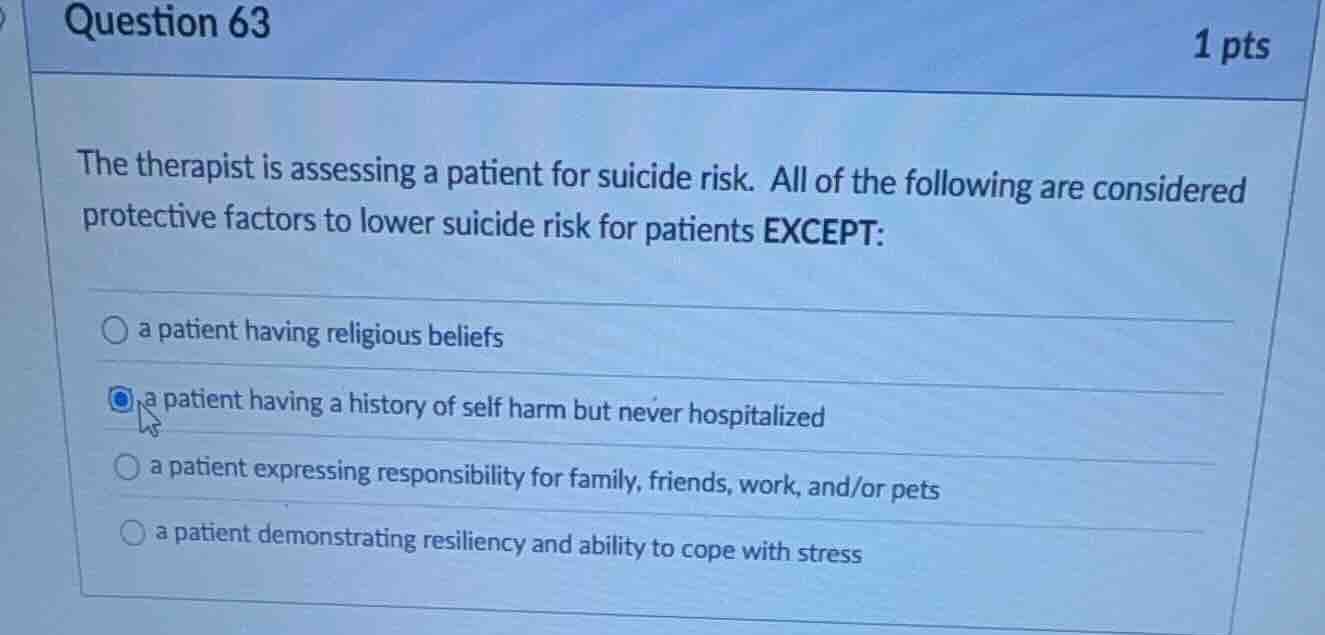
the therapist is assessing a patient for suicide risk. all of the following are considered protective factors to lower suicide risk for patients except:
a patient having religious beliefs
a patient having a history of self harm but never hospitalized
a patient expressing responsibility for family, friends, work, and/or pets
a patient demonstrating resiliency and ability to cope with stress
🆕 New Concept Discovered: Suicide Risk Assessment
Evaluating factors that increase or decrease self-harm risk.
Step 1: Define Protective Factors
Protective factors are personal, social, or environmental attributes that buffer individuals from suicidal thoughts and behaviors. They help reduce the overall risk of suicide. Common protective factors include:
- Strong religious, spiritual, or moral beliefs against suicide.
- A sense of responsibility to family, friends, children, or pets.
- Positive coping skills, resilience, and frustration tolerance.
- Strong social support networks and clinical therapeutic alliances.
Step 2: Analyze the Options
- A patient having religious beliefs: This is a well-documented protective factor, as many religious traditions discourage suicide and provide a supportive community.
- A patient having a history of self-harm but never hospitalized: A history of self-harm (non-suicidal self-injury or previous suicide attempts) is one of the strongest statistical risk factors for future suicide attempts, regardless of whether it led to hospitalization. It is not a protective factor.
- A patient expressing responsibility for family, friends, work, and/or pets: This is a protective factor because feelings of obligation and connection to others provide a reason to live.
- A patient demonstrating resiliency and ability to cope with stress: This is a protective factor because healthy coping mechanisms help individuals navigate crises without resorting to self-harm.
Step 3: Identify the Exception
The question asks for the option that is NOT a protective factor (indicated by "EXCEPT"). Since a history of self-harm is a risk factor rather than a protective factor, it is the correct exception.

Snap & solve any problem in the app
Get step-by-step solutions on Sovi AI
Photo-based solutions with guided steps
Explore more problems and detailed explanations
a patient having a history of self harm but never hospitalized