QUESTION IMAGE
Question
question 19
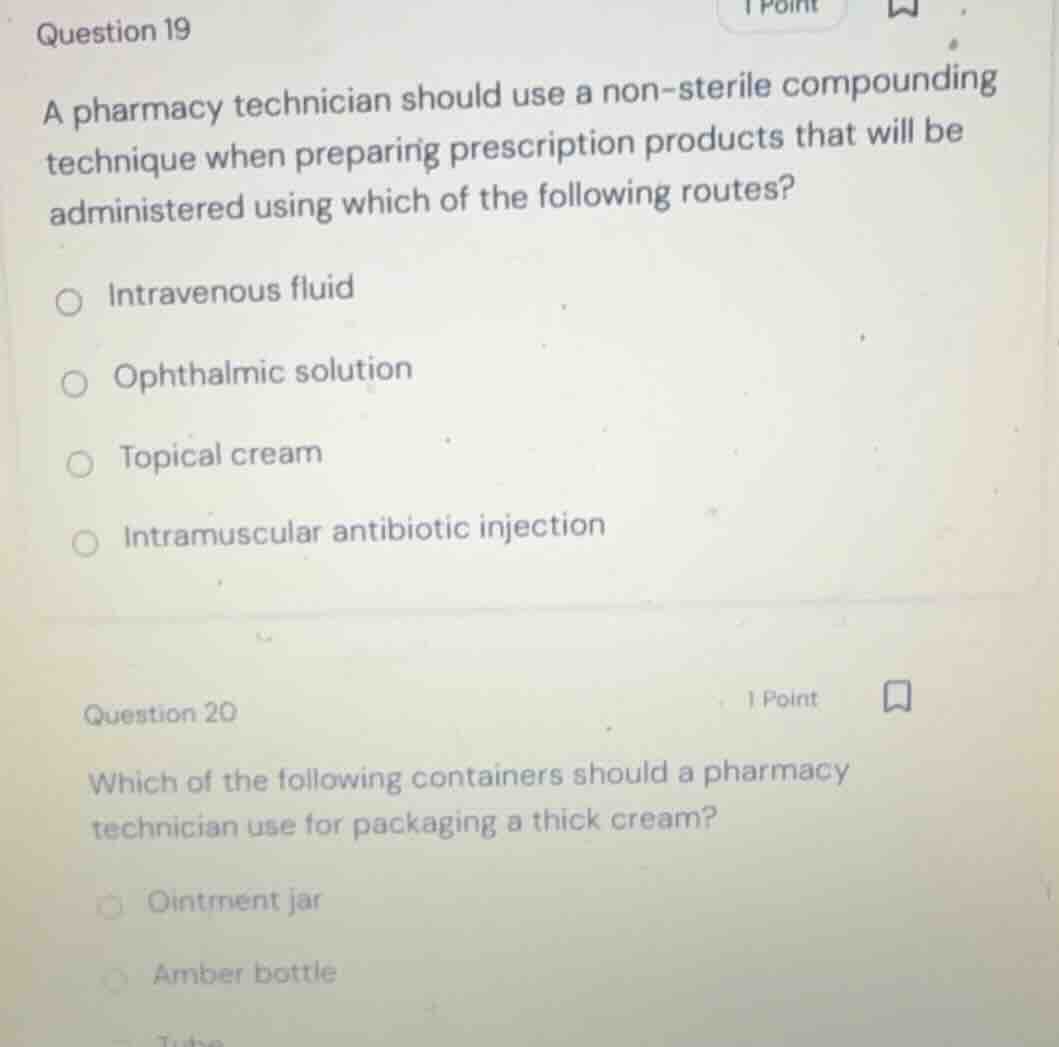
a pharmacy technician should use a non-sterile compounding technique when preparing prescription products that will be administered using which of the following routes?
- intravenous fluid
- ophthalmic solution
- topical cream
- intramuscular antibiotic injection
question 20
which of the following containers should a pharmacy technician use for packaging a thick cream?
- ointment jar
- amber bottle
- tube
Analyze Question 19
Using the Nonsterile Compounding knowledge point
Sterile compounding is strictly required for medications administered via routes that bypass the body's natural defenses, such as injections (intravenous, intramuscular) and ophthalmic (eye) installations. Non-sterile compounding is appropriate for dosage forms administered via routes that do not require sterility, such as oral, topical, or rectal routes.
- Intravenous fluid: Requires sterile compounding (USP 797).
- Ophthalmic solution: Requires sterile compounding (USP 797).
- Topical cream: Administered topically to the skin; prepared using non-sterile compounding techniques (USP 795).
- Intramuscular antibiotic injection: Requires sterile compounding (USP 797).
Therefore, a non-sterile compounding technique is used for a topical cream.
Analyze Question 20
Using the Ointment Slab Compounding knowledge point
When packaging compounded semi-solid preparations, the physical properties of the product dictate the container choice:
- Thick creams and ointments: Best packaged in wide-mouth containers like an ointment jar to allow easy access and application by the patient.
- Amber bottles: Used primarily for liquid formulations to protect them from light.
- Tubes: Typically used for less viscous creams or gels that can be easily squeezed out.
For a very thick cream, an ointment jar is the most appropriate packaging container.

Snap & solve any problem in the app
Get step-by-step solutions on Sovi AI
Photo-based solutions with guided steps
Explore more problems and detailed explanations
Question 19
- (A) Intravenous fluid
- (B) Ophthalmic solution
- (C) Topical cream (Correct answer)
- (D) Intramuscular antibiotic injection
Question 20
- (A) Ointment jar (Correct answer)
- (B) Amber bottle
- (C) Tube