QUESTION IMAGE
Question
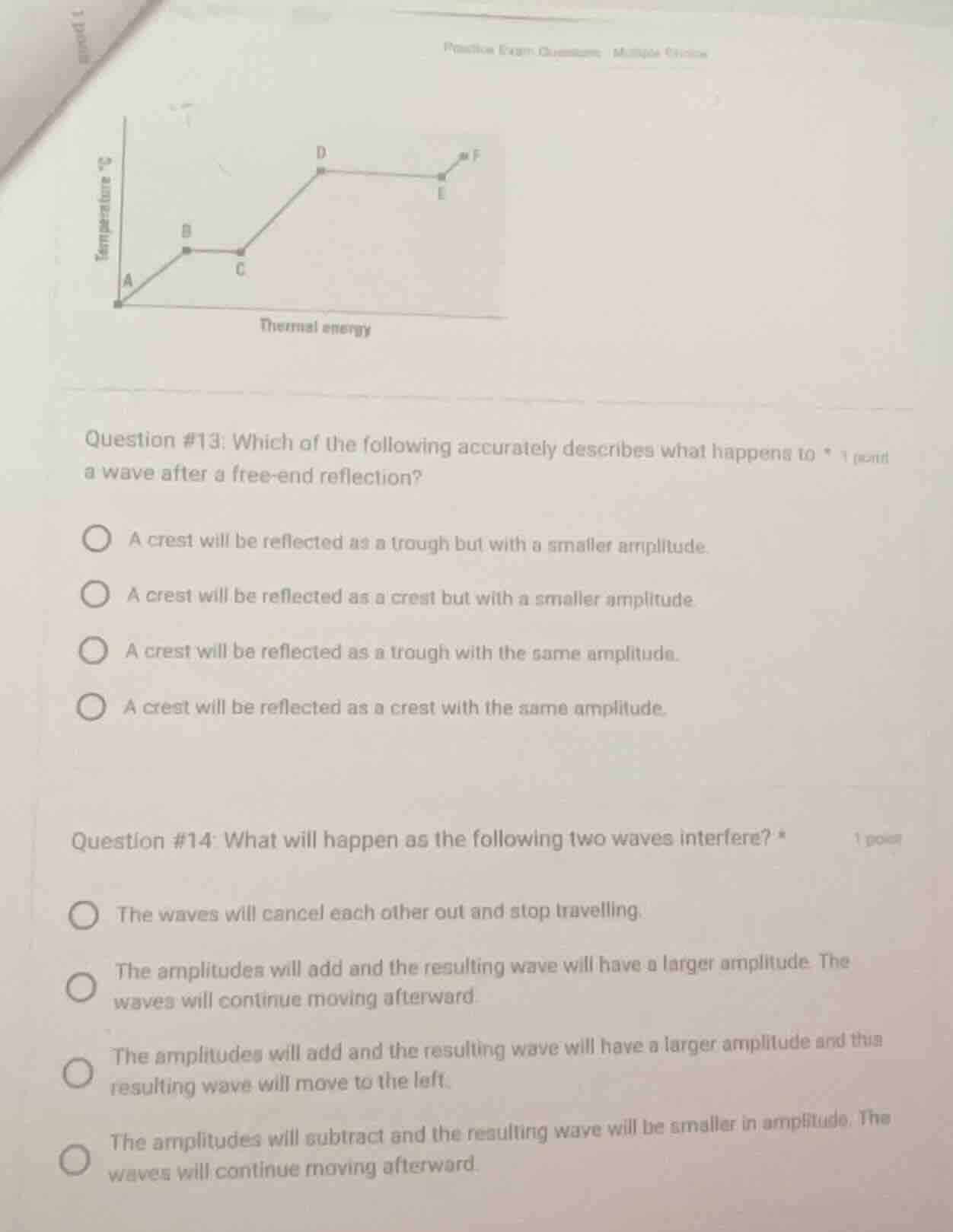
question #13: which of the following accurately describes what happens to a wave after a free-end reflection?
a crest will be reflected as a trough but with a smaller amplitude.
a crest will be reflected as a crest but with a smaller amplitude.
a crest will be reflected as a trough with the same amplitude.
a crest will be reflected as a crest with the same amplitude.
question #14: what will happen as the following two waves interfere?
the waves will cancel each other out and stop travelling.
the amplitudes will add and the resulting wave will have a larger amplitude. the waves will continue moving afterward.
the amplitudes will add and the resulting wave will have a larger amplitude and this resulting wave will move to the left.
the amplitudes will subtract and the resulting wave will be smaller in amplitude. the waves will continue moving afterward.
Analyze free-end wave reflection
When a wave pulse travels along a medium and encounters a free-end boundary (a boundary that is free to move vertically), the medium at the boundary moves with the wave. This results in the wave reflecting back without any phase inversion. Therefore, an incoming crest reflects back as a crest. Assuming an ideal medium with no energy loss, the amplitude of the reflected wave remains the same as the incident wave.
Evaluate Question 13 options
- Option 1: Incorrect because a crest does not invert to a trough, and amplitude is conserved in ideal reflection.
- Option 2: Incorrect because amplitude is conserved.
- Option 3: Incorrect because a crest does not invert to a trough.
- Option 4: Correct because a crest reflects as a crest with the same amplitude.
Analyze wave interference
When two wave pulses meet while traveling along the same medium, they undergo superposition (interference). During interference, their displacements add together algebraically. After they pass through each other, they continue traveling in their original directions of motion, completely unaltered in shape, amplitude, and speed.
Evaluate Question 14 options
- Option 1: Incorrect because waves do not stop traveling after interfering.
- Option 2: Correct because during constructive interference, amplitudes add to create a larger wave, and the individual waves continue moving in their original directions afterward.
- Option 3: Incorrect because the resulting wave does not simply move to one side; the individual waves continue in their respective directions.
- Option 4: Incorrect because it describes destructive interference, and waves always continue moving afterward regardless.

Snap & solve any problem in the app
Get step-by-step solutions on Sovi AI
Photo-based solutions with guided steps
Explore more problems and detailed explanations
Question 13
- A crest will be reflected as a trough but with a smaller amplitude.
- A crest will be reflected as a crest but with a smaller amplitude.
- A crest will be reflected as a trough with the same amplitude.
- A crest will be reflected as a crest with the same amplitude. (Correct answer)
Question 14
- The waves will cancel each other out and stop travelling.
- The amplitudes will add and the resulting wave will have a larger amplitude. The waves will continue moving afterward. (Correct answer)
- The amplitudes will add and the resulting wave will have a larger amplitude and this resulting wave will move to the left.
- The amplitudes will subtract and the resulting wave will be smaller in amplitude. The waves will continue moving afterward.