QUESTION IMAGE
Question
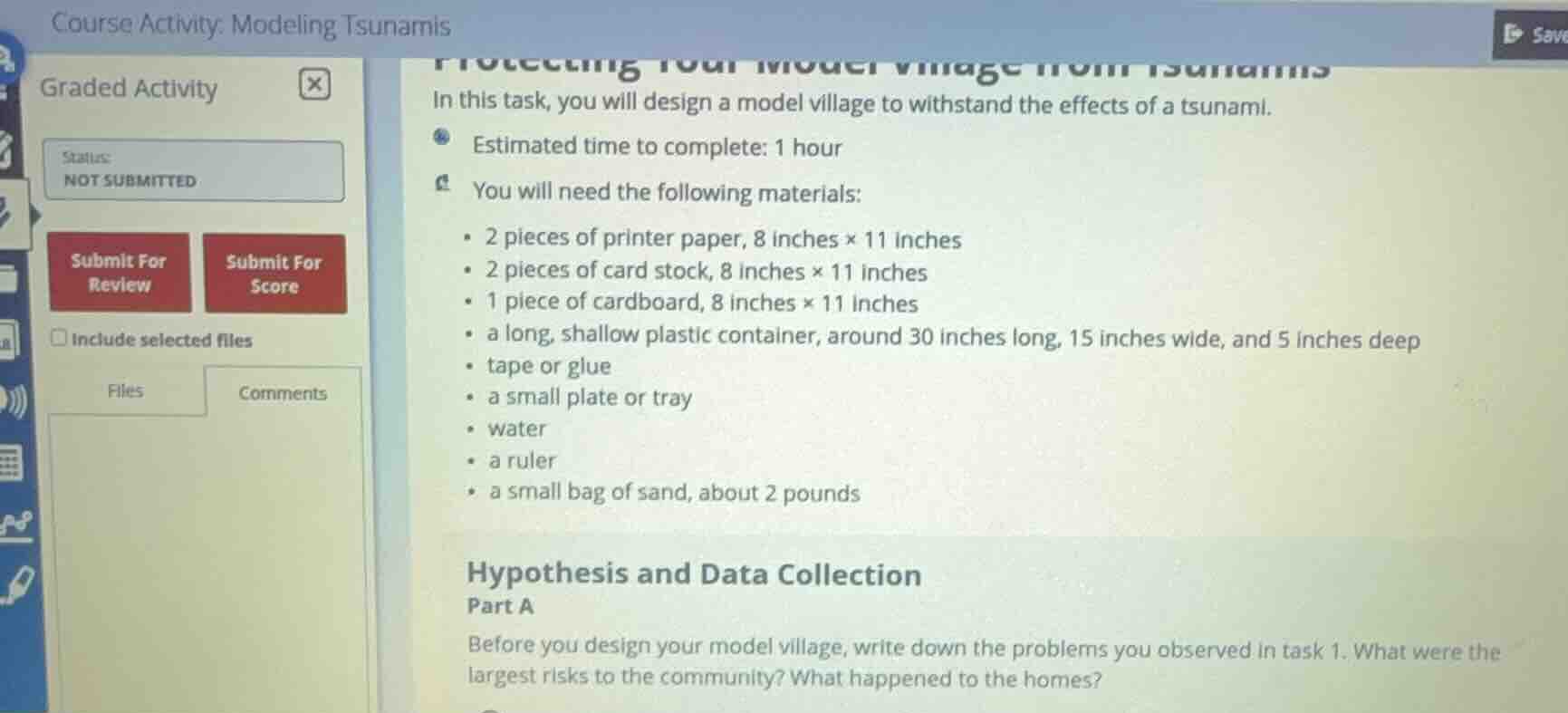
protecting your model village from tsunamis
in this task, you will design a model village to withstand the effects of a tsunami.
estimated time to complete: 1 hour
you will need the following materials:
- 2 pieces of printer paper, 8 inches x 11 inches
- 2 pieces of card stock, 8 inches x 11 inches
- 1 piece of cardboard, 8 inches x 11 inches
- a long, shallow plastic container, around 30 inches long, 15 inches wide, and 5 inches deep
- tape or glue
- a small plate or tray
- water
- a ruler
- a small bag of sand, about 2 pounds
hypothesis and data collection
part a
before you design your model village, write down the problems you observed in task 1. what were the largest risks to the community? what happened to the homes?
Identify the task requirements
The prompt asks to address Part A under "Hypothesis and Data Collection" for the course activity "Modeling Tsunamis". The question is: "Before you design your model village, write down the problems you observed in task 1. What were the largest risks to the community? What happened to the homes?"
Analyze tsunami impacts on coastal structures
Tsunamis generate massive, fast-moving walls of water. When these waves hit a coastal community, they exert immense hydrodynamic pressure, cause severe erosion, and carry heavy debris.
Determine risks to the community
The primary risks to a coastal community during a tsunami include:
- Inundation and flooding of low-lying areas.
- High-velocity water currents sweeping away people, vehicles, and structures.
- Impact from floating debris (such as cars, trees, and parts of other buildings) acting as battering rams.
- Soil erosion and foundation undermining.
Determine the impact on homes
Unprotected or poorly anchored homes typically experience:
- Structural failure due to the lateral force of the incoming wave.
- Being completely washed off their foundations.
- Severe water damage and destruction of interiors.
- Collapsing under the weight of water or due to impact from debris.
Synthesize a comprehensive response
Combine these observations into a clear, structured answer that directly addresses the prompt's questions about observed problems, community risks, and the fate of the homes.

Snap & solve any problem in the app
Get step-by-step solutions on Sovi AI
Photo-based solutions with guided steps
Explore more problems and detailed explanations
Before designing a model village to withstand a tsunami, the typical observations and risks identified from initial wave impacts (Task 1) include:
- Observed Problems: The primary issue is the lack of barriers or elevation to slow down or redirect the incoming wave energy, allowing high-velocity water to penetrate deep inland.
- Largest Risks to the Community:
- Hydrodynamic Force: The sheer momentum and volume of fast-moving water.
- Debris Impact: Floating objects (like other structures, vehicles, or trees) acting as projectiles that destroy everything in their path.
- Erosion and Scour: Water washing away the sand or soil beneath foundations, leading to structural collapse.
- What Happened to the Homes: Unprotected homes, especially those built at sea level near the shoreline, are easily pushed off their foundations, flooded, structurally compromised, or completely washed away by the force of the wave.