QUESTION IMAGE
Question
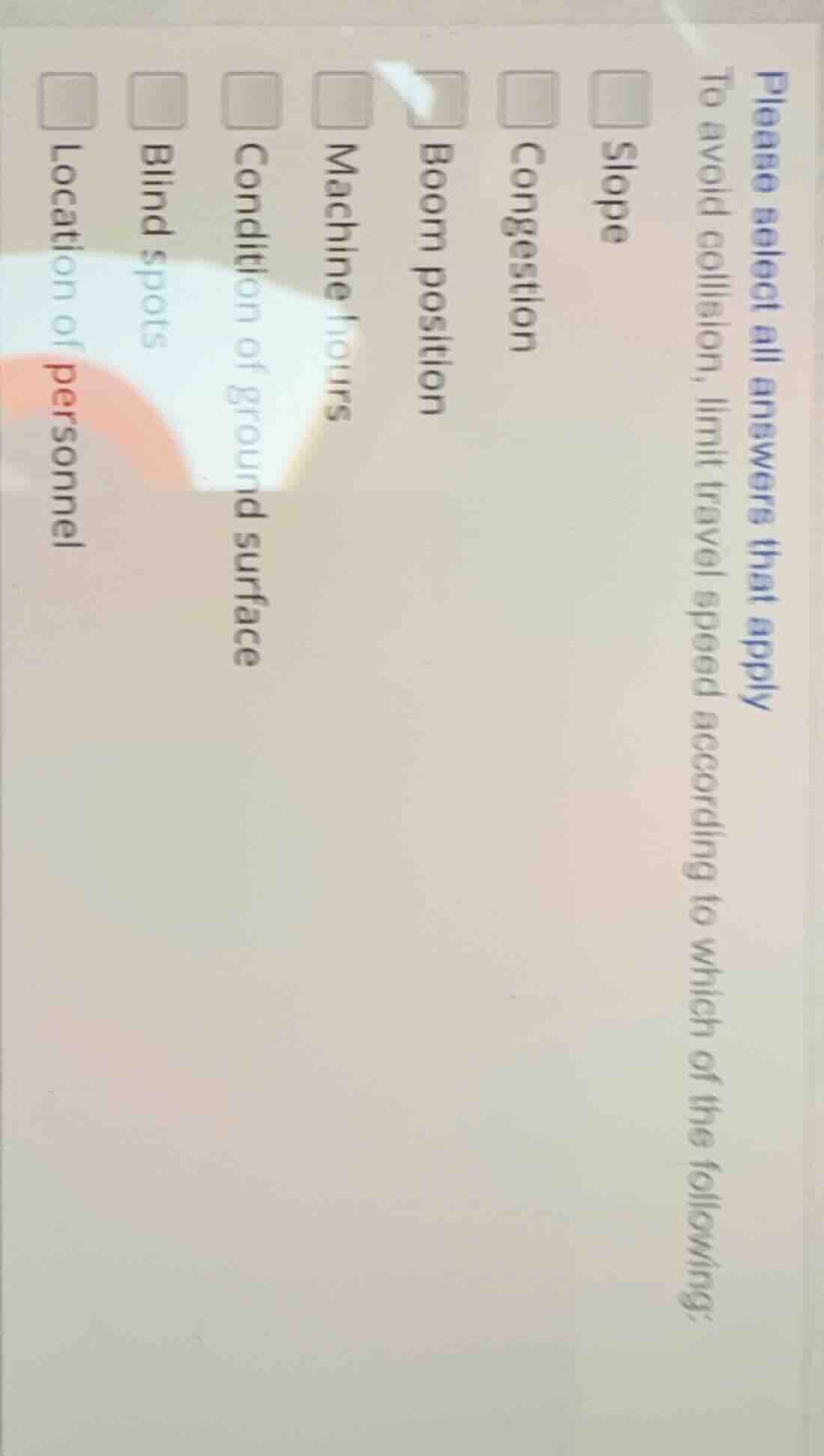
please select all answers that apply
to avoid collision, limit travel speed according to which of the following:
slope
congestion
boom position
machine hours
condition of ground surface
blind spots
location of personnel
Identify factors affecting safe travel speed to avoid collision
To determine safe travel speed and avoid collisions when operating mobile equipment (such as aerial work platforms or forklifts), operators must adjust their speed based on environmental and operational hazards:
- Slope: Steepness affects braking distance and stability.
- Congestion: High-traffic areas require slower speeds to react to other vehicles or obstacles.
- Boom position: An elevated or extended boom changes the center of gravity and stability, requiring slower travel.
- Condition of ground surface: Wet, slippery, rough, or uneven surfaces reduce traction and increase stopping distance.
- Blind spots: Reduced visibility requires slower speeds to allow adequate reaction time.
- Location of personnel: Proximity to pedestrians requires extreme caution and reduced speed.
Exclude irrelevant factors
- Machine hours: This measures total operating time for maintenance tracking and does not directly dictate the immediate safe travel speed needed to avoid a collision.

Snap & solve any problem in the app
Get step-by-step solutions on Sovi AI
Photo-based solutions with guided steps
Explore more problems and detailed explanations
- [x] Slope (Correct answer)
- [x] Congestion (Correct answer)
- [x] Boom position (Correct answer)
- [ ] Machine hours
- [x] Condition of ground surface (Correct answer)
- [x] Blind spots (Correct answer)
- [x] Location of personnel (Correct answer)