QUESTION IMAGE
Question
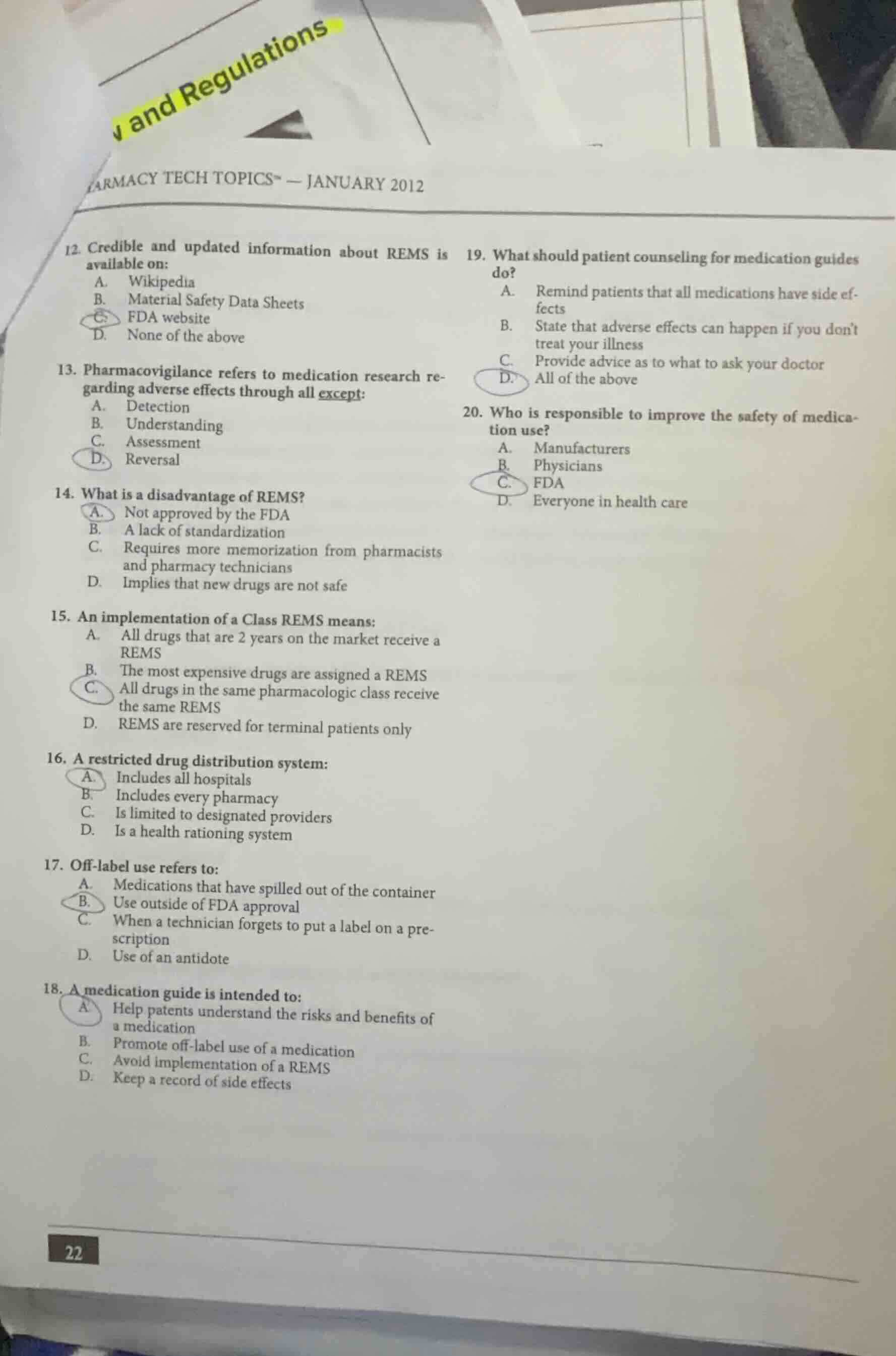
pharmacy tech topics - january 2012
- credible and updated information about rems is available on:
a. wikipedia
b. material safety data sheets
c. fda website
d. none of the above
- pharmacovigilance refers to medication research regarding adverse effects through all except:
a. detection
b. understanding
c. assessment
d. reversal
- what is a disadvantage of rems?
a. not approved by the fda
b. a lack of standardization
c. requires more memorization from pharmacists and pharmacy technicians
d. implies that new drugs are not safe
- an implementation of a class rems means:
a. all drugs that are 2 years on the market receive a rems
b. the most expensive drugs are assigned a rems
c. all drugs in the same pharmacologic class receive the same rems
d. rems are reserved for terminal patients only
- a restricted drug distribution system:
a. includes all hospitals
b. includes every pharmacy
c. is limited to designated providers
d. is a health rationing system
- off-label use refers to:
a. medications that have spilled out of the container
b. use outside of fda approval
c. when a technician forgets to put a label on a prescription
d. use of an antidote
- a medication guide is intended to:
a. help patients understand the risks and benefits of a medication
b. promote off-label use of a medication
c. avoid implementation of a rems
d. keep a record of side effects
- what should patient counseling for medication guides do?
a. remind patients that all medications have side effects
b. state that adverse effects can happen if you dont treat your illness
c. provide advice as to what to ask your doctor
d. all of the above
- who is responsible to improve the safety of medication use?
a. manufacturers
b. physicians
c. fda
d. everyone in health care
Analyze REMS Information Sources
Using the REMS Programs knowledge point, we identify credible sources. The Food and Drug Administration (FDA) mandates and oversees Risk Evaluation and Mitigation Strategies (REMS). Therefore, the official FDA website is the most credible, updated source.
Define Pharmacovigilance Scope
Using the Pharmacology and Adverse Drug Reactions knowledge points, we analyze pharmacovigilance. It is defined as the science and activities relating to the detection, assessment, understanding, and prevention of adverse effects. Reversal is a clinical treatment action, not a research component of pharmacovigilance.
Identify REMS Disadvantages
Using the REMS Programs knowledge point, we evaluate the challenges of these safety programs. A major disadvantage is the lack of standardization across different REMS, which increases administrative burdens on healthcare systems.
Define Class REMS Implementation
Using the REMS Programs knowledge point, we examine class-wide strategies. A Class REMS means that all drugs belonging to the same pharmacologic class are subject to the same REMS requirements to streamline safety protocols.
Define Restricted Drug Distribution
Using the REMS Programs knowledge point, we analyze distribution controls. A restricted drug distribution system ensures that high-risk medications are only distributed through and limited to designated, certified healthcare providers.
Define Off-Label Use
Using the Pharmacology knowledge point, we define regulatory terms. Off-label use refers to the practice of prescribing a drug for an indication, dosage, population, or route of administration not approved by the FDA.
Analyze Medication Guide Intent
Using the REMS Programs and Adverse Drug Reactions knowledge points, we evaluate patient labeling. Medication Guides are FDA-approved paper handouts designed to help patients understand the serious risks and benefits associated with a specific medication.
Analyze Patient Counseling Goals
Using the Adverse Drug Reactions knowledge point, we evaluate counseling objectives. Counseling on medication guides should remind patients of side effects, state risks of untreated illness, and advise on doctor consultations. Thus, all of the listed goals are correct.
Identify Safety Responsibility
Using the Pharmacology knowledge point, we evaluate systemic safety. Improving the safety of medication use is a shared responsibility that involves manufacturers, physicians, the FDA, and ultimately everyone in healthcare.

Snap & solve any problem in the app
Get step-by-step solutions on Sovi AI
Photo-based solutions with guided steps
Explore more problems and detailed explanations
Question 12
- A. Wikipedia
- B. Material Safety Data Sheets
- C. FDA website (Correct answer)
- D. None of the above
Question 13
- A. Detection
- B. Understanding
- C. Assessment
- D. Reversal (Correct answer)
Question 14
- A. Not approved by the FDA
- B. A lack of standardization (Correct answer)
- C. Requires more memorization from pharmacists and pharmacy technicians
- D. Implies that new drugs are not safe
Question 15
- A. All drugs that are 2 years on the market receive a REMS
- B. The most expensive drugs are assigned a REMS
- C. All drugs in the same pharmacologic class receive the same REMS (Correct answer)
- D. REMS are reserved for terminal patients only
Question 16
- A. Includes all hospitals
- B. Includes every pharmacy
- C. Is limited to designated providers (Correct answer)
- D. Is a health rationing system
Question 17
- A. Medications that have spilled out of the container
- B. Use outside of FDA approval (Correct answer)
- C. When a technician forgets to put a label on a prescription
- D. Use of an antidote
Question 18
- A. Help patients understand the risks and benefits of a medication (Correct answer)
- B. Promote off-label use of a medication
- C. Avoid implementation of a REMS
- D. Keep a record of side effects
Question 19
- A. Remind patients that all medications have side effects
- B. State that adverse effects can happen if you don't treat your illness
- C. Provide advice as to what to ask your doctor
- D. All of the above (Correct answer)
Question 20
- A. Manufacturers
- B. Physicians
- C. FDA
- D. Everyone in health care (Correct answer)