QUESTION IMAGE
Question
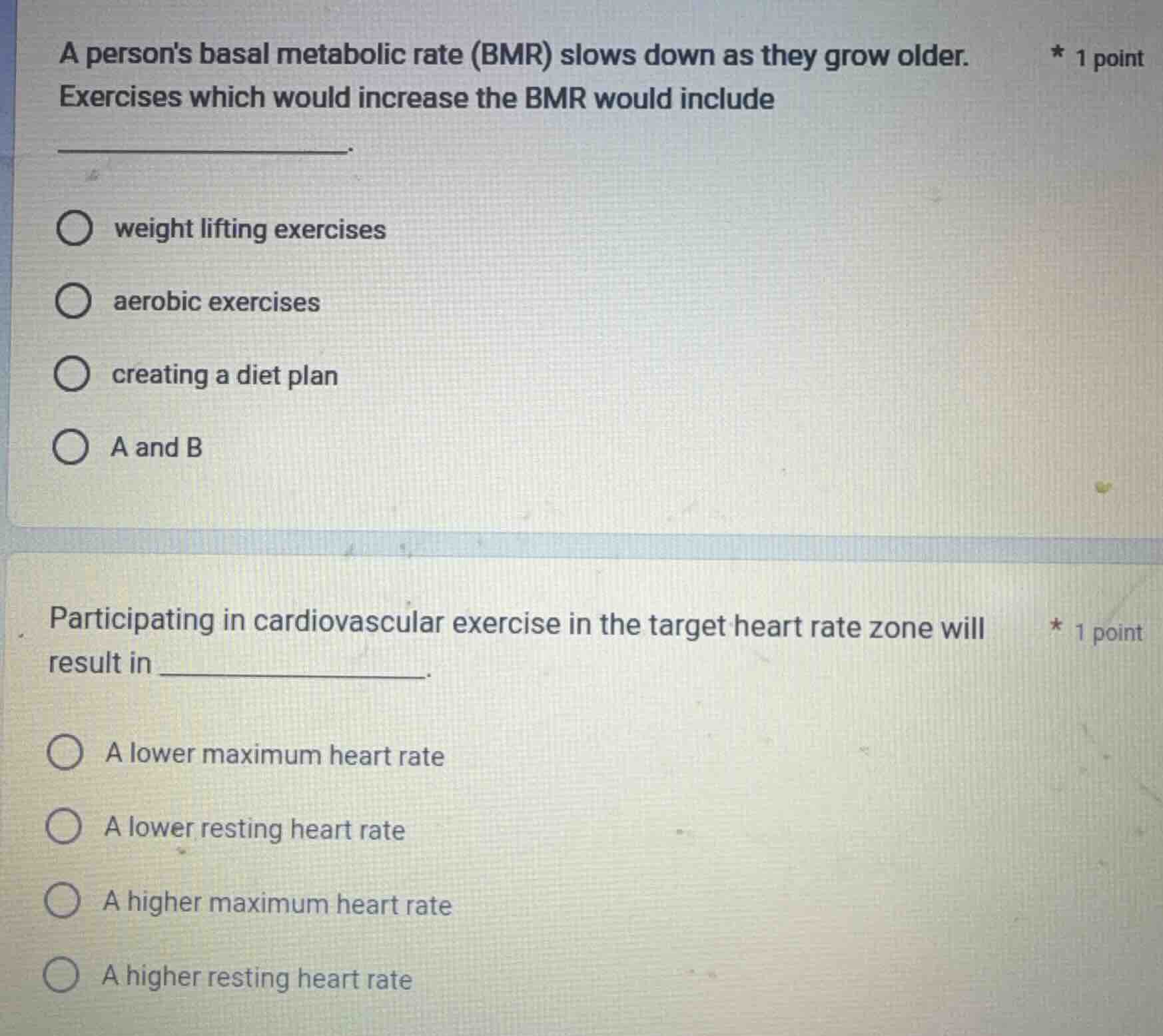
a persons basal metabolic rate (bmr) slows down as they grow older. exercises which would increase the bmr would include
- weight lifting exercises
- aerobic exercises
- creating a diet plan
- a and b
participating in cardiovascular exercise in the target heart rate zone will result in
- a lower maximum heart rate
- a lower resting heart rate
- a higher maximum heart rate
- a higher resting heart rate
<pre_analysis>
{
"quality": "clear",
"question_count": 2,
"skills_matched": [
"direct_cot",
"multiple_choice_formatter",
"explain_then_answer",
"tutor"
],
"needs_drawing": false,
"concepts_used": [
"Exercise Physiology",
"Target Heart Rate Zone"
],
"new_concepts": [
"Basal Metabolic Rate Factors",
"Cardiovascular Adaptations"
],
"current_concepts": [
"Exercise Physiology",
"Target Heart Rate Zone",
"Basal Metabolic Rate Factors",
"Cardiovascular Adaptations"
]
}
</pre_analysis>
<reasoning>
Analyze factors affecting Basal Metabolic Rate
To increase Basal Metabolic Rate (BMR), we look at how different exercises affect metabolism. Weight lifting (resistance training) builds lean muscle mass, which is highly metabolic and increases BMR. Aerobic exercises also elevate metabolism during and shortly after exercise, and regular aerobic training helps maintain metabolic health. Therefore, both weight lifting and aerobic exercises contribute to increasing BMR, making "A and B" the correct choice. This relates to Exercise Physiology.
Analyze cardiovascular adaptations to exercise
Participating in cardiovascular exercise within the Target Heart Rate Zone strengthens the heart muscle. A stronger heart can pump more blood per beat (increased stroke volume), meaning it does not need to beat as many times per minute to deliver the same amount of oxygen to the body at rest. This physiological adaptation results in a lower resting heart rate. Maximum heart rate is primarily determined by age and genetics, not training status.
</reasoning>
<answer>
Question 1
<mcq-option>weight lifting exercises</mcq-option>
<mcq-option>aerobic exercises</mcq-option>
<mcq-option>creating a diet plan</mcq-option>
<mcq-correct>A and B</mcq-correct>
Question 2
<mcq-option>A lower maximum heart rate</mcq-option>
<mcq-correct>A lower resting heart rate</mcq-correct>
<mcq-option>A higher maximum heart rate</mcq-option>
<mcq-option>A higher resting heart rate</mcq-option>
</answer>
<post_analysis>
{
"subject": "Natural Science",
"question_type": "Multiple Choice",
"knowledge_point": [
"Natural Science",
"Biology",
"Exercise Physiology"
]
}
</post_analysis>
Snap & solve any problem in the app
Get step-by-step solutions on Sovi AI
Photo-based solutions with guided steps
Explore more problems and detailed explanations
<pre_analysis>
{
"quality": "clear",
"question_count": 2,
"skills_matched": [
"direct_cot",
"multiple_choice_formatter",
"explain_then_answer",
"tutor"
],
"needs_drawing": false,
"concepts_used": [
"Exercise Physiology",
"Target Heart Rate Zone"
],
"new_concepts": [
"Basal Metabolic Rate Factors",
"Cardiovascular Adaptations"
],
"current_concepts": [
"Exercise Physiology",
"Target Heart Rate Zone",
"Basal Metabolic Rate Factors",
"Cardiovascular Adaptations"
]
}
</pre_analysis>
<reasoning>
Analyze factors affecting Basal Metabolic Rate
To increase Basal Metabolic Rate (BMR), we look at how different exercises affect metabolism. Weight lifting (resistance training) builds lean muscle mass, which is highly metabolic and increases BMR. Aerobic exercises also elevate metabolism during and shortly after exercise, and regular aerobic training helps maintain metabolic health. Therefore, both weight lifting and aerobic exercises contribute to increasing BMR, making "A and B" the correct choice. This relates to Exercise Physiology.
Analyze cardiovascular adaptations to exercise
Participating in cardiovascular exercise within the Target Heart Rate Zone strengthens the heart muscle. A stronger heart can pump more blood per beat (increased stroke volume), meaning it does not need to beat as many times per minute to deliver the same amount of oxygen to the body at rest. This physiological adaptation results in a lower resting heart rate. Maximum heart rate is primarily determined by age and genetics, not training status.
</reasoning>
<answer>
Question 1
<mcq-option>weight lifting exercises</mcq-option>
<mcq-option>aerobic exercises</mcq-option>
<mcq-option>creating a diet plan</mcq-option>
<mcq-correct>A and B</mcq-correct>
Question 2
<mcq-option>A lower maximum heart rate</mcq-option>
<mcq-correct>A lower resting heart rate</mcq-correct>
<mcq-option>A higher maximum heart rate</mcq-option>
<mcq-option>A higher resting heart rate</mcq-option>
</answer>
<post_analysis>
{
"subject": "Natural Science",
"question_type": "Multiple Choice",
"knowledge_point": [
"Natural Science",
"Biology",
"Exercise Physiology"
]
}
</post_analysis>