QUESTION IMAGE
Question
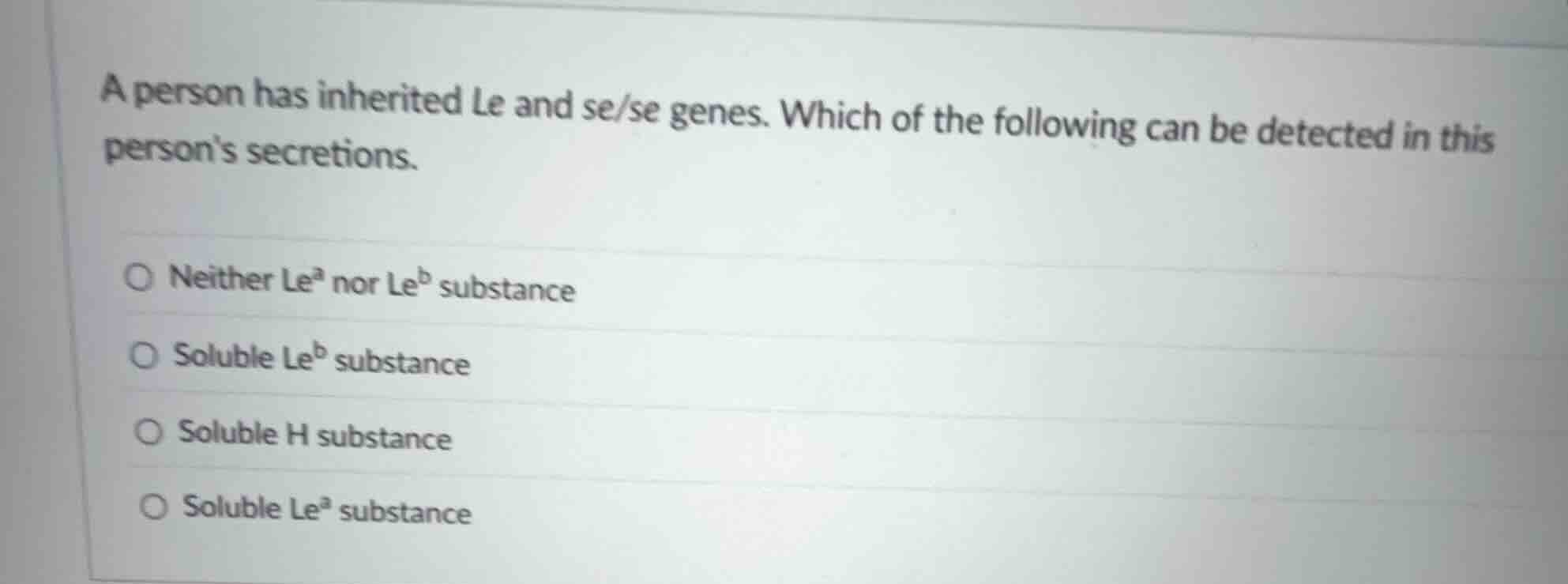
a person has inherited le and se/se genes. which of the following can be detected in this persons secretions.
neither \\(\text{le}^\text{a}\\) nor \\(\text{le}^\text{b}\\) substance
soluble \\(\text{le}^\text{b}\\) substance
soluble h substance
soluble \\(\text{le}^\text{a}\\) substance
Analyze the inherited genes
Using the Lewis Blood Group and ABH Secretor Status knowledge points
- The individual has inherited at least one functional \(Le\) gene (genotype \(Le/Le\) or \(Le/le\)), meaning they possess the fucosyltransferase 3 enzyme (FUT3).
- The individual has inherited homozygous non-secretor genes (\(se/se\)), meaning they lack the functional fucosyltransferase 2 enzyme (FUT2).
Determine antigen biosynthesis
Using the Lewis Antigen Biosynthesis knowledge point
- The FUT3 enzyme (\(Le\) gene product) transfers fucose to type 1 precursor chains to form \(\text{Le}^\text{a}\) antigen.
- Because the individual is a non-secretor (\(se/se\)), the FUT2 enzyme is absent, preventing the conversion of type 1 precursor chains into type 1 H chains, which is a prerequisite for forming \(\text{Le}^\text{b}\) antigen.
- Consequently, only \(\text{Le}^\text{a}\) antigen is synthesized and secreted.
Identify secreted substances
Using the Lewis Phenotypes knowledge point
- Since the individual has the \(Le\) gene but is a non-secretor (\(se/se\)), their red blood cells will phenotype as \(\text{Le}(\text{a}+\text{b}-)\).
- In secretions (such as saliva), only soluble \(\text{Le}^\text{a}\) substance will be present.
- Neither soluble \(\text{Le}^\text{b}\) nor soluble H substance can be synthesized or detected.

Snap & solve any problem in the app
Get step-by-step solutions on Sovi AI
Photo-based solutions with guided steps
Explore more problems and detailed explanations
- Neither Leª nor Leᵇ substance
- Soluble Leᵇ substance
- Soluble H substance
- Soluble Leª substance (Correct answer)