QUESTION IMAGE
Question
part a
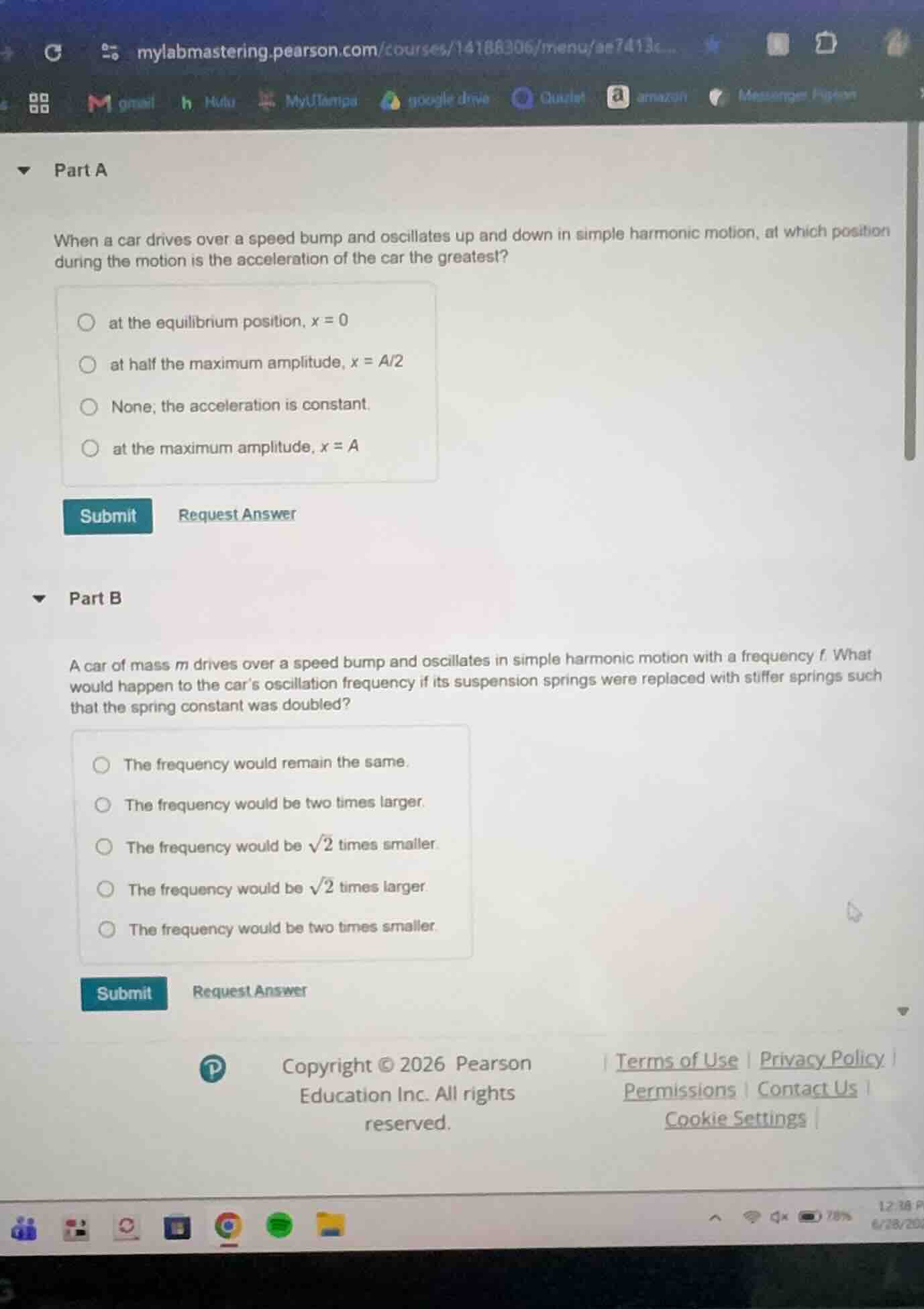
when a car drives over a speed bump and oscillates up and down in simple harmonic motion, at which position during the motion is the acceleration of the car the greatest?
at the equilibrium position, \\(x = 0\\)
at half the maximum amplitude, \\(x = a/2\\)
none; the acceleration is constant.
at the maximum amplitude, \\(x = a\\)
part b
a car of mass \\(m\\) drives over a speed bump and oscillates in simple harmonic motion with a frequency \\(f\\). what would happen to the cars oscillation frequency if its suspension springs were replaced with stiffer springs such that the spring constant was doubled?
the frequency would remain the same.
the frequency would be two times larger.
the frequency would be \\(\sqrt{2}\\) times smaller.
the frequency would be \\(\sqrt{2}\\) times larger.
the frequency would be two times smaller.
Analyze acceleration in simple harmonic motion
Using the Simple Harmonic Motion Acceleration knowledge point
Analyze frequency dependence on spring constant
Using the Simple Harmonic Motion Period knowledge point

Snap & solve any problem in the app
Get step-by-step solutions on Sovi AI
Photo-based solutions with guided steps
Explore more problems and detailed explanations
Question 1
- at the equilibrium position, x = 0
- at half the maximum amplitude, x = A/2
- None; the acceleration is constant.
- at the maximum amplitude, x = A (Correct answer)
Question 2
- The frequency would remain the same.
- The frequency would be two times larger.
- The frequency would be \(\sqrt{2}\) times smaller.
- The frequency would be \(\sqrt{2}\) times larger. (Correct answer)
- The frequency would be two times smaller.