QUESTION IMAGE
Question
parameters reference vs primitive
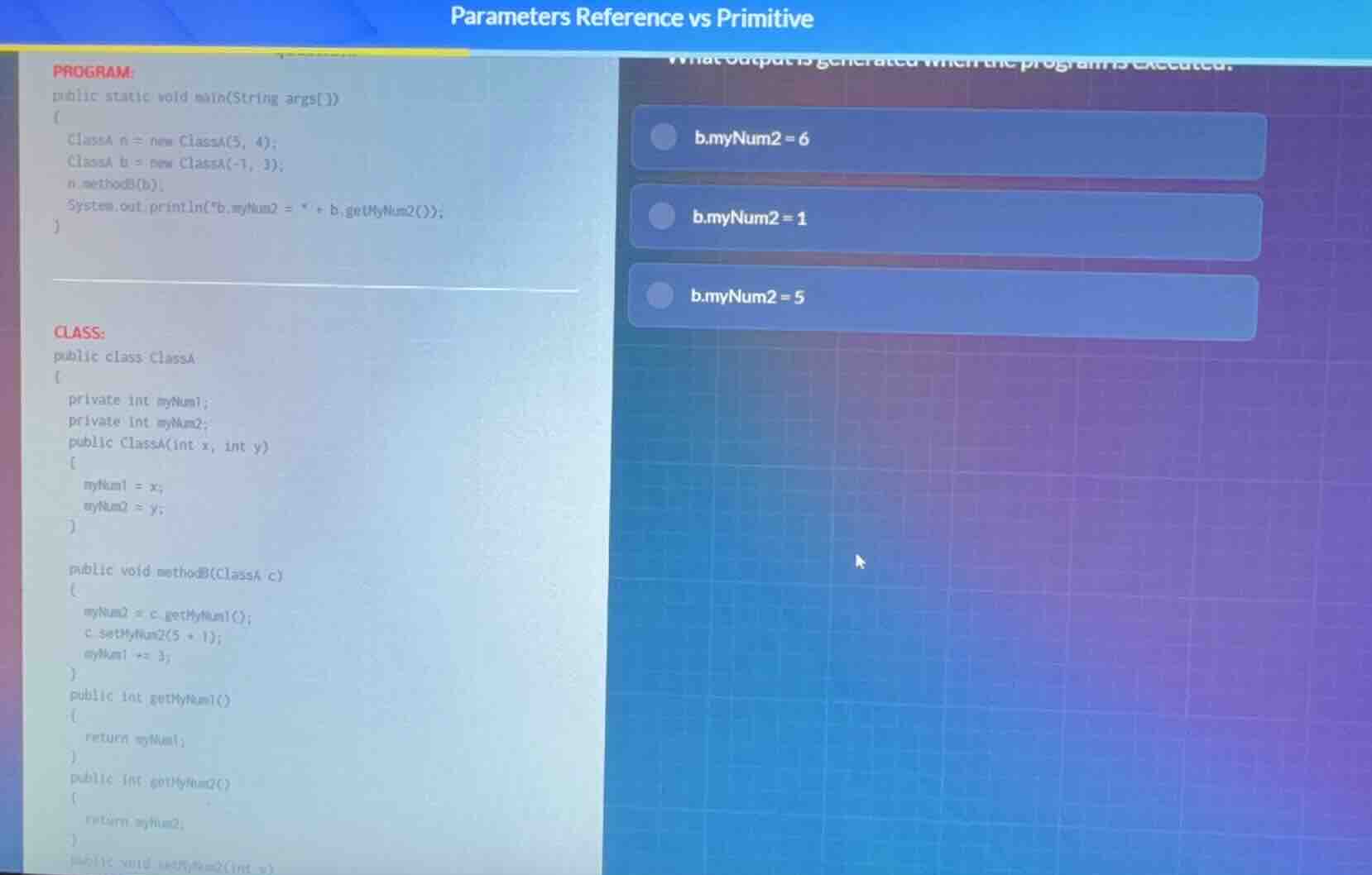
what output is generated when the program is executed?
program:
public static void main(string args)
{
classa a = new classa(5, 4);
classa b = new classa(-1, 3);
a.methodb(b);
system.out.println(\b.mynum2 = \ + b.getmynum2());
}
class:
public class classa
{
private int mynum1;
private int mynum2;
public classa(int x, int y)
{
mynum1 = x;
mynum2 = y;
}
public void methodb(classa c)
{
mynum2 = c.getmynum1();
c.setmynum2(5 + 1);
mynum1 += 3;
}
public int getmynum1()
{
return mynum1;
}
public int getmynum2()
{
return mynum2;
}
public void setmynum2(int v)
{
mynum2 = v;
}
}
options:
- b.mynum2 = 6
- b.mynum2 = 1
- b.mynum2 = 5
🆕 New Concept Discovered: Object Reference Pass-by-Value
How Java passes object references to methods.
Step 1: Analyze Object Initialization
In the main method, two objects of type ClassA are instantiated:
ais initialized asnew ClassA(5, 4). This means for objecta:myNum1 = 5myNum2 = 4bis initialized asnew ClassA(-1, 3). This means for objectb:myNum1 = -1myNum2 = 3
Step 2: Trace the Method Call a.methodB(b)
The method methodB is called on object a with object b passed as the argument c.
Inside methodB(ClassA c):
- The calling object is
a(sothisrefers toa). - The parameter
cis a reference pointing to the same object asb.
Let's execute the statements inside methodB step-by-step:
myNum2 = c.getMyNum1();
c.getMyNum1()retrievesmyNum1of objectb, which is-1.- This value is assigned to
this.myNum2(which isa.myNum2). - Thus,
a.myNum2becomes-1.
c.setMyNum2(5 + 1);
- This calls the setter method on object
c(which is objectb) with the argument6. - This changes
b.myNum2to6.
myNum1 += 3;
- This adds
3tothis.myNum1(which isa.myNum1). a.myNum1becomes5 + 3 = 8.
Step 3: Determine the Output
After a.methodB(b) finishes executing, control returns to the main method:
System.out.println("b.myNum2 = " + b.getMyNum2());- Since
b.myNum2was updated to6in Step 2,b.getMyNum2()returns6.
The printed output is:b.myNum2 = 6

Snap & solve any problem in the app
Get step-by-step solutions on Sovi AI
Photo-based solutions with guided steps
Explore more problems and detailed explanations
b.myNum2 = 6