QUESTION IMAGE
Question
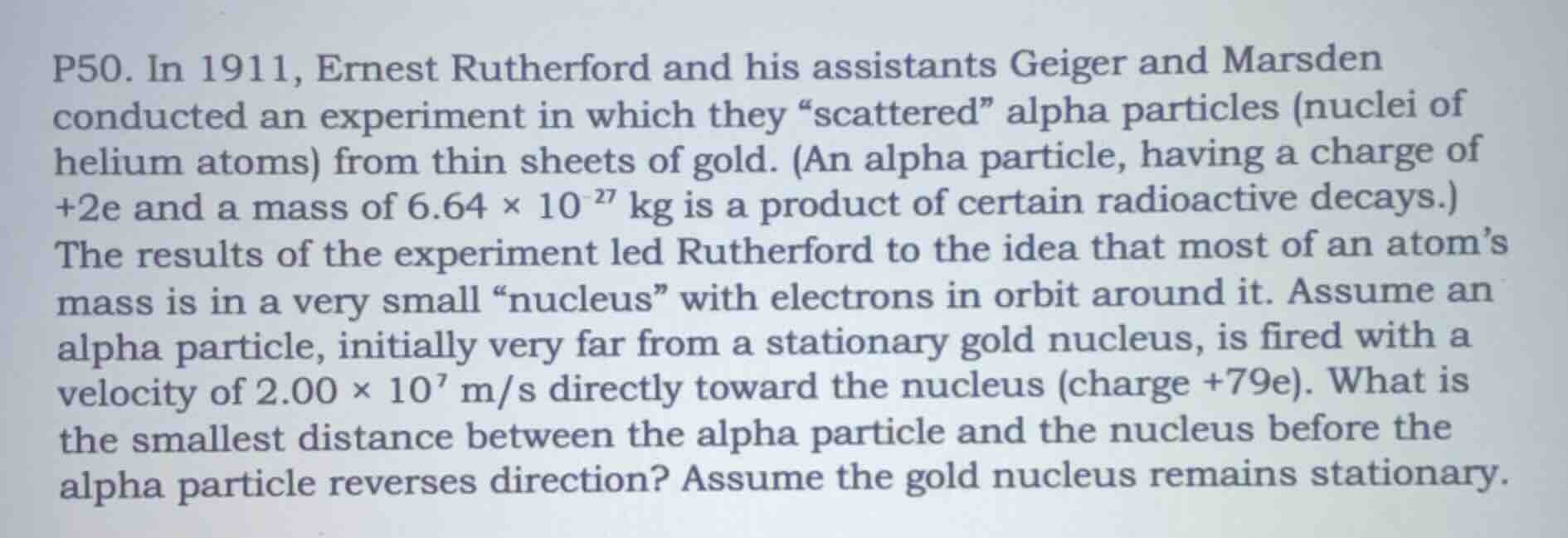
p50. in 1911, ernest rutherford and his assistants geiger and marsden conducted an experiment in which they \scattered\ alpha particles (nuclei of helium atoms) from thin sheets of gold. (an alpha particle, having a charge of \\(+2e\\) and a mass of \\(6.64 \times 10^{-27}\text{ kg}\\) is a product of certain radioactive decays.) the results of the experiment led rutherford to the idea that most of an atoms mass is in a very small
ucleus\ with electrons in orbit around it. assume an alpha particle, initially very far from a stationary gold nucleus, is fired with a velocity of \\(2.00 \times 10^7\text{ m/s}\\) directly toward the nucleus (charge \\(+79e\\)). what is the smallest distance between the alpha particle and the nucleus before the alpha particle reverses direction? assume the gold nucleus remains stationary.
Identify the physical principles and given values
Using the Electrostatics and Electric Potential Energy of Point Charges knowledge points
- Mass of alpha particle: \(m = 6.64 \times 10^{-27}\text{ kg}\)
- Charge of alpha particle: \(q_1 = +2e = 2(1.602 \times 10^{-19}\text{ C}) = 3.204 \times 10^{-19}\text{ C}\)
- Charge of gold nucleus: \(q_2 = +79e = 79(1.602 \times 10^{-19}\text{ C}) = 1.266 \times 10^{-17}\text{ C}\)
- Initial velocity: \(v = 2.00 \times 10^7\text{ m/s}\)
- Coulomb constant: \(k_e = 8.988 \times 10^9\text{ N}\cdot\text{m}^2/\text{C}^2\)
Apply conservation of energy
Using the Electric Potential Energy of Point Charges knowledge point
Solve for the distance of closest approach
Using the Electric Potential Energy of Point Charges knowledge point
Calculate the numerical value
Using the Electrostatics knowledge point

Snap & solve any problem in the app
Get step-by-step solutions on Sovi AI
Photo-based solutions with guided steps
Explore more problems and detailed explanations
\(2.74 \times 10^{-14}\text{ m}\)