QUESTION IMAGE
Question
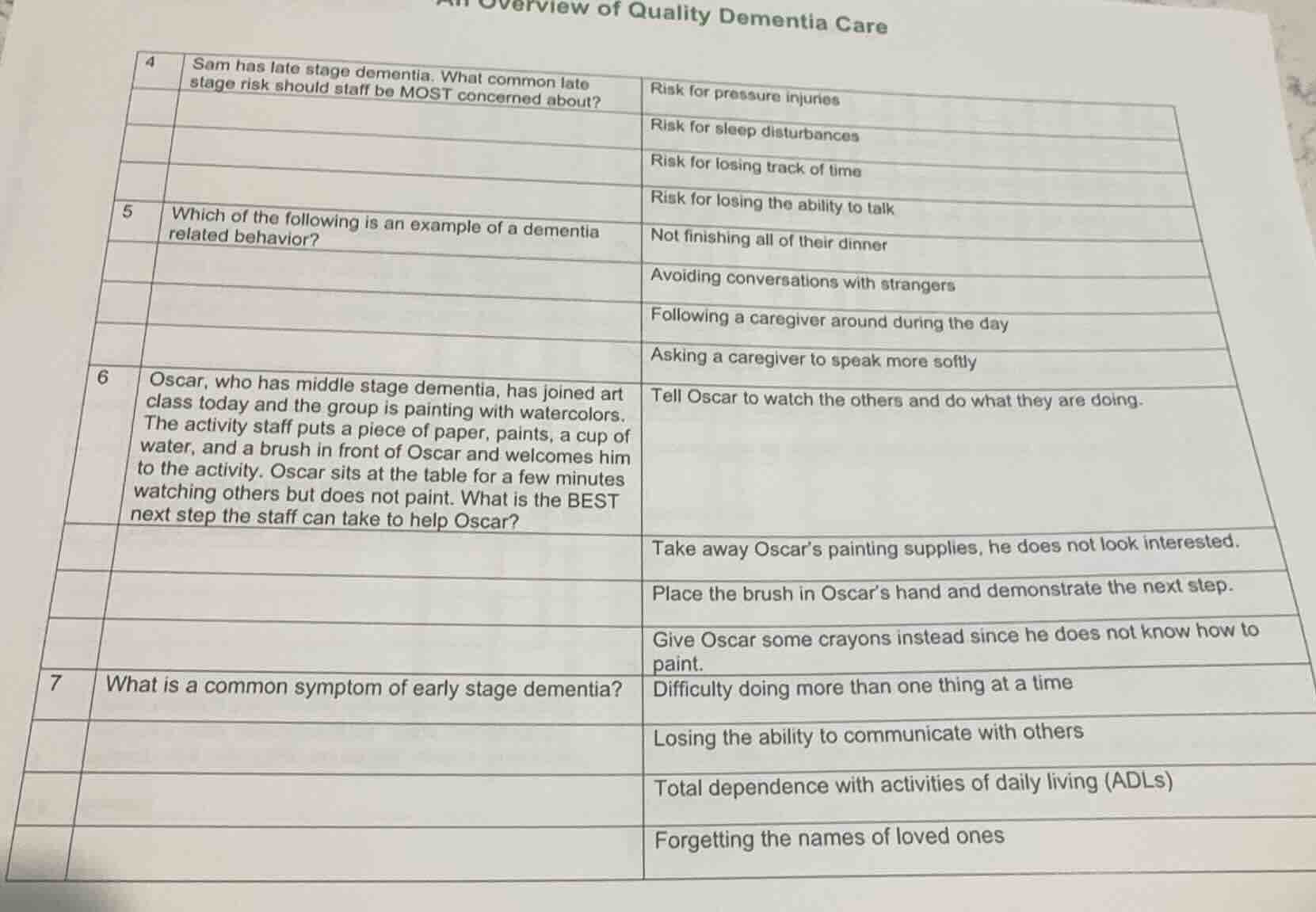
an overview of quality dementia care
- sam has late stage dementia. what common late stage risk should staff be most concerned about?
- risk for pressure injuries
- risk for sleep disturbances
- risk for losing track of time
- risk for losing the ability to talk
- which of the following is an example of a dementia related behavior?
- not finishing all of their dinner
- avoiding conversations with strangers
- following a caregiver around during the day
- asking a caregiver to speak more softly
- oscar, who has middle stage dementia, has joined art class today and the group is painting with watercolors. the activity staff puts a piece of paper, paints, a cup of water, and a brush in front of oscar and welcomes him to the activity. oscar sits at the table for a few minutes watching others but does not paint. what is the best next step the staff can take to help oscar?
- tell oscar to watch the others and do what they are doing.
- take away oscars painting supplies, he does not look interested.
- place the brush in oscars hand and demonstrate the next step.
- give oscar some crayons instead since he does not know how to paint.
- what is a common symptom of early stage dementia?
- difficulty doing more than one thing at a time
- losing the ability to communicate with others
- total dependence with activities of daily living (adls)
- forgetting the names of loved ones
Analyze late-stage dementia risks
In late-stage dementia, individuals experience severe physical decline, including limited mobility, difficulty swallowing, and incontinence. These physical limitations place them at a very high risk for physical complications. Among the options, "Risk for pressure injuries" is a critical physical risk that staff must be most concerned about due to prolonged immobility. Other options like losing track of time or losing the ability to talk are already established characteristics of late-stage dementia rather than acute risks to monitor and prevent.
Identify dementia-related behaviors
Dementia-related behaviors are actions resulting from cognitive decline, such as confusion, anxiety, or disorientation. "Following a caregiver around during the day" (often called shadowing) is a classic dementia-related behavior driven by a need for security and reassurance. The other options represent normal behaviors or preferences (like not finishing dinner, avoiding strangers, or asking to speak softly).
Determine the best intervention for Oscar
Oscar has middle-stage dementia and is struggling to initiate the painting activity despite having the supplies. This is a common issue with motor planning and initiation. Using Dementia Communication and Behavior Problem-Solving strategies, the best approach is to provide a physical and visual cue to help him start. Placing the brush in his hand and demonstrating the next step helps bridge the cognitive gap without taking away his autonomy or isolating him.
Identify early-stage dementia symptoms
Early-stage dementia is characterized by mild cognitive changes that begin to impact daily functioning but do not result in total dependence. "Difficulty doing more than one thing at a time" (multitasking challenges) is a common early cognitive symptom. In contrast, losing the ability to communicate, total dependence on ADLs, and forgetting the names of loved ones are characteristic of middle-to-late stages.

Snap & solve any problem in the app
Get step-by-step solutions on Sovi AI
Photo-based solutions with guided steps
Explore more problems and detailed explanations
Question 4
- Risk for pressure injuries (Correct answer)
- Risk for sleep disturbances
- Risk for losing track of time
- Risk for losing the ability to talk
Question 5
- Not finishing all of their dinner
- Avoiding conversations with strangers
- Following a caregiver around during the day (Correct answer)
- Asking a caregiver to speak more softly
Question 6
- Tell Oscar to watch the others and do what they are doing.
- Take away Oscar's painting supplies, he does not look interested.
- Place the brush in Oscar's hand and demonstrate the next step. (Correct answer)
- Give Oscar some crayons instead since he does not know how to paint.
Question 7
- Difficulty doing more than one thing at a time (Correct answer)
- Losing the ability to communicate with others
- Total dependence with activities of daily living (ADLs)
- Forgetting the names of loved ones