QUESTION IMAGE
Question
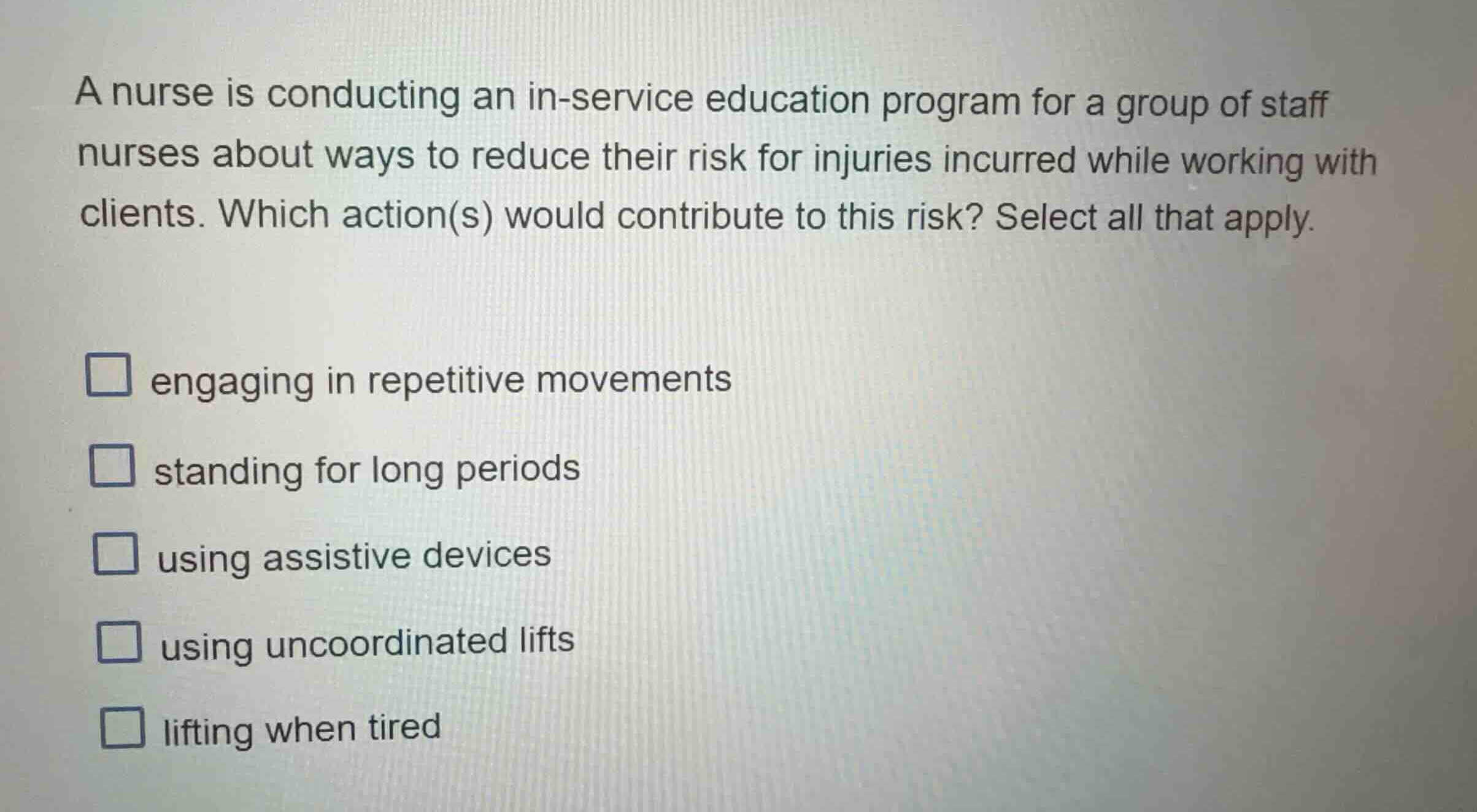
a nurse is conducting an in-service education program for a group of staff nurses about ways to reduce their risk for injuries incurred while working with clients. which action(s) would contribute to this risk? select all that apply.
engaging in repetitive movements
standing for long periods
using assistive devices
using uncoordinated lifts
lifting when tired
Analyze the question prompt
The question asks which actions contribute to the risk of injuries incurred by staff nurses while working with clients. This is a "Select all that apply" (SATA) multiple-choice question.
Evaluate each option
Using the Safe Patient Handling and Ergonomic Transfer Techniques knowledge points:
- engaging in repetitive movements: Repetitive motions strain muscles and joints over time, increasing musculoskeletal injury risk. This contributes to the risk.
- standing for long periods: Prolonged static standing causes muscle fatigue and pooling of blood in the lower extremities, contributing to physical strain and injury risk. This contributes to the risk.
- using assistive devices: Assistive devices (e.g., mechanical lifts, slide sheets) are designed to reduce physical strain on nurses. Using them decreases injury risk rather than contributing to it.
- using uncoordinated lifts: Lifting a client without proper coordination or synchronization among staff members leads to sudden, uneven loads on the spine, significantly increasing injury risk. This contributes to the risk.
- lifting when tired: Fatigue impairs physical strength, coordination, and clinical judgment, making a nurse much more susceptible to acute injuries during lifting tasks. This contributes to the risk.
Synthesize the correct selections
The actions that increase or contribute to the risk of injury are:
- engaging in repetitive movements
- standing for long periods
- using uncoordinated lifts
- lifting when tired

Snap & solve any problem in the app
Get step-by-step solutions on Sovi AI
Photo-based solutions with guided steps
Explore more problems and detailed explanations
- engaging in repetitive movements (Correct answer)
- standing for long periods (Correct answer)
- using assistive devices
- using uncoordinated lifts (Correct answer)
- lifting when tired (Correct answer)