QUESTION IMAGE
Question
multiple choice question
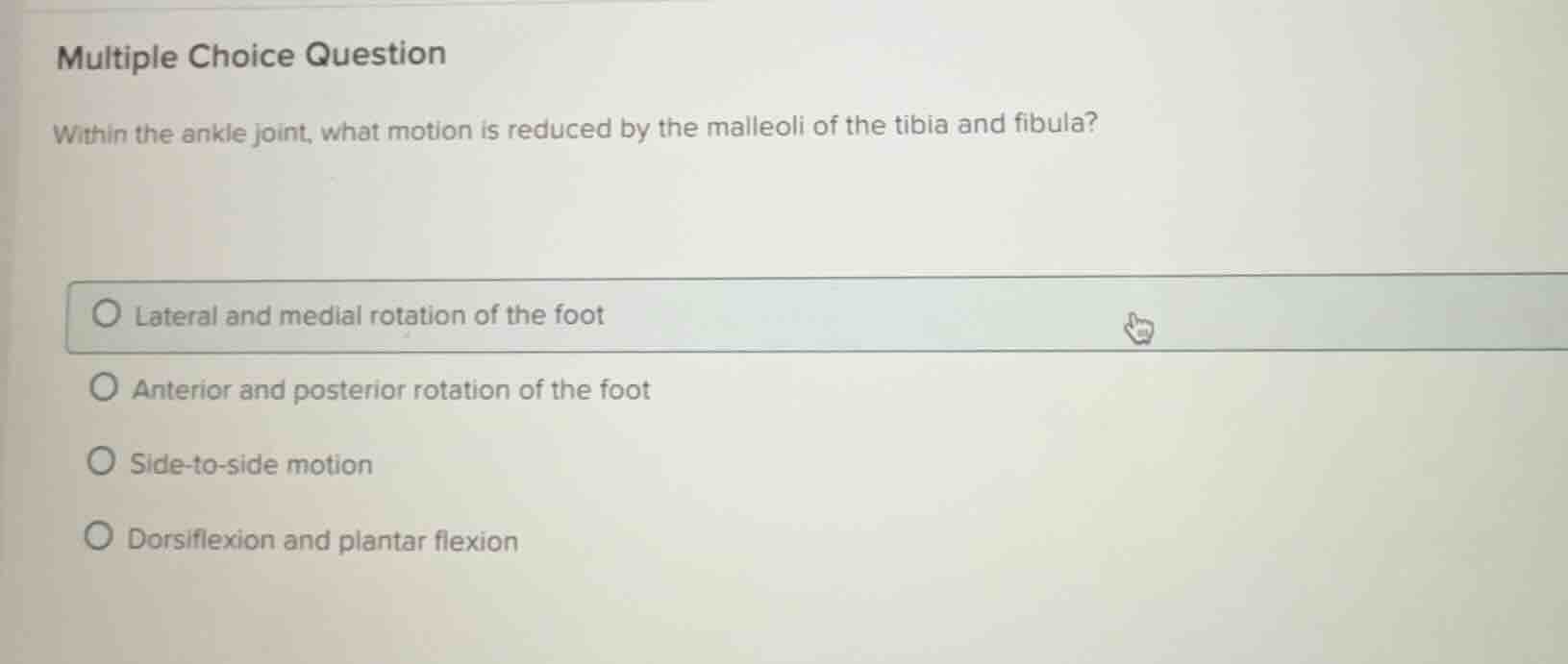
within the ankle joint, what motion is reduced by the malleoli of the tibia and fibula?
lateral and medial rotation of the foot
anterior and posterior rotation of the foot
side-to-side motion
dorsiflexion and plantar flexion
Analyze ankle joint structure
Using the Ankle Joint Anatomy and Talocrural Joint knowledge points
The talocrural (ankle) joint is a uniaxial hinge joint formed by the distal ends of the tibia and fibula articulating with the talus. The medial malleolus of the tibia and the lateral malleolus of the fibula form a deep bracket-shaped socket (mortise) that snugly fits the trochlea of the talus.
Determine restricted movements
Using the Medial Ankle Joint knowledge point
The bony architecture of the medial and lateral malleoli physically brackets the talus on both sides. This structural arrangement prevents the talus from sliding or tilting sideways within the mortise, thereby restricting side-to-side movement (abduction/adduction and inversion/eversion at this specific joint) to ensure stability during weight-bearing.
Evaluate the options
- Lateral and medial rotation of the foot: Rotation occurs primarily at other joints (such as the subtalar and transverse tarsal joints) and through rotation of the lower leg, rather than being the primary motion restricted by the mortise.
- Anterior and posterior rotation of the foot: This is not standard anatomical terminology for primary ankle movements.
- Side-to-side motion: The rigid mortise formed by the two malleoli prevents lateral and medial shifting, directly reducing side-to-side motion.
- Dorsiflexion and plantar flexion: These are the primary allowed movements of the hinge-like talocrural joint, not the motions reduced or prevented by the malleoli.

Snap & solve any problem in the app
Get step-by-step solutions on Sovi AI
Photo-based solutions with guided steps
Explore more problems and detailed explanations
- Lateral and medial rotation of the foot
- Anterior and posterior rotation of the foot
- Side-to-side motion (Correct answer)
- Dorsiflexion and plantar flexion