Sovi.AI - AI Math Tutor

Scan to solve math questions

QUESTION IMAGE

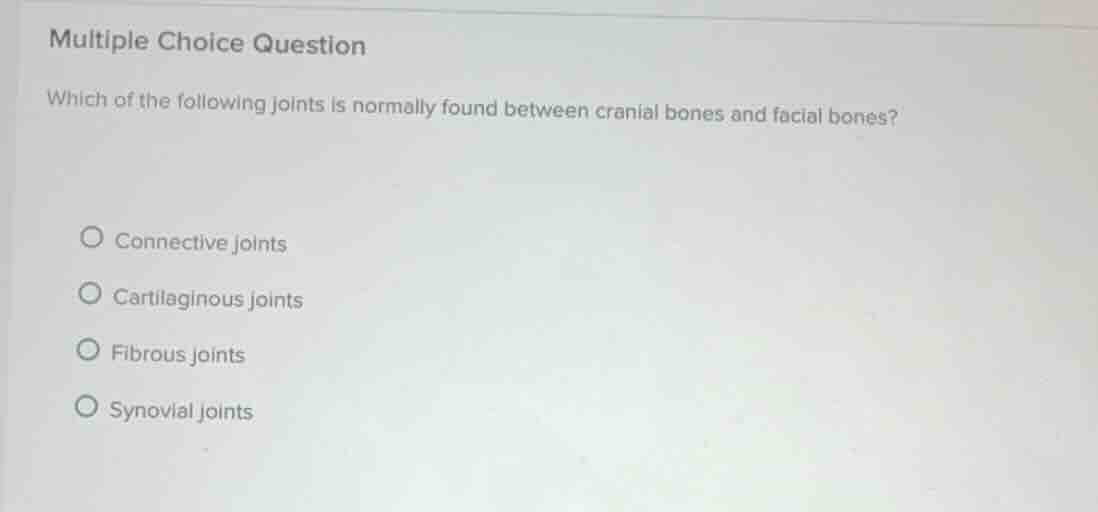
multiple choice question which of the following joints is normally foun…

Question

multiple choice question

which of the following joints is normally found between cranial bones and facial bones?

connective joints
cartilaginous joints
fibrous joints
synovial joints

Explanation:

Response

<pre_analysis>
{
"quality": "clear",
"question_count": 1,
"skills_matched": [
"direct_cot",
"multiple_choice_formatter",
"explain_then_answer",
"tutor",
"mastery_adaptive_brevity"
],
"needs_drawing": false,
"concepts_used": [
"Joint Classification",
"Cartilaginous Joints"
],
"new_concepts": [
"Fibrous Joints",
"Sutures"
],
"current_concepts": [
"Joint Classification",
"Cartilaginous Joints",
"Fibrous Joints",
"Sutures"
]
}
</pre_analysis>

<reasoning>

Identify the anatomical structures involved

The question asks about the type of joints normally found between cranial bones and facial bones of the skull.

Analyze joint classifications

Using the Joint Classification knowledge point

  • Joints are classified structurally as fibrous, cartilaginous, or synovial.
  • Cranial and facial bones (except the mandible) are tightly fused together by immovable joints called sutures.

Determine the structural joint type

Using the Cartilaginous Joints knowledge point

  • Cartilaginous joints are connected by hyaline cartilage or fibrocartilage (e.g., intervertebral discs).
  • Sutures of the skull are composed of dense fibrous connective tissue, which structurally classifies them as fibrous joints.

Evaluate the given options

  • Connective joints: Not a standard structural classification category.
  • Cartilaginous joints: Connected by cartilage, not found between adjacent cranial/facial bones.
  • Fibrous joints: Connected by dense fibrous connective tissue (sutures), which is correct.
  • Synovial joints: Freely movable joints with a fluid-filled cavity (e.g., temporomandibular joint), not found between most cranial and facial bones.

</reasoning>

<answer>
<mcq-option>Connective joints</mcq-option>
<mcq-option>Cartilaginous joints</mcq-option>
<mcq-correct>Fibrous joints</mcq-correct>
<mcq-option>Synovial joints</mcq-option>
</answer>

<post_analysis>
{
"subject": "Natural Science",
"question_type": "Multiple Choice",
"knowledge_point": [
"Natural Science",
"Anatomy & Physiology",
"Joint Classification"
]
}
</post_analysis>

Answer:

<pre_analysis>
{
"quality": "clear",
"question_count": 1,
"skills_matched": [
"direct_cot",
"multiple_choice_formatter",
"explain_then_answer",
"tutor",
"mastery_adaptive_brevity"
],
"needs_drawing": false,
"concepts_used": [
"Joint Classification",
"Cartilaginous Joints"
],
"new_concepts": [
"Fibrous Joints",
"Sutures"
],
"current_concepts": [
"Joint Classification",
"Cartilaginous Joints",
"Fibrous Joints",
"Sutures"
]
}
</pre_analysis>

<reasoning>

Identify the anatomical structures involved

The question asks about the type of joints normally found between cranial bones and facial bones of the skull.

Analyze joint classifications

Using the Joint Classification knowledge point

  • Joints are classified structurally as fibrous, cartilaginous, or synovial.
  • Cranial and facial bones (except the mandible) are tightly fused together by immovable joints called sutures.

Determine the structural joint type

Using the Cartilaginous Joints knowledge point

  • Cartilaginous joints are connected by hyaline cartilage or fibrocartilage (e.g., intervertebral discs).
  • Sutures of the skull are composed of dense fibrous connective tissue, which structurally classifies them as fibrous joints.

Evaluate the given options

  • Connective joints: Not a standard structural classification category.
  • Cartilaginous joints: Connected by cartilage, not found between adjacent cranial/facial bones.
  • Fibrous joints: Connected by dense fibrous connective tissue (sutures), which is correct.
  • Synovial joints: Freely movable joints with a fluid-filled cavity (e.g., temporomandibular joint), not found between most cranial and facial bones.

</reasoning>

<answer>
<mcq-option>Connective joints</mcq-option>
<mcq-option>Cartilaginous joints</mcq-option>
<mcq-correct>Fibrous joints</mcq-correct>
<mcq-option>Synovial joints</mcq-option>
</answer>

<post_analysis>
{
"subject": "Natural Science",
"question_type": "Multiple Choice",
"knowledge_point": [
"Natural Science",
"Anatomy & Physiology",
"Joint Classification"
]
}
</post_analysis>