QUESTION IMAGE
Question
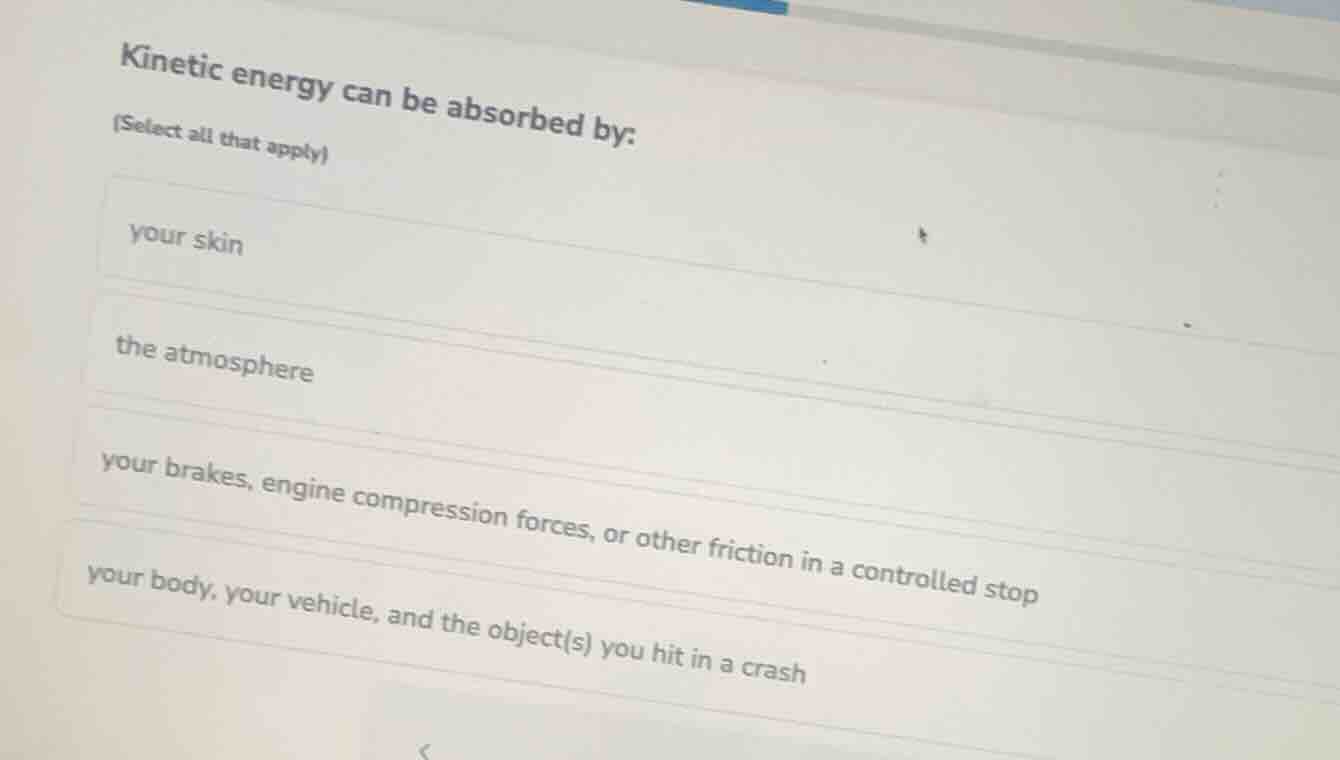
kinetic energy can be absorbed by:
(select all that apply)
your skin
the atmosphere
your brakes, engine compression forces, or other friction in a controlled stop
your body, your vehicle, and the object(s) you hit in a crash
Analyze kinetic energy in driving
The question asks how kinetic energy can be absorbed. In the context of driving and vehicle safety, Kinetic Energy is the energy of motion that must be dissipated or transferred to bring a moving vehicle to a stop.
Evaluate controlled stopping mechanisms
During a controlled stop, the vehicle's kinetic energy is converted into thermal energy (heat) through friction. This is primarily done by your brakes, engine compression forces, or other friction (such as tires against the road and air resistance). Therefore, this option is correct.
Evaluate crash impact mechanisms
In a collision or crash, the remaining kinetic energy is absorbed rapidly and violently. This energy is absorbed by the deformation of your vehicle (crumple zones), the body of the occupants (which can cause injury), and the object(s) hit during the impact. Therefore, this option is also correct.
Evaluate incorrect options
While air resistance (the atmosphere) and friction on your skin do technically dissipate tiny amounts of energy in everyday life, in the context of driver's education and vehicle physics, "your skin" and "the atmosphere" are not standard or primary mechanisms for absorbing a vehicle's kinetic energy. The primary focus is on controlled braking versus crash impacts.

Snap & solve any problem in the app
Get step-by-step solutions on Sovi AI
Photo-based solutions with guided steps
Explore more problems and detailed explanations
- your skin
- the atmosphere
- your brakes, engine compression forces, or other friction in a controlled stop (Correct answer)
- your body, your vehicle, and the object(s) you hit in a crash (Correct answer)