QUESTION IMAGE
Question
Question was provided via image upload.
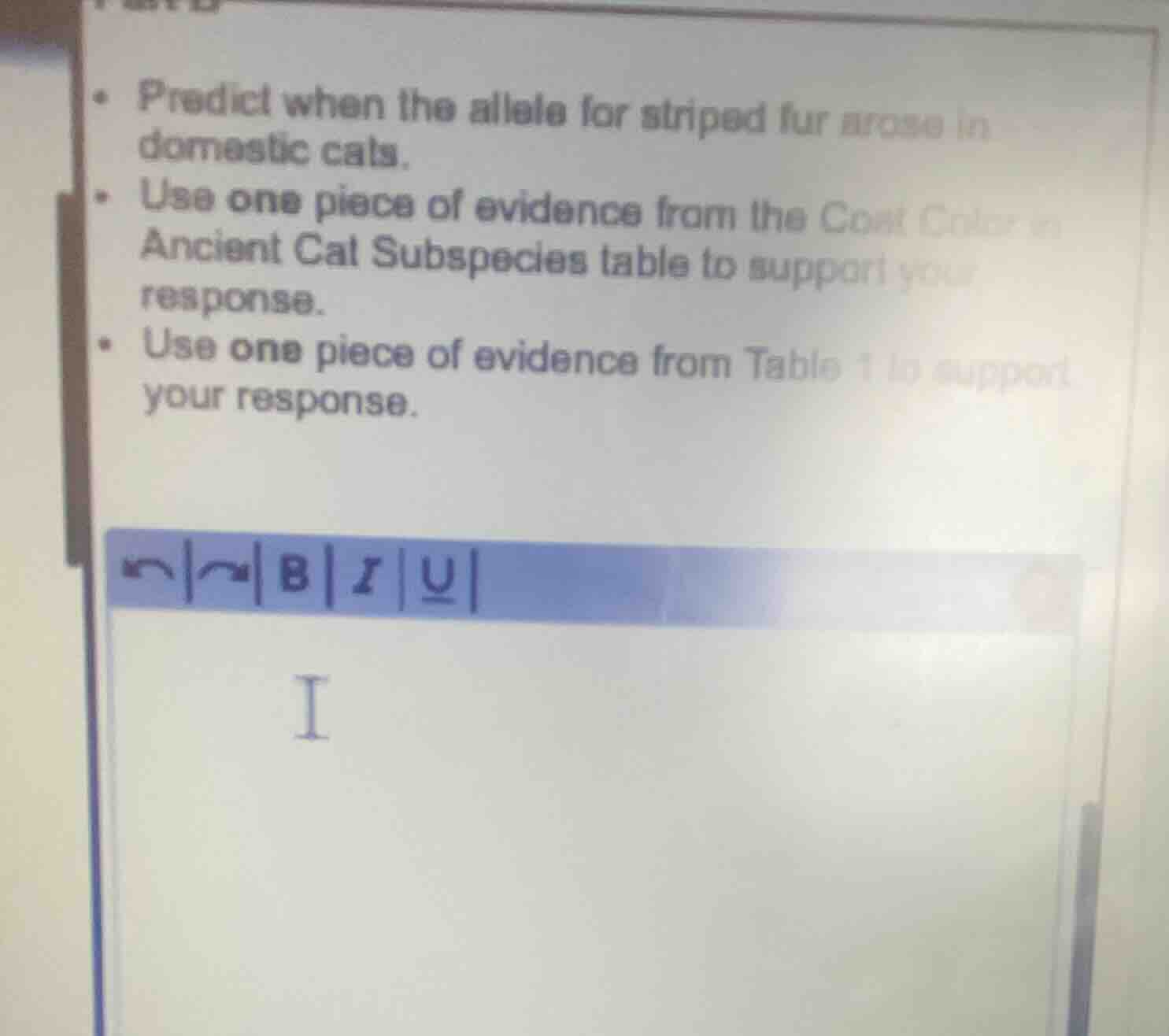
Identify the target question
The prompt asks to predict when the allele for striped fur arose in domestic cats using evidence from two referenced tables: "Coat Color in Ancient Cat Subspecies" and "Table 1".
Analyze the missing context
Using Allele Origin principles, we know that alleles arise via mutation and their historical presence is reconstructed using ancient DNA samples from different archaeological periods. Although the specific tables are not fully visible in this cropped image, standard biological datasets on cat domestication (such as those from Ottoni et al., 2017 on the paleogenetics of cat dispersal) show that the wildcat ancestor (Felis silvestris lybica) historically possessed the striped (tabby) coat pattern.
Formulate the prediction
The allele for striped fur is the ancestral (wild-type) allele. Therefore, it arose long before domestication, in the wild ancestors of domestic cats (thousands to millions of years ago).
Identify expected evidence
Using Allele Origin reconstruction:
- The "Coat Color in Ancient Cat Subspecies" table typically shows that ancient wildcat subspecies (dating back to the Neolithic or earlier) carried the striped allele.
- "Table 1" typically shows that modern domestic cats share this ancestral allele with their wild relatives, or that ancient domestic remains from early agricultural periods already possessed the striped genotype.

Snap & solve any problem in the app
Get step-by-step solutions on Sovi AI
Photo-based solutions with guided steps
Explore more problems and detailed explanations
Based on evolutionary genetics and ancient DNA evidence:
- Prediction: The allele for striped fur arose in the wild ancestors of domestic cats long before domestication occurred (likely hundreds of thousands of years ago).
- Evidence from Coat Color in Ancient Cat Subspecies table: Ancient wildcat subspecies (Felis silvestris) from historical and prehistoric periods carried the allele for striped fur, showing it predates domestic breeds.
- Evidence from Table 1: Early domestic cat specimens from the earliest archaeological sites of cat-human association already possessed the striped allele, confirming it was inherited directly from their wild ancestors rather than arising post-domestication.