QUESTION IMAGE
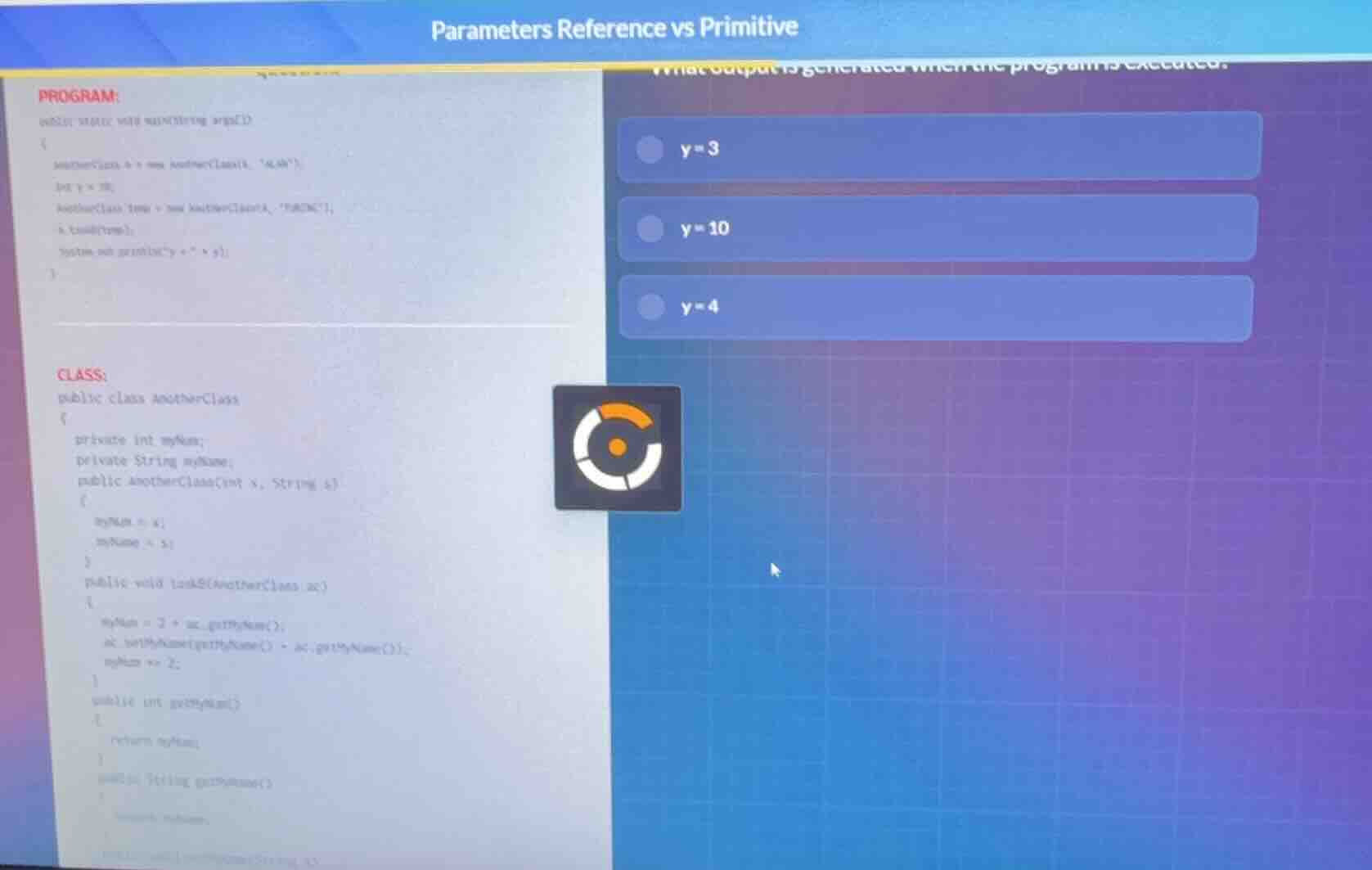
Question
Question was provided via image upload.
🆕 New Concept Discovered: Java Pass-by-Value (Primitives vs. References)
How Java passes variables to methods.
To find the output of the program, we need to trace the execution of the code step-by-step, paying close attention to how primitive variables and object references behave when passed as arguments to a method.
---
Step 1: Analyze the Code Structure
Let's reconstruct the relevant parts of the code from the image:
The Class Definition:
public class AnotherClass {
    private int myNum;
    private String myName;

    public AnotherClass(int x, String s) {
        myNum = x;
        myName = s;
    }

    public void task5(AnotherClass ac) {
        myNum = 2 + ac.getMyNum();
        // (Some other operations on ac and myName)
        myNum -= 2;
    }

    public int getMyNum() {
        return myNum;
    }

    // ... other getters/setters
}
The Main Program Execution:
AnotherClass a = new AnotherClass(4, "ALAN");
int y = 10;
AnotherClass temp = new AnotherClass(3, "FRANCIS");
a.task5(temp);
System.out.println("y = " + y);
---
Step 2: Trace the Variables and Method Call
- Initialization:
- Object
ais created withmyNum = 4andmyName = "ALAN". - Primitive variable
yis initialized to10. - Object
tempis created withmyNum = 3andmyName = "FRANCIS".
- Method Call:
- The method call
a.task5(temp)is executed. - Inside this call, the calling object (
this) isa, and the parameteracrefers to the objecttemp.
- Value of
y:
- Notice that the primitive variable
yis declared in the main method:int y = 10;. - The variable
yis never passed into thetask5method, nor is it modified anywhere in the program after its initialization. - In Java, primitive variables like
intare stored locally in the stack frame of the method they are declared in (themainmethod). Since no code modifiesy, its value remains completely unchanged.
---
Step 3: Determine the Output
Since y starts at 10 and is never modified, the print statement:
System.out.println("y = " + y);will output:y = 10

Snap & solve any problem in the app
Get step-by-step solutions on Sovi AI
Photo-based solutions with guided steps
Explore more problems and detailed explanations
y = 10