QUESTION IMAGE
Question
Question was provided via image upload.
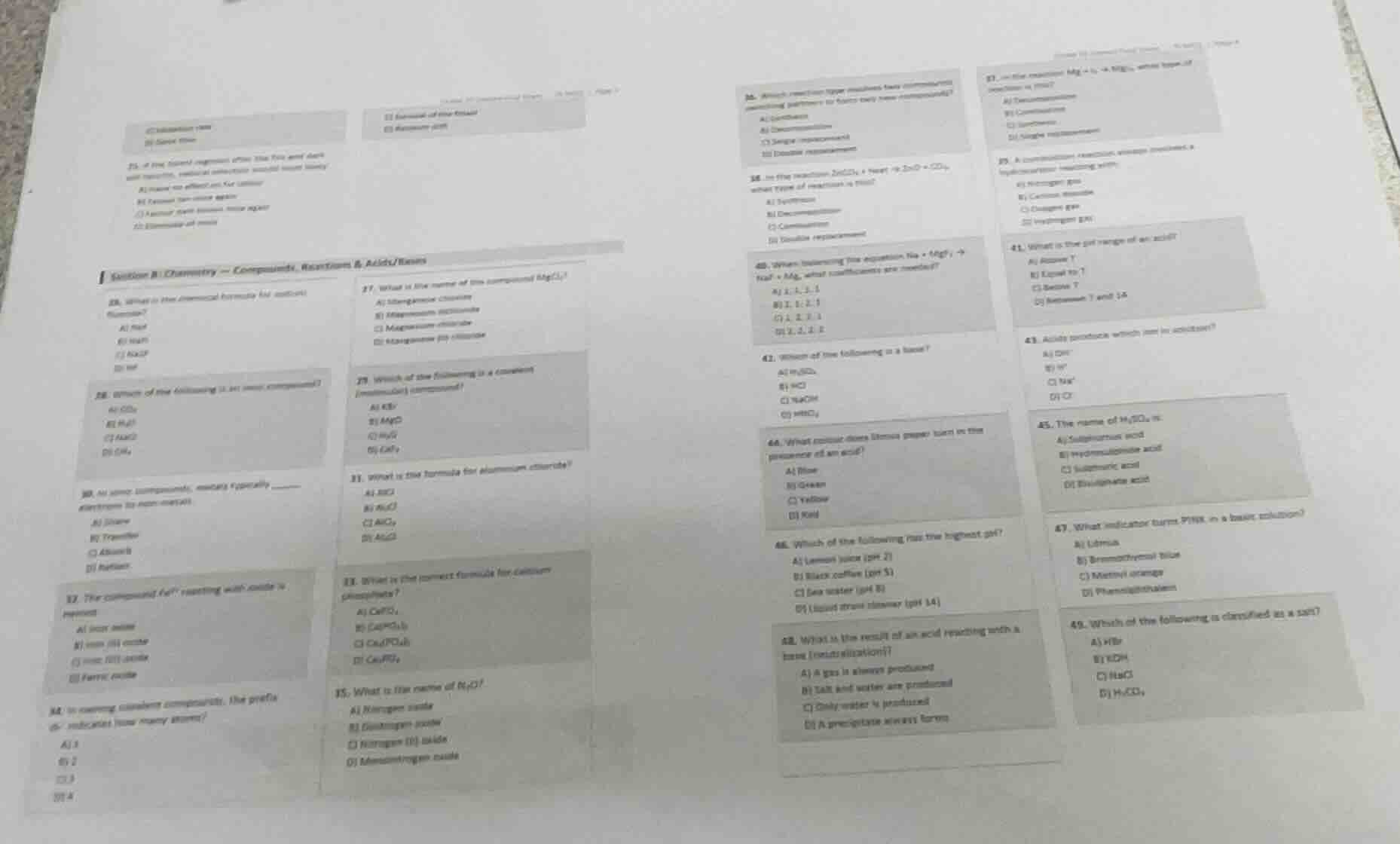
Identify questions and options
The image contains multiple-choice questions under "Section B: Chemistry - Compounds, Reactions & Acids/Bases". Let's analyze each visible question:
- Question 26: What is the chemical formula for sodium fluoride?
- Options: A) NaF, B) NaF2, C) Na2F, D) NaF3.
- Sodium is \( \text{Na}^+ \), Fluoride is \( \text{F}^- \). The formula is \( \text{NaF} \). (Option A)
- Question 27: What is the name of this compound: \( \text{MgCl}_2 \)?
- Options: A) Manganese Chloride, B) Magnesium Chloride, C) Magnesium dichloride, D) Manganese (II) chloride.
- \( \text{Mg} \) is magnesium, \( \text{Cl} \) is chlorine. For ionic compounds, it is magnesium chloride. (Option B)
- Question 28: Which of the following is an ionic compound?
- Options: A) \( \text{H}_2\text{O} \), B) \( \text{NaCl} \), C) \( \text{CO}_2 \), D) \( \text{CH}_4 \).
- \( \text{NaCl} \) consists of metal and non-metal ions. (Option B)
- Question 29: Which of the following is a covalent (molecular) compound?
- Options: A) \( \text{KCl} \), B) \( \text{H}_2\text{O} \), C) \( \text{MgO} \), D) \( \text{CaF}_2 \).
- \( \text{H}_2\text{O} \) consists of non-metals sharing electrons. (Option B)
- Question 30: In ionic compounds, metals typically ______ electrons to non-metals.
- Options: A) Share, B) Transfer, C) Absorb, D) Retain.
- Metals transfer electrons to non-metals. (Option B)
- Question 31: What is the formula for aluminum chloride?
- Options: A) \( \text{AlCl} \), B) \( \text{Al}_3\text{Cl} \), C) \( \text{AlCl}_3 \), D) \( \text{Al}_3\text{Cl}_3 \).
- Aluminum is \( \text{Al}^{3+} \), chloride is \( \text{Cl}^- \). The formula is \( \text{AlCl}_3 \). (Option C)
- Question 32: The compound \( \text{Fe}_2\text{O}_3 \) starting with iron(III) is named:
- Options: A) Iron oxide, B) Iron(III) oxide, C) Iron(II) oxide, D) Ferric oxide.
- The IUPAC name is Iron(III) oxide. (Option B)
- Question 33: What is the correct formula for calcium phosphate?
- Options: A) \( \text{CaPO}_4 \), B) \( \text{Ca}_3\text{PO}_4 \), C) \( \text{Ca}_3(\text{PO}_4)_2 \), D) \( \text{Ca}(\text{PO}_4)_2 \).
- Calcium is \( \text{Ca}^{2+} \), phosphate is \( \text{PO}_4^{3-} \). The formula is \( \text{Ca}_3(\text{PO}_4)_2 \). (Option C)
- Question 34: In naming covalent compounds, the prefix di- indicates how many atoms?
- Options: A) 1, B) 2, C) 3, D) 4.
- "di-" means 2. (Option B)
- Question 35: What is the name of \( \text{N}_2\text{O} \)?
- Options: A) Nitrogen oxide, B) Dinitrogen oxide, C) Nitrogen (I) oxide, D) Mononitrogen oxide.
- Two nitrogens and one oxygen: Dinitrogen monoxide (or dinitrogen oxide). (Option B)
- Question 36: Which reaction type involves two compounds switching partners to form two new compounds?
- Options: A) Synthesis, B) Decomposition, C) Single replacement, D) Double replacement.
- This is a double replacement reaction. (Option D)
- Question 37: In the reaction \( \text{Mg} + \text{O}_2
ightarrow \text{MgO} \), what type of reaction is this?
- Options: A) Decomposition, B) Combustion, C) Synthesis, D) Single replacement.
- Two reactants combine to form one pro…

Snap & solve any problem in the app
Get step-by-step solutions on Sovi AI
Photo-based solutions with guided steps
Explore more problems and detailed explanations
| No. | Answer |
|---|---|
| 27 | (B) |
| 28 | (B) |
| 29 | (B) |
| 30 | (B) |
| 31 | (C) |
| 32 | (B) |
| 33 | (C) |
| 34 | (B) |
| 35 | (B) |
| 36 | (D) |
| 37 | (C) |
| 38 | (B) |
| 39 | (C) |
| 40 | (C) |
| 41 | (C) |
| 42 | (C) |
| 43 | (B) |
| 44 | (D) |
| 45 | (C) |
| 46 | (D) |
| 47 | (D) |
| 48 | (B) |
| 49 | (C) |