QUESTION IMAGE
Question
Question was provided via image upload.
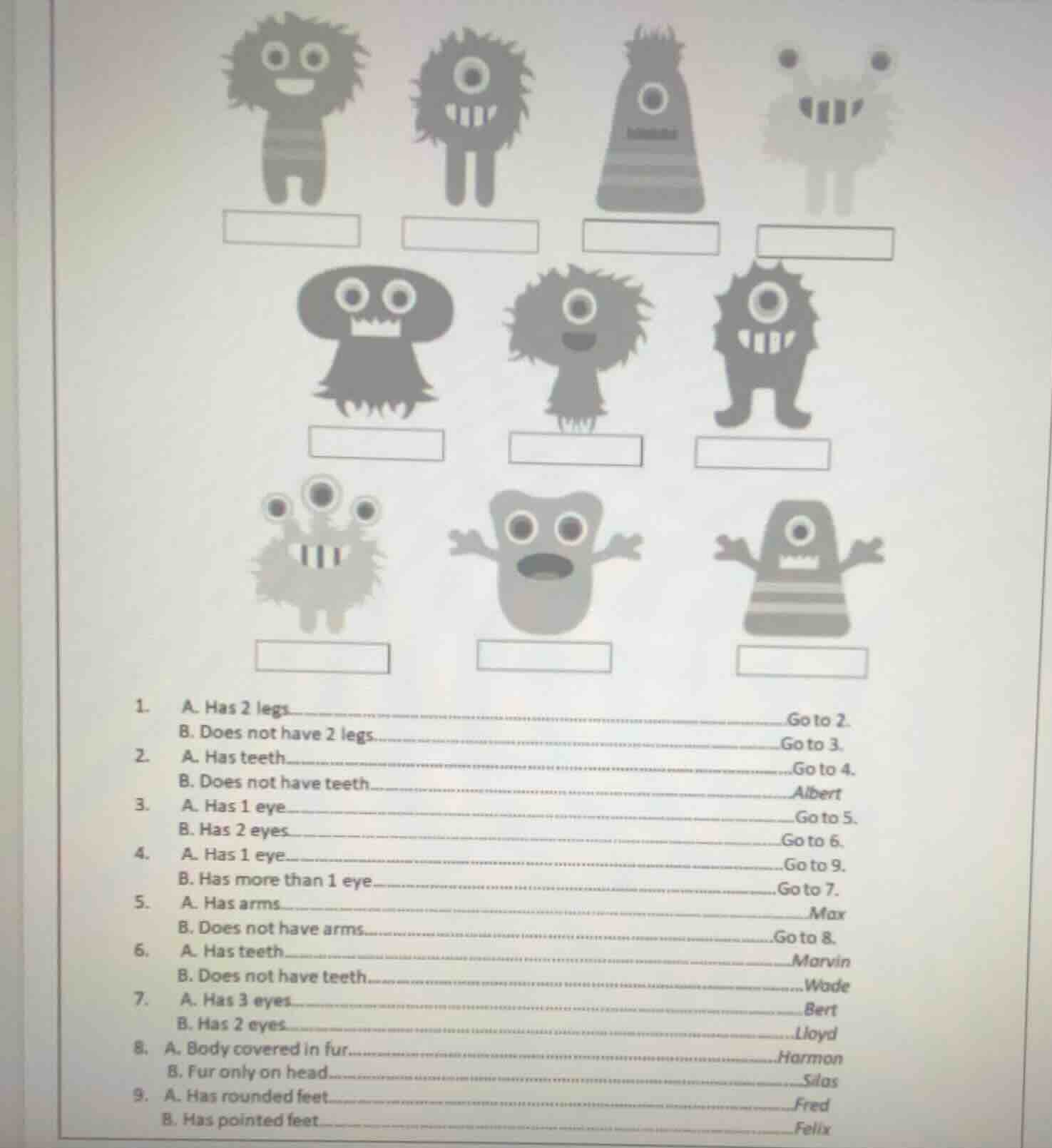
Analyze the dichotomous key structure
We need to identify each of the 10 monsters using the provided dichotomous key. Let's trace the key paths for each monster from top-left to bottom-right.
Monster 1 (Top row, 1st from left):
- Features: 2 legs, no teeth, 2 eyes, fur on head, body has stripes.
- Path:
- 1. A. Has 2 legs -> Go to 2.
- 2. B. Does not have teeth -> Albert
Monster 2 (Top row, 2nd from left):
- Features: No legs (2 long vertical lines/tentacles, but let's check if they count as legs. If they are legs, it has 2 legs. Let's trace both paths).
- If 2 legs:
- 1. A. Has 2 legs -> Go to 2.
- 2. A. Has teeth -> Go to 4.
- 4. A. Has 1 eye -> Go to 9.
- 9. B. Has pointed feet -> Felix (This monster has pointed feet/ends on its legs). Let's verify.
- If not 2 legs:
- 1. B. Does not have 2 legs -> Go to 3.
- 3. A. Has 1 eye -> Go to 5.
- 5. B. Does not have arms -> Go to 8.
- 8. B. Fur only on head -> Silas (This monster has fur all over, so it would be Harmon, but Harmon has a body covered in fur. Let's check if Silas fits better elsewhere).
- Let's re-evaluate: Monster 2 has 2 legs, teeth, 1 eye, and pointed feet. Thus, it is Felix.
Monster 3 (Top row, 3rd from left):
- Features: No legs (cone-shaped body), 1 eye, no arms.
- Path:
- 1. B. Does not have 2 legs -> Go to 3.
- 3. A. Has 1 eye -> Go to 5.
- 5. B. Does not have arms -> Go to 8.
- 8. B. Fur only on head -> Silas (It has a tuft of fur/hair on top of its head, and a smooth cone body). This fits perfectly! Thus, it is Silas.
Monster 4 (Top row, 4th from left):
- Features: No legs (4 small bottom tentacles/stumps), 2 eyes on stalks, teeth, furry body.
- Path:
- 1. B. Does not have 2 legs -> Go to 3.
- 3. B. Has 2 eyes -> Go to 6.
- 6. A. Has teeth -> Marvin
Monster 5 (Middle row, 1st from left):
- Features: 2 legs, teeth, 2 eyes, pointed feet.
- Path:
- 1. A. Has 2 legs -> Go to 2.
- 2. A. Has teeth -> Go to 4.
- 4. B. Has more than 1 eye -> Go to 7.
- 7. B. Has 2 eyes -> Lloyd
Monster 6 (Middle row, 2nd from left):
- Features: No legs (stumpy bottom), 1 eye, arms, furry body.
- Path:
- 1. B. Does not have 2 legs -> Go to 3.
- 3. A. Has 1 eye -> Go to 5.
- 5. A. Has arms -> Max
Monster 7 (Middle row, 3rd from left):
- Features: 2 legs, teeth, 1 eye, rounded feet.
- Path:
- 1. A. Has 2 legs -> Go to 2.
- 2. A. Has teeth -> Go to 4.
- 4. A. Has 1 eye -> Go to 9.
- 9. A. Has rounded feet -> Fred
Monster 8 (Bottom row, 1st from left):
- Features: No legs (stumpy bottom), 3 eyes, teeth, furry body.
- Path:
- 1. B. Does not have 2 legs -> Go to 3.
- 3. B. Has 2 eyes? Wait, it has 3 eyes. Let's look at step 3: "B. Has 2 eyes -> Go to 6." But this monster has 3 eyes. Let's check step 7: "A. Has 3 eyes -> Bert". But step 7 is reached from step 4 (which requires 2 legs).
- Let's re-examine the legs of Monster 8: It has 2 legs? No, it has 2 legs with feet at the bottom, or is it 2 legs? Yes, those are 2 legs with feet. Let's trace with 2 legs:
- 1. A. Has 2 legs -> Go to 2.
- 2. A. Has teeth -> Go to 4.…

Snap & solve any problem in the app
Get step-by-step solutions on Sovi AI
Photo-based solutions with guided steps
Explore more problems and detailed explanations
The identified names of the monsters, listed in order from top-left to bottom-right, are as follows:
| Position | Monster Description | Identified Name |
|---|---|---|
| 2 | Top row, 2nd | Felix |
| 3 | Top row, 3rd | Silas |
| 4 | Top row, 4th | Marvin |
| 5 | Middle row, 1st | Lloyd |
| 6 | Middle row, 2nd | Max |
| 7 | Middle row, 3rd | Fred |
| 8 | Bottom row, 1st | Bert |
| 9 | Bottom row, 2nd | Wade |
| 10 | Bottom row, 3rd | Harmon |