QUESTION IMAGE
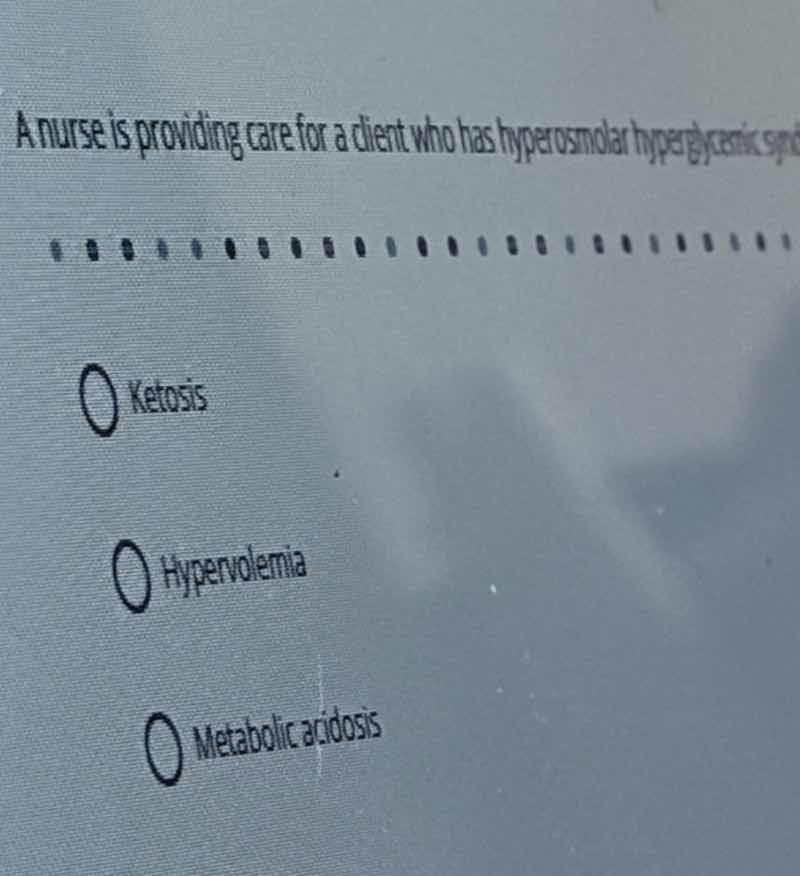
Question
Question was provided via image upload.
Analyze the clinical condition
The question asks about a client with hyperosmolar hyperglycemic syndrome (HHS). HHS is a life-threatening complication of diabetes mellitus characterized by extreme hyperglycemia, high serum osmolality, and profound dehydration.
Evaluate the options
- Ketosis: Ketosis and significant metabolic acidosis are hallmark features of Diabetic Ketoacidosis (DKA), not HHS. In HHS, there is enough endogenous insulin present to prevent lipolysis and subsequent ketogenesis.
- Hypervolemia: HHS causes severe osmotic diuresis due to extreme hyperglycemia, leading to profound dehydration (hypovolemia), not hypervolemia (fluid overload).
- Metabolic acidosis: Significant metabolic acidosis (with a low bicarbonate level and low pH) is characteristic of DKA. In HHS, the pH is typically greater than 7.30 and bicarbonate is greater than 18 mEq/L, meaning significant metabolic acidosis is absent.
Identify the missing correct option
Since the visible options (Ketosis, Hypervolemia, Metabolic acidosis) represent findings that are either absent in HHS or opposite to what occurs, the correct answer is typically a finding such as Severe dehydration (or profound hypovolemia), High serum osmolality, or Extreme hyperglycemia (often >600 mg/dL). Given the incomplete nature of the image, we will evaluate the visible options as incorrect and identify the expected clinical manifestations of HHS.

Snap & solve any problem in the app
Get step-by-step solutions on Sovi AI
Photo-based solutions with guided steps
Explore more problems and detailed explanations
Question 1
Based on the visible options for a client with hyperosmolar hyperglycemic syndrome (HHS):
- (A) Ketosis
- (B) Hypervolemia
- (C) Metabolic acidosis
(Note: The correct clinical findings for HHS typically include severe dehydration/hypovolemia, extreme hyperglycemia (>600 mg/dL), and high serum osmolality, which are absent from the visible options due to the cropped image.)