QUESTION IMAGE
Question
Question was provided via image upload.
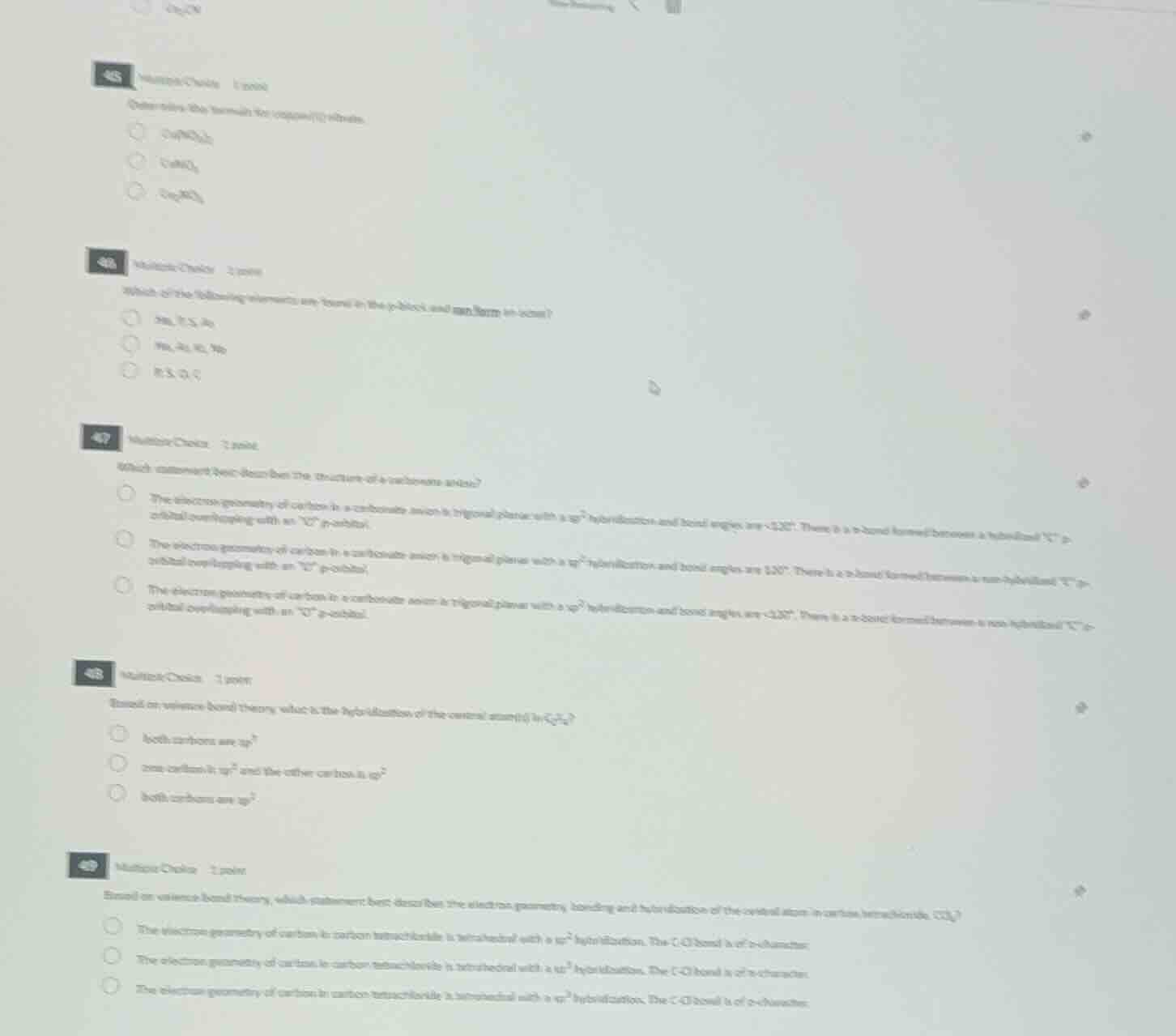
Identify copper(II) nitrate formula
Using the Chemical Nomenclature knowledge point:
- Copper(II) indicates a copper cation with a \(2+\) charge: \(\text{Cu}^{2+}\).
- Nitrate is a polyatomic anion with a \(1-\) charge: \(\text{NO}_3^-\).
- To balance the charges, two nitrate ions are needed for every copper(II) ion, yielding \(\text{Cu(NO}_3)_2\).
Identify p-block elements forming anions
Using the Electron Configuration Blocks knowledge point:
- We look for elements located in the p-block (Groups 13–18) that typically form anions (nonmetals/metalloids).
- Option 1: \(\text{Se, P, As}\) are all nonmetals/metalloids in the p-block that form anions (\(\text{Se}^{2-}\), \(\text{P}^{3-}\), \(\text{As}^{3-}\)).
- Option 2: \(\text{Na, Al, Rb}\) contain s-block metals (\(\text{Na, Rb}\)) and a p-block metal (\(\text{Al}\)) which form cations.
- Option 3: \(\text{F, S, Cl}\) are p-block nonmetals forming anions, but the third option listed in the image is \(\text{F, S, Cl}\). Let's double check the options:
- Option 1: \(\text{Se, P, As}\)
- Option 2: \(\text{Na, Al, Rb}\)
- Option 3: \(\text{F, S, Cl}\)
Both Option 1 and Option 3 contain p-block elements that form anions. Let's re-examine the image text: "Which of the following elements are found in the p-block and can form anions?". \(\text{F, S, Cl}\) are classic p-block elements forming monoatomic anions (\(\text{F}^-\), \(\text{S}^{2-}\), \(\text{Cl}^-\)).
Analyze carbonate anion structure
Using the Lewis Structures and VSEPR Theory knowledge points:
- Carbonate (\(\text{CO}_3^{2-}\)) has a central carbon bonded to three oxygen atoms with a steric number of 3 (trigonal planar electron geometry, \(sp^2\) hybridization, and \(120^\circ\) bond angles).
- The double bond consists of a \(\sigma\)-bond and a \(\pi\)-bond. The \(\pi\)-bond is formed by the sideways overlap of unhybridized \(p\)-orbitals on carbon and oxygen.
- Therefore, the correct statement is: "The electron geometry of carbon in a carbonate anion is trigonal planar with a \(sp^2\) hybridization and bond angles are \(120^\circ\). There is a \(\pi\)-bond formed between a non-hybridized 'C' p-orbital overlapping with an 'O' p-orbital."
Determine hybridization of C2H2
Using the Valence Bond Theory knowledge point:
- Acetylene (\(\text{C}_2\text{H}_2\)) has a triple bond between the two carbon atoms (\(\text{H}-\text{C}\equiv\text{C}-\text{H}\)).
- Each carbon is bonded to two atoms (one hydrogen, one carbon) and has zero lone pairs, giving a steric number of 2.
- A steric number of 2 corresponds to \(sp\) hybridization for both carbon atoms.
Analyze carbon tetrachloride bonding
Using the Valence Bond Theory and VSEPR Theory knowledge points:
- Carbon tetrachloride (\(\text{CCl}_4\)) has a central carbon bonded to four chlorine atoms with a steric number of 4.
- This results in a tetrahedral electron geometry and \(sp^3\) hybridization.
- The…

Snap & solve any problem in the app
Get step-by-step solutions on Sovi AI
Photo-based solutions with guided steps
Explore more problems and detailed explanations
Question 45
- (A) \(\text{CuNO}_3\)
- (B) \(\text{Cu(NO}_3)_2\) (Correct answer)
- (C) \(\text{CuNO}_2\)
- (D) \(\text{Cu}_2\text{NO}_3\)
Question 46
- (A) \(\text{Se, P, As}\)
- (B) \(\text{Na, Al, Rb}\)
- (C) \(\text{F, S, Cl}\) (Correct answer)
Question 47
- (A) The electron geometry of carbon in a carbonate anion is trigonal planar with a \(sp^2\) hybridization and bond angles are <\(120^\circ\). There is a \(\sigma\)-bond formed between a hybridized 'C' p-orbital overlapping with an 'O' p-orbital.
- (B) The electron geometry of carbon in a carbonate anion is trigonal planar with a \(sp^2\) hybridization and bond angles are \(120^\circ\). There is a \(\pi\)-bond formed between a non-hybridized 'C' p-orbital overlapping with an 'O' p-orbital. (Correct answer)
- (C) The electron geometry of carbon in a carbonate anion is trigonal planar with a \(sp^3\) hybridization and bond angles are <\(120^\circ\). There is a \(\pi\)-bond formed between a non-hybridized 'C' s-orbital overlapping with an 'O' p-orbital.
Question 48
- (A) both carbons are \(sp\) (Correct answer)
- (B) one carbon is \(sp^2\) and the other carbon is \(sp\)
- (C) both carbons are \(sp^2\)
Question 49
- (A) The electron geometry of carbon in carbon tetrachloride is tetrahedral with a \(sp^3\) hybridization. The \(\text{C}-\text{Cl}\) bond is of s-character
- (B) The electron geometry of carbon in carbon tetrachloride is tetrahedral with a \(sp^3\) hybridization. The \(\text{C}-\text{Cl}\) bond is of \(\sigma\)-character (Correct answer)
- (C) The electron geometry of carbon in carbon tetrachloride is tetrahedral with a \(sp^2\) hybridization. The \(\text{C}-\text{Cl}\) bond is of \(\pi\)-character