QUESTION IMAGE
Question
Question was provided via image upload.
Analyze the visible questions
The image contains two distinct questions:
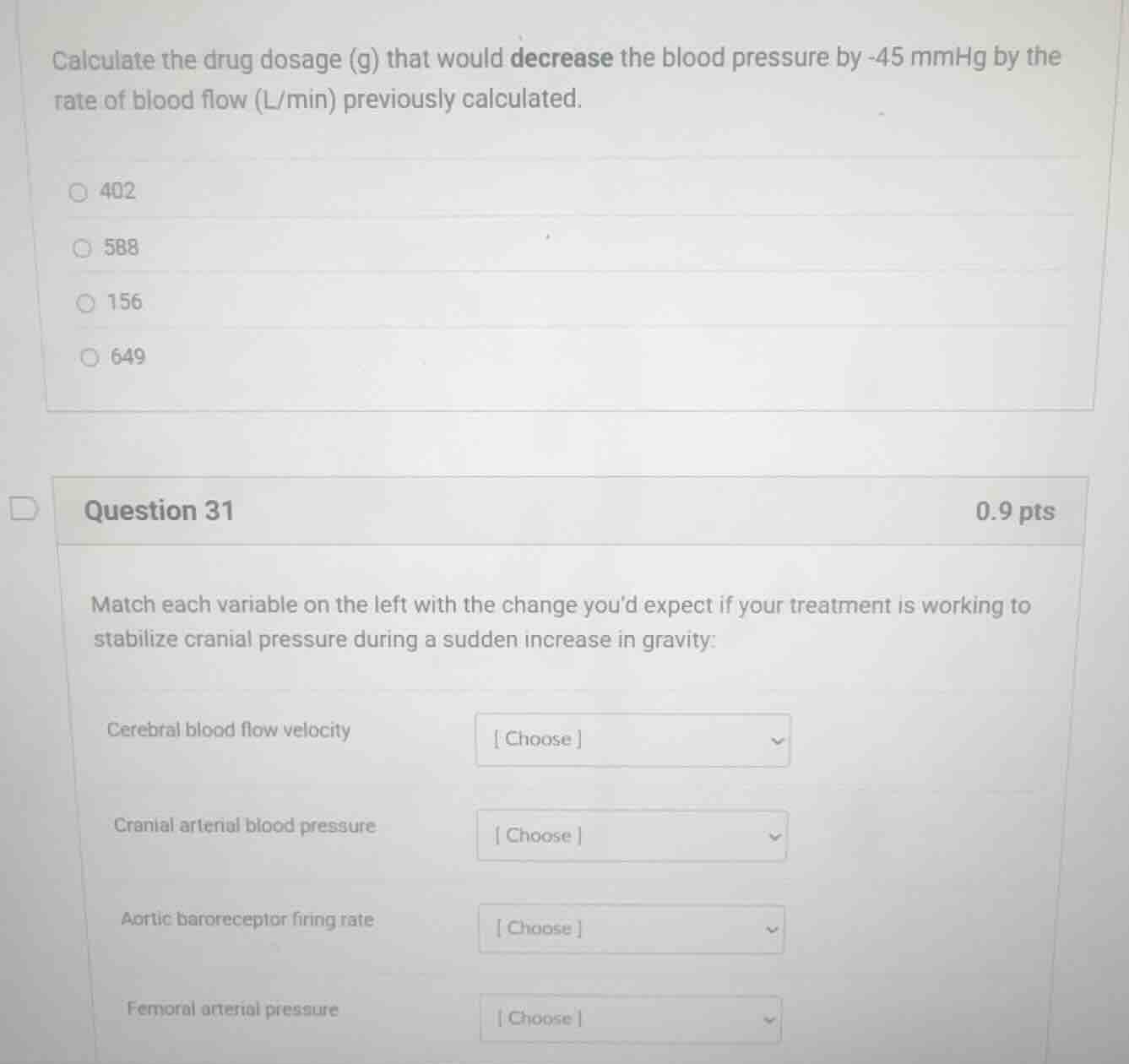
- A top multiple-choice question: "Calculate the drug dosage (g) that would decrease the blood pressure by -45 mmHg by the rate of blood flow (L/min) previously calculated."
- This question refers to a "rate of blood flow (L/min) previously calculated" and a specific drug dosage relationship which is not provided in the image. Because this crucial context (the formula relating dosage to pressure change and flow rate, or the previously calculated flow rate) is missing, this question cannot be solved numerically with certainty.
- Question 31: "Match each variable on the left with the change you'd expect if your treatment is working to stabilize cranial pressure during a sudden increase in gravity:"
- The variables to match are:
- Cerebral blood flow velocity
- Cranial arterial blood pressure
- Aortic baroreceptor firing rate
- Femoral arterial pressure
Analyze physiological effects of gravity and treatment
During a sudden increase in gravity (such as positive G-z acceleration, pulling blood down toward the lower limbs):
- Blood pools in the lower extremities, leading to a decrease in venous return, cardiac output, and arterial blood pressure at the level of the head (cranial arterial blood pressure drops).
- Consequently, cerebral blood flow velocity drops, risking G-LOC (gravity-induced loss of consciousness).
- The baroreceptors in the carotid sinus and aortic arch detect this drop in pressure, decreasing their firing rate to trigger a sympathetic reflex (vasoconstriction and increased heart rate) to restore pressure.
- Femoral arterial pressure increases due to the hydrostatic column of blood being pulled downward by gravity.
If a treatment is working to stabilize cranial pressure during this sudden increase in gravity:
- Cranial arterial blood pressure: The treatment aims to restore or maintain this pressure toward normal. Therefore, we expect it to increase (or remain stable/be restored) compared to the untreated gravity-induced drop.
- Cerebral blood flow velocity: By stabilizing cranial pressure, the treatment restores perfusion to the brain, so cerebral blood flow velocity should increase (or be maintained/restored) compared to the untreated state.
- Aortic baroreceptor firing rate: As the treatment successfully raises/stabilizes arterial pressure back toward normal, the stretch on the aortic baroreceptors increases compared to the untreated hypotensive state, so the firing rate increases (restoring toward baseline).
- Femoral arterial pressure: To push blood back up to the head, treatments (like G-suits or systemic vasoconstrictors) increase systemic vascular resistance and lower-body compression, which further increases (or maintains high) femoral arterial pressure, or if we look at the reflex, systemic vasoconstriction increases arterial pressure globally.

Snap & solve any problem in the app
Get step-by-step solutions on Sovi AI
Photo-based solutions with guided steps
Explore more problems and detailed explanations
Question 31
Based on cardiovascular physiology, when a treatment is successfully working to counteract the pooling of blood and stabilize cranial pressure during a sudden increase in gravity, the expected changes are:
- Cerebral blood flow velocity: Increase (restored back toward normal to maintain brain perfusion)
- Cranial arterial blood pressure: Increase (restored back toward normal levels)
- Aortic baroreceptor firing rate: Increase (as arterial pressure is restored, baroreceptor stretch and firing rate increase back toward baseline)
- Femoral arterial pressure: Increase (due to compensatory vasoconstriction and/or physical compression like a G-suit to push blood upward)