QUESTION IMAGE
Question
Question was provided via image upload.
Identify the components of a homeostatic feedback loop
Homeostasis is maintained through a self-regulating feedback loop. The three core components of this loop are:
- Sensor (or Receptor): Detects a change in the internal or external environment (stimulus) and sends data to the control center.
- Control Center: Receives and processes information from the sensor, compares it to the set point, and sends signals to the effector.
- Effector: Responds to the signals from the control center to bring the variable back to its normal range.
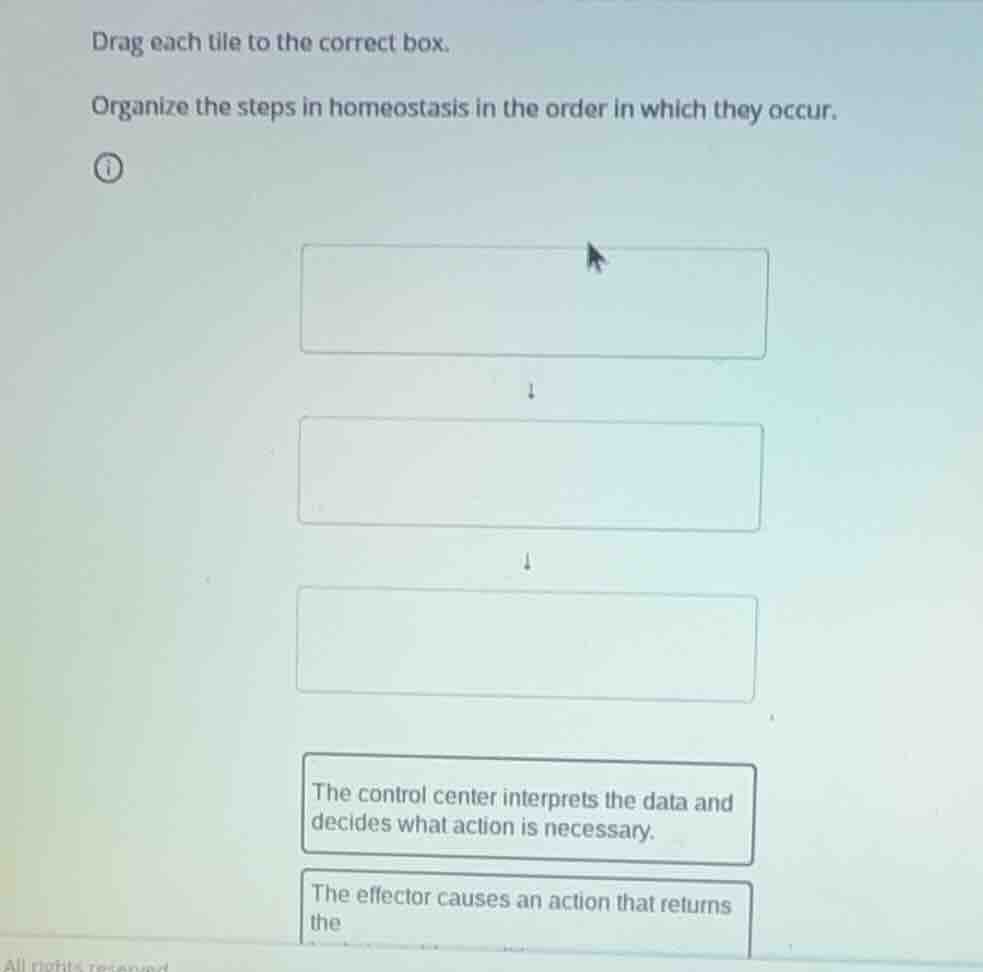
Analyze the visible tiles and reconstruct the missing information
The image is partially cropped at the bottom, but we can clearly identify the standard sequence:
- The first step (missing from the bottom list but implied by standard biology) is the detection of a stimulus by a receptor: "A sensor detects a change in the environment."
- The second step is shown in the first visible tile: "The control center interprets the data and decides what action is necessary."
- The third step is partially visible in the second tile: "The effector causes an action that returns the [body to homeostasis/normal state]."
Order the steps sequentially
Based on the biological pathway of a homeostatic feedback loop, the correct chronological order from top to bottom is:
- First Box: The sensor detects a change in the environment.
- Second Box: The control center interprets the data and decides what action is necessary.
- Third Box: The effector causes an action that returns the body to its normal state.

Snap & solve any problem in the app
Get step-by-step solutions on Sovi AI
Photo-based solutions with guided steps
Explore more problems and detailed explanations
The correct order of the steps in homeostasis from top to bottom is:
- A sensor detects a change in the environment.
- The control center interprets the data and decides what action is necessary.
- The effector causes an action that returns the body to its normal state.