QUESTION IMAGE
Question
Question was provided via image upload.
Analyze the question and options
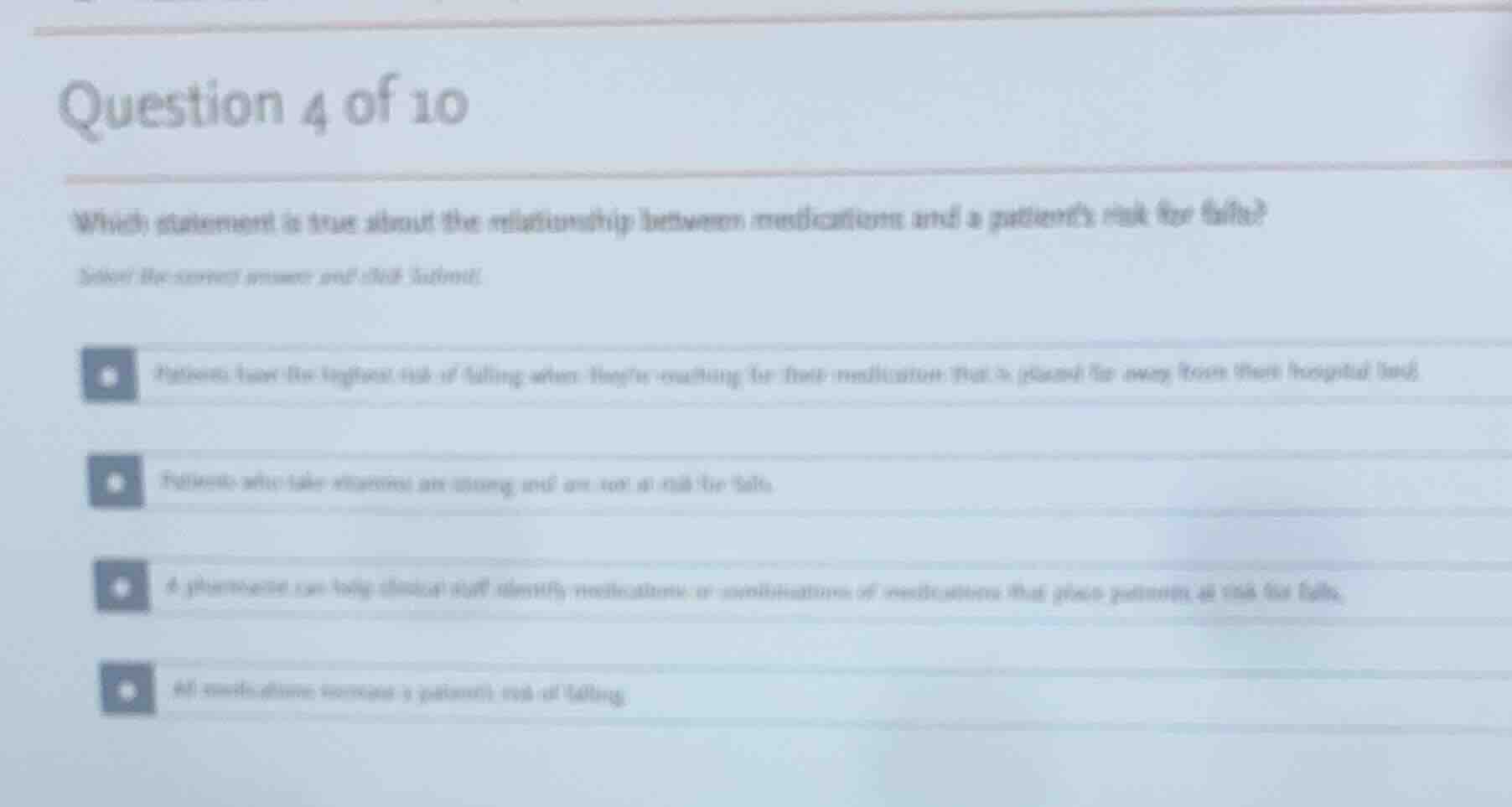
The question asks: "Which statement is true about the relationship between medications and a patient's risk for falls?"
Let's evaluate the visible options:
- "Patients have the highest risk of falling when they're reaching for their medication that is placed far away from their hospital bed." (Incorrect: This is an environmental/positioning issue, not a direct pharmacological relationship between medication action and fall risk).
- "Patients who take vitamins are strong and are not at risk for falls." (Incorrect: Taking vitamins does not eliminate fall risk).
- "A pharmacist can help clinical staff identify medications or combinations of medications that place patients at risk for falls." (Correct: Pharmacists play a key role in medication reconciliation and identifying high-risk medications like sedatives, antihypertensives, or polypharmacy that increase fall risk).
- "All medications increase a patient's risk of falling." (Incorrect: Not all medications increase fall risk).
Determine the correct choice
Option 3 is the only clinically accurate and logical statement regarding the relationship between medications and fall risk management.

Snap & solve any problem in the app
Get step-by-step solutions on Sovi AI
Photo-based solutions with guided steps
Explore more problems and detailed explanations
- (A) Patients have the highest risk of falling when they're reaching for their medication that is placed far away from their hospital bed.
- (B) Patients who take vitamins are strong and are not at risk for falls.
- (C) A pharmacist can help clinical staff identify medications or combinations of medications that place patients at risk for falls. (Correct answer)
- (D) All medications increase a patient's risk of falling.