QUESTION IMAGE
Question
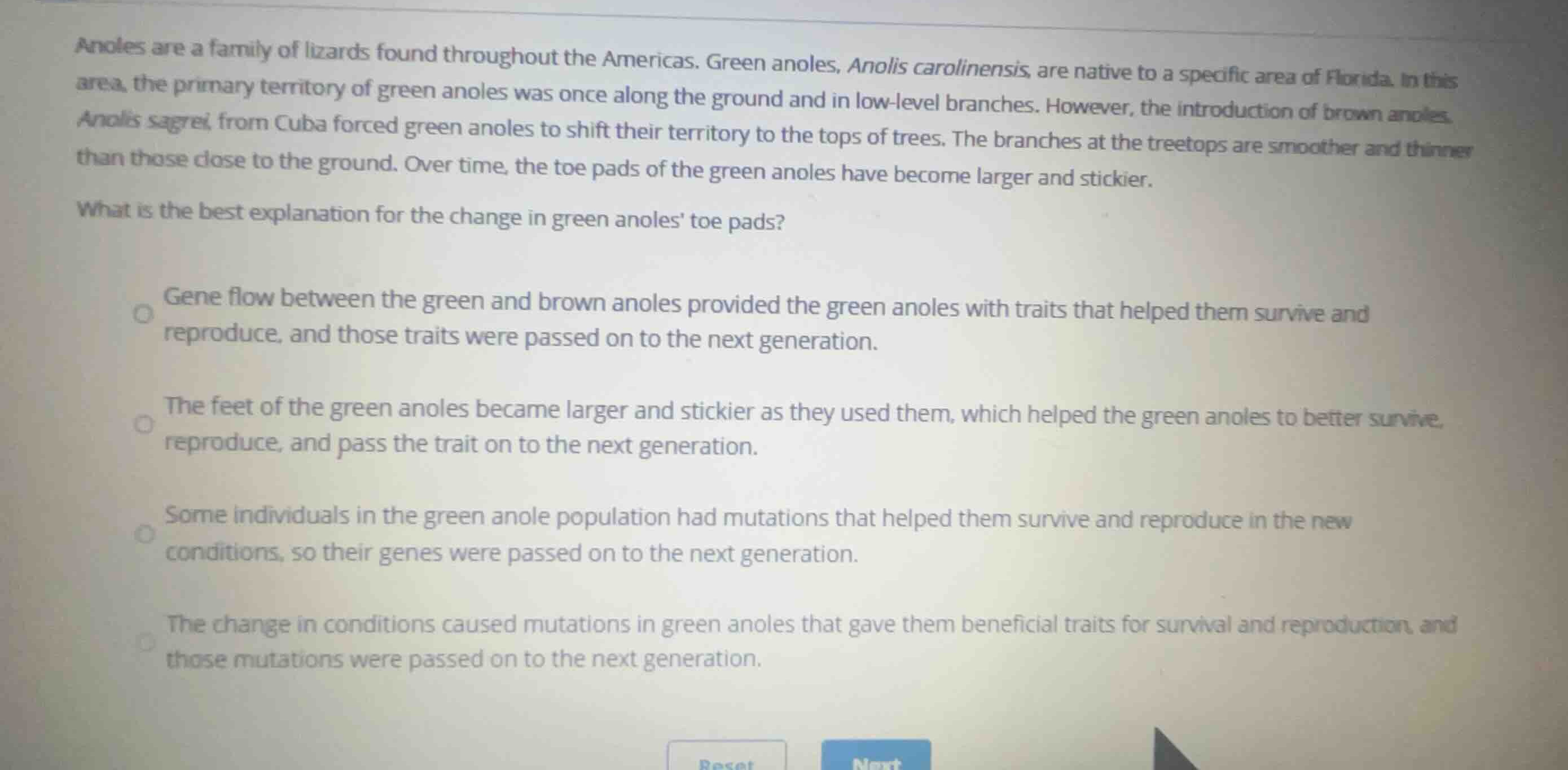
Question was provided via image upload.
Analyze the ecological scenario
Using the Adaptive Radiation knowledge point, we observe that the introduction of brown anoles (Anolis sagrei) created interspecific competition, forcing green anoles (Anolis carolinensis) to shift their ecological niche from the ground to the treetops. The smoother, thinner branches in the treetops represent a new environmental pressure requiring different physical adaptations, specifically larger and stickier toe pads for climbing.
Evaluate evolutionary mechanisms
Using the Natural Selection knowledge point, we evaluate how this physical change occurred over time:
- Natural selection acts on pre-existing genetic variation within a population.
- Random genetic mutations occur independently of environmental needs; the environment does not "cause" specific mutations to appear.
- Individuals possessing advantageous traits (larger, stickier toe pads due to random mutations) survive and reproduce at higher rates.
- These individuals pass their beneficial alleles to the next generation, shifting the population's traits over time.
Assess the given options
- Option 1 (Gene flow): Suggests gene flow between different species (green and brown anoles) introduced the trait. This is incorrect as they are distinct species and do not readily hybridize to pass functional niche-specific traits this way.
- Option 2 (Lamarckian inheritance): Suggests toe pads grew larger through use during an individual's lifetime and were passed on. This describes the incorrect theory of inheritance of acquired characteristics.
- Option 3 (Natural Selection via pre-existing mutation): Correctly states that random mutations already present in some individuals provided a survival advantage in the new treetop environment, leading to differential reproductive success and inheritance.
- Option 4 (Directed mutation): Incorrectly claims that the change in conditions caused the mutations to occur. Mutations are random, not directed by environmental demands.

Snap & solve any problem in the app
Get step-by-step solutions on Sovi AI
Photo-based solutions with guided steps
Explore more problems and detailed explanations
- Gene flow between the green and brown anoles provided the green anoles with traits that helped them survive and reproduce, and those traits were passed on to the next generation.
- The feet of the green anoles became larger and stickier as they used them, which helped the green anoles to better survive, reproduce, and pass the trait on to the next generation.
- Some individuals in the green anole population had mutations that helped them survive and reproduce in the new conditions, so their genes were passed on to the next generation. (Correct answer)
- The change in conditions caused mutations in green anoles that gave them beneficial traits for survival and reproduction, and those mutations were passed on to the next generation.