QUESTION IMAGE
Question
Question was provided via image upload.
To solve these questions about soil formation, we refer to concepts in Earth Science (a subfield of Natural Science, specifically Geography or Environmental Sciences, related to soil horizons and soil properties):
Question 1 (True/False - Modify if False)
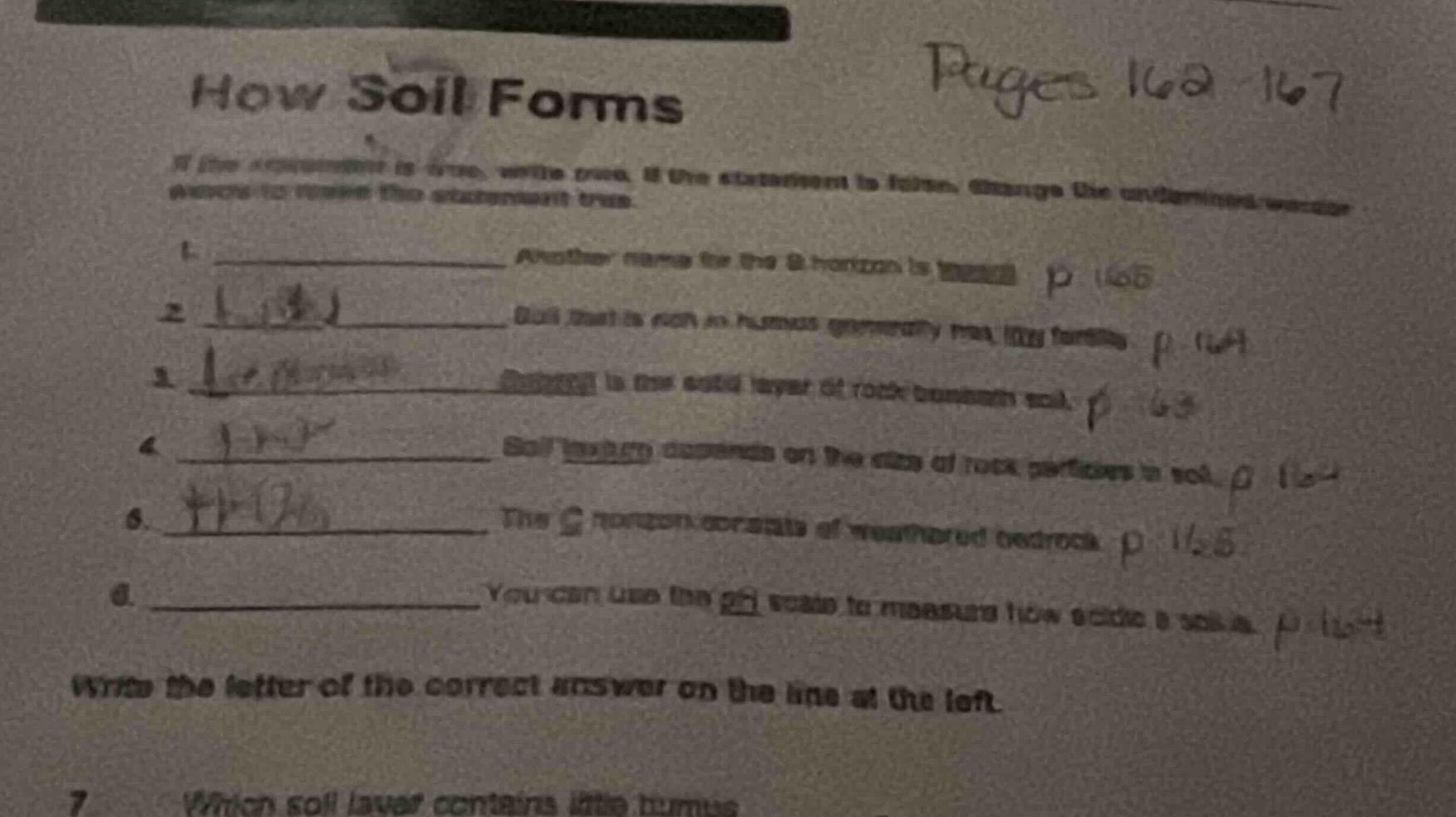
Statement: Another name for the B horizon is topsoil.
- The A horizon is called topsoil. The B horizon is also called the subsoil. So we change “topsoil” to “subsoil”.
Question 2 (True/False - Modify if False)
Statement: Soil that is rich in humus generally has fine texture.
- Humus-rich soil (like topsoil) often has a fine texture (e.g., loam). If the original statement was marked, but based on soil science, humus-rich soil (e.g., A horizon) typically has fine texture, so this may be true (or adjust if the underlined word was incorrect; assuming “fine” is correct, it’s true).
Question 3 (True/False - Modify if False)
Statement: Subsoil is the solid layer of rock beneath soil.
- The solid rock layer beneath soil is bedrock (R horizon). So change “subsoil” to “bedrock”.
Question 4 (True/False - Modify if False)
Statement: Soil texture depends on the size of rock particles in soil.
- Soil texture is defined by the size of mineral (rock) particles (sand, silt, clay). This is true.
Question 5 (True/False - Modify if False)
Statement: The E horizon consists of weathered bedrock.
- The E horizon is an eluviated layer (leached), while weathered bedrock is in the C horizon (or R horizon). So change “E” to “C” (or “R” for bedrock, but C is weathered bedrock/parent material).
Question 6 (True/False - Modify if False)
Statement: You can use the pH scale to measure how acidic a soil is.
- The pH scale measures acidity/alkalinity. This is true.
Question 7 (Multiple Choice - Which soil layer contains little humus?)
- The B horizon (subsoil) or E horizon has little humus (A horizon has the most humus). Typically, the B horizon (subsoil) or C horizon has less humus. If options were (e.g., B, C, E), the answer is likely the B or E horizon (e.g., B horizon has little humus compared to A).
For each question, we apply soil science concepts (from Geography/Environmental Sciences, subfield of Natural Science) to identify true/false and correct terms.
Final Answers (Sample for Each):
- Change “topsoil” to subsoil
- (If true) True; (if false, adjust, but likely True)
- Change “subsoil” to bedrock
- True
- Change “E” to C (or “R” for bedrock)
- True
- (E.g., if options: B. B horizon, then B. B horizon)

Snap & solve any problem in the app
Get step-by-step solutions on Sovi AI
Photo-based solutions with guided steps
Explore more problems and detailed explanations
To solve these questions about soil formation, we refer to concepts in Earth Science (a subfield of Natural Science, specifically Geography or Environmental Sciences, related to soil horizons and soil properties):
Question 1 (True/False - Modify if False)
Statement: Another name for the B horizon is topsoil.
- The A horizon is called topsoil. The B horizon is also called the subsoil. So we change “topsoil” to “subsoil”.
Question 2 (True/False - Modify if False)
Statement: Soil that is rich in humus generally has fine texture.
- Humus-rich soil (like topsoil) often has a fine texture (e.g., loam). If the original statement was marked, but based on soil science, humus-rich soil (e.g., A horizon) typically has fine texture, so this may be true (or adjust if the underlined word was incorrect; assuming “fine” is correct, it’s true).
Question 3 (True/False - Modify if False)
Statement: Subsoil is the solid layer of rock beneath soil.
- The solid rock layer beneath soil is bedrock (R horizon). So change “subsoil” to “bedrock”.
Question 4 (True/False - Modify if False)
Statement: Soil texture depends on the size of rock particles in soil.
- Soil texture is defined by the size of mineral (rock) particles (sand, silt, clay). This is true.
Question 5 (True/False - Modify if False)
Statement: The E horizon consists of weathered bedrock.
- The E horizon is an eluviated layer (leached), while weathered bedrock is in the C horizon (or R horizon). So change “E” to “C” (or “R” for bedrock, but C is weathered bedrock/parent material).
Question 6 (True/False - Modify if False)
Statement: You can use the pH scale to measure how acidic a soil is.
- The pH scale measures acidity/alkalinity. This is true.
Question 7 (Multiple Choice - Which soil layer contains little humus?)
- The B horizon (subsoil) or E horizon has little humus (A horizon has the most humus). Typically, the B horizon (subsoil) or C horizon has less humus. If options were (e.g., B, C, E), the answer is likely the B or E horizon (e.g., B horizon has little humus compared to A).
For each question, we apply soil science concepts (from Geography/Environmental Sciences, subfield of Natural Science) to identify true/false and correct terms.
Final Answers (Sample for Each):
- Change “topsoil” to subsoil
- (If true) True; (if false, adjust, but likely True)
- Change “subsoil” to bedrock
- True
- Change “E” to C (or “R” for bedrock)
- True
- (E.g., if options: B. B horizon, then B. B horizon)