Sovi.AI - AI Math Tutor

Scan to solve math questions

QUESTION IMAGE

how should you position an alert patient who presents with slurred spee…

Question

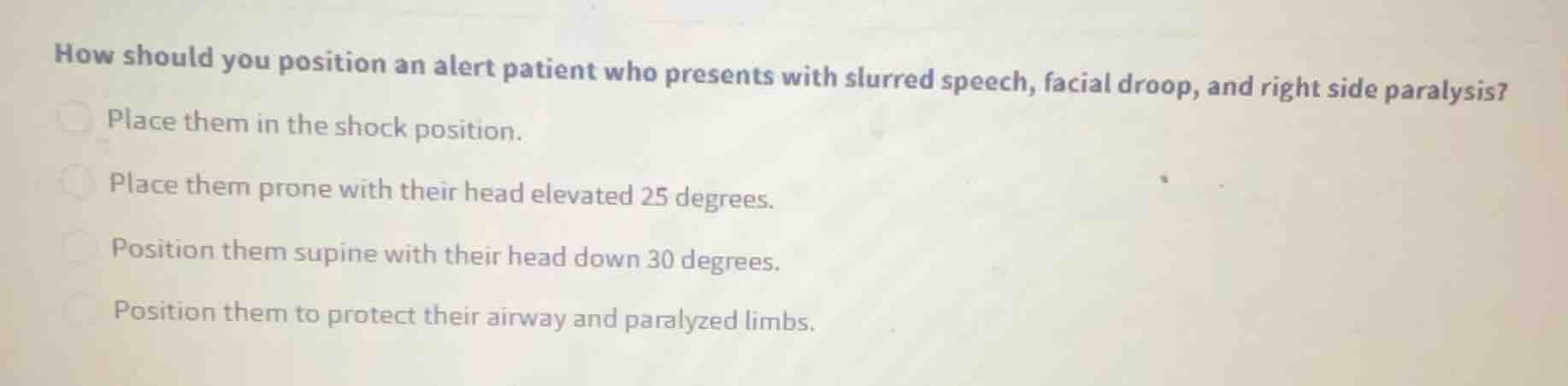
how should you position an alert patient who presents with slurred speech, facial droop, and right side paralysis?
place them in the shock position.
place them prone with their head elevated 25 degrees.
position them supine with their head down 30 degrees.
position them to protect their airway and paralyzed limbs.

Explanation:

Response

<pre_analysis>
{
"quality": "clear",
"question_count": 1,
"skills_matched": [
"direct_cot",
"multiple_choice_formatter",
"explain_then_answer",
"tutor",
"mastery_adaptive_brevity"
],
"needs_drawing": false,
"concepts_used": [
"Stroke Patient Positioning",
"Airway Protection in Stroke"
],
"new_concepts": [],
"current_concepts": [
"Stroke Patient Positioning",
"Airway Protection in Stroke"
]
}
</pre_analysis>

<reasoning>

Identify clinical presentation

The patient presents with slurred speech, facial droop, and right-sided paralysis. These signs are classic indicators of an acute stroke (cerebrovascular accident).

Evaluate positioning goals

Using the Stroke Patient Positioning and Airway Protection in Stroke knowledge points:

  • The primary goals when positioning a stroke patient are to maintain a patent airway, prevent aspiration (especially if secretions or vomiting occur), and protect paralyzed limbs from injury.
  • Placing a patient in a shock position (legs elevated), prone (face down), or supine with the head down is contraindicated because these positions increase intracranial pressure and compromise airway protection.
  • Therefore, the patient should be positioned to protect their airway and paralyzed limbs (typically in a semi-Fowler's position or lateral recumbent position if airway compromise is a threat).

</reasoning>

<answer>
<mcq-option>Place them in the shock position.</mcq-option>
<mcq-option>Place them prone with their head elevated 25 degrees.</mcq-option>
<mcq-option>Position them supine with their head down 30 degrees.</mcq-option>
<mcq-correct>Position them to protect their airway and paralyzed limbs.</mcq-correct>
</answer>

<post_analysis>
{
"subject": "Natural Science",
"question_type": "Multiple Choice",
"knowledge_point": [
"Natural Science",
"Medicine",
"Stroke Patient Positioning"
]
}
</post_analysis>

Answer:

<pre_analysis>
{
"quality": "clear",
"question_count": 1,
"skills_matched": [
"direct_cot",
"multiple_choice_formatter",
"explain_then_answer",
"tutor",
"mastery_adaptive_brevity"
],
"needs_drawing": false,
"concepts_used": [
"Stroke Patient Positioning",
"Airway Protection in Stroke"
],
"new_concepts": [],
"current_concepts": [
"Stroke Patient Positioning",
"Airway Protection in Stroke"
]
}
</pre_analysis>

<reasoning>

Identify clinical presentation

The patient presents with slurred speech, facial droop, and right-sided paralysis. These signs are classic indicators of an acute stroke (cerebrovascular accident).

Evaluate positioning goals

Using the Stroke Patient Positioning and Airway Protection in Stroke knowledge points:

  • The primary goals when positioning a stroke patient are to maintain a patent airway, prevent aspiration (especially if secretions or vomiting occur), and protect paralyzed limbs from injury.
  • Placing a patient in a shock position (legs elevated), prone (face down), or supine with the head down is contraindicated because these positions increase intracranial pressure and compromise airway protection.
  • Therefore, the patient should be positioned to protect their airway and paralyzed limbs (typically in a semi-Fowler's position or lateral recumbent position if airway compromise is a threat).

</reasoning>

<answer>
<mcq-option>Place them in the shock position.</mcq-option>
<mcq-option>Place them prone with their head elevated 25 degrees.</mcq-option>
<mcq-option>Position them supine with their head down 30 degrees.</mcq-option>
<mcq-correct>Position them to protect their airway and paralyzed limbs.</mcq-correct>
</answer>

<post_analysis>
{
"subject": "Natural Science",
"question_type": "Multiple Choice",
"knowledge_point": [
"Natural Science",
"Medicine",
"Stroke Patient Positioning"
]
}
</post_analysis>