QUESTION IMAGE
Question
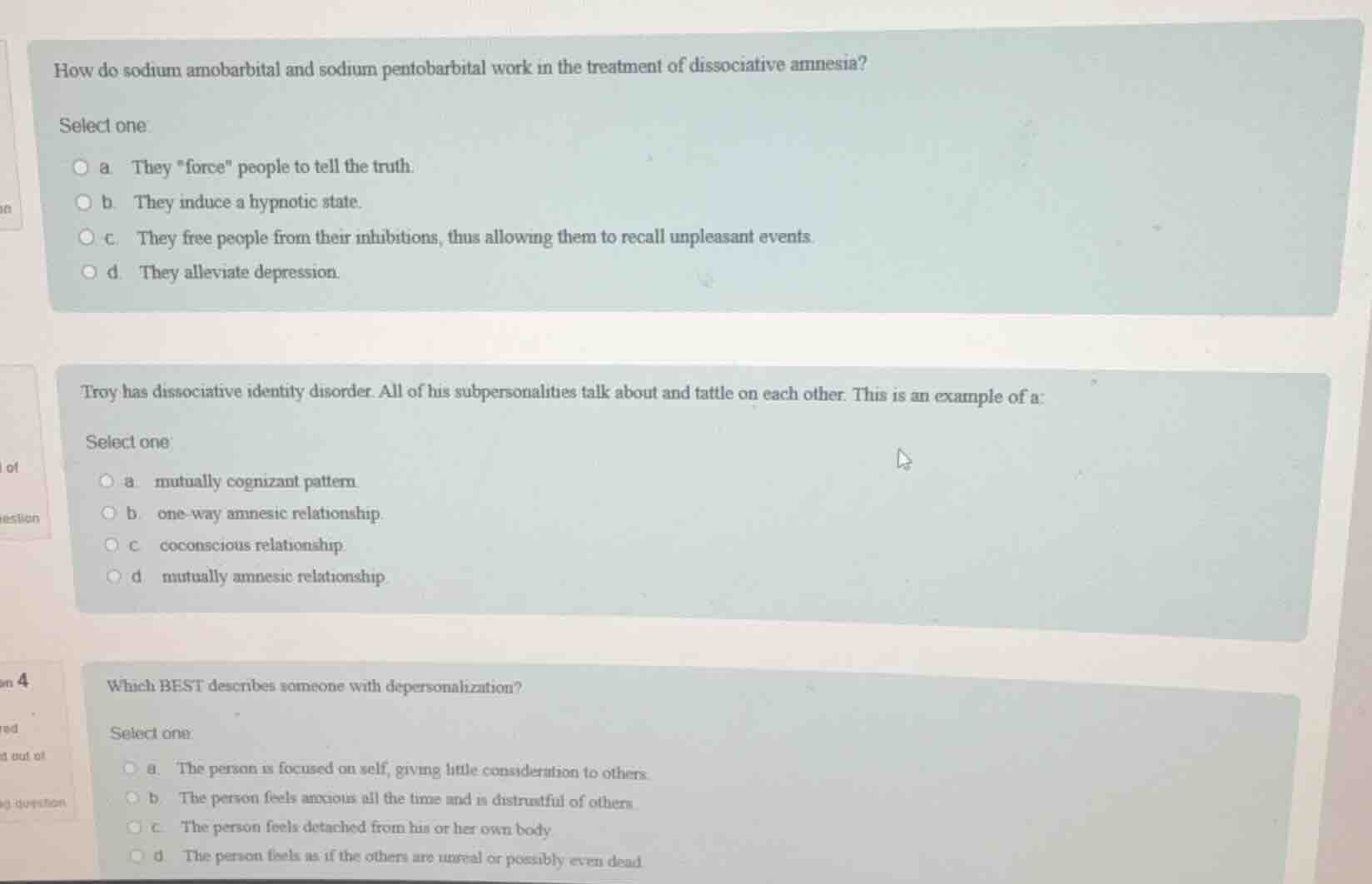
how do sodium amobarbital and sodium pentobarbital work in the treatment of dissociative amnesia?
select one:
a. they \force\ people to tell the truth.
b. they induce a hypnotic state.
c. they free people from their inhibitions, thus allowing them to recall unpleasant events.
d. they alleviate depression.
troy has dissociative identity disorder. all of his subpersonalities talk about and tattle on each other. this is an example of a:
select one:
a. mutually cognizant pattern
b. one-way amnesic relationship
c. coconscious relationship
d. mutually amnesic relationship
which best describes someone with depersonalization?
select one:
a. the person is focused on self, giving little consideration to others.
b. the person feels anxious all the time and is distrustful of others.
c. the person feels detached from his or her own body.
d. the person feels as if the others are unreal or possibly even dead.
Analyze Question 1: Barbiturates in Dissociative Amnesia
The first question asks how sodium amobarbital and sodium pentobarbital work in treating dissociative amnesia. These drugs are barbiturates, often historically referred to as "truth serums." However, they do not literally force truth-telling. Instead, they act as central nervous system depressants that reduce anxiety and lower inhibitions. By freeing patients from their profound inhibitions and defense mechanisms, the drugs help them recall deeply buried, unpleasant, or traumatic events that they had otherwise blocked out. Therefore, option (c) is the most accurate description of their therapeutic mechanism in this context.
Analyze Question 2: Subpersonality Relationships in DID
The second question describes Troy, who has dissociative identity disorder (DID), where all of his subpersonalities talk about and tattle on each other. In DID, the relationships between subpersonalities can take different forms:
- Mutually amnesic: Subpersonalities have no awareness of each other.
- One-way amnesic: Some subpersonalities are aware of others, but the awareness is not reciprocal.
- Mutually cognizant: Every subpersonality is aware of all the others, and they can hear, talk about, or interact with one another.
Since Troy's subpersonalities all talk about and tattle on each other, they share mutual awareness. This is a classic example of a mutually cognizant pattern, which corresponds to option (a).
Analyze Question 3: Depersonalization Description
The third question asks for the best description of someone experiencing depersonalization. Depersonalization-derealization disorder involves two distinct components:
- Depersonalization: Feeling detached or estranged from one's own body, mental processes, or self (as if observing oneself from the outside).
- Derealization: Feeling that the external world, other people, or surroundings are unreal or dreamlike.
Option (c) states "The person feels detached from his or her own body," which directly and accurately defines depersonalization. Option (d) describes derealization rather than depersonalization. Thus, option (c) is the correct choice.

Snap & solve any problem in the app
Get step-by-step solutions on Sovi AI
Photo-based solutions with guided steps
Explore more problems and detailed explanations
Question 1
- (a) They "force" people to tell the truth.
- (b) They induce a hypnotic state.</mcq-correct>
- (c) They free people from their inhibitions, thus allowing them to recall unpleasant events. (Correct answer)
<mcq-option>(d) They alleviate depression.
Question 2
- (a) mutually cognizant pattern (Correct answer)
- (b) one-way amnesic relationship
- (c) coconscious relationship
- (d) mutually amnesic relationship
Question 3
- (a) The person is focused on self, giving little consideration to others.
- (b) The person feels anxious all the time and is distrustful of others.
- (c) The person feels detached from his or her own body (Correct answer)
- (d) The person feels as if the others are unreal or possibly even dead