Sovi.AI - AI Math Tutor

Scan to solve math questions

QUESTION IMAGE

how deep should you push the chest of an adult victim when giving chest…

Question

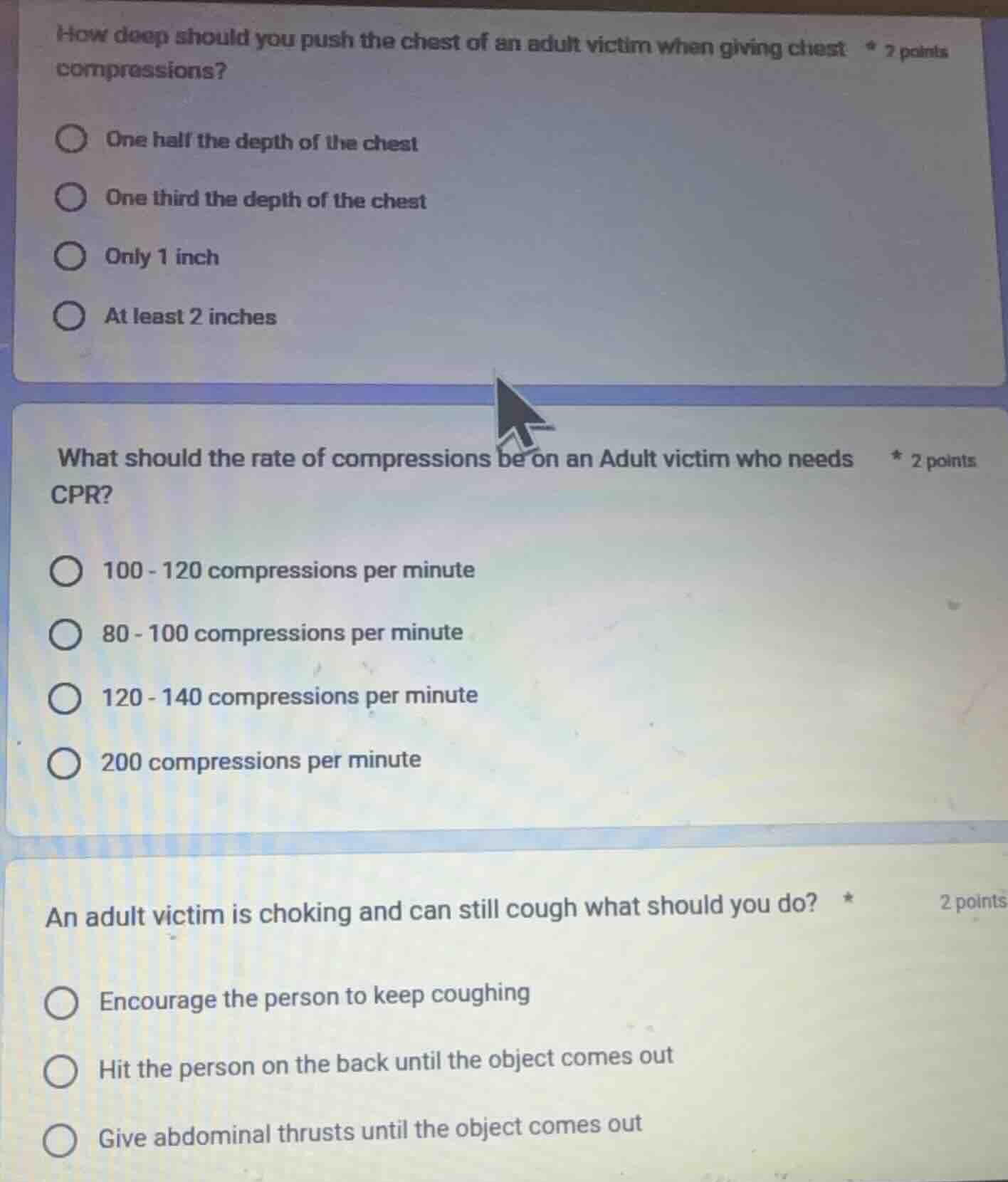
how deep should you push the chest of an adult victim when giving chest compressions?

one half the depth of the chest
one third the depth of the chest
only 1 inch
at least 2 inches

what should the rate of compressions be on an adult victim who needs cpr?

100 - 120 compressions per minute
80 - 100 compressions per minute
120 - 140 compressions per minute
200 compressions per minute

an adult victim is choking and can still cough what should you do?

encourage the person to keep coughing
hit the person on the back until the object comes out
give abdominal thrusts until the object comes out

Explanation:

Response

<pre_analysis>
{
"quality": "clear",
"question_count": 3,
"skills_matched": [
"direct_cot",
"multiple_choice_formatter",
"explain_then_answer",
"tutor"
],
"needs_drawing": false,
"concepts_used": [],
"new_concepts": [
"CPR Guidelines",
"Choking First Aid"
],
"current_concepts": [
"CPR Guidelines",
"Choking First Aid"
]
}
</pre_analysis>

<reasoning>

Analyze adult chest compression depth

For an adult victim, standard cardiopulmonary resuscitation (CPR) guidelines established by the American Heart Association (AHA) specify that chest compressions must be delivered at a depth of at least 2 inches (5 cm) but no more than 2.4 inches (6 cm). This depth ensures adequate blood circulation to vital organs.

Analyze adult chest compression rate

According to standard CPR protocols, the recommended rate for chest compressions on an adult victim is 100 to 120 compressions per minute. This rate mimics the heart's natural rhythm to maintain effective perfusion during cardiac arrest.

Analyze first aid for a choking adult who can cough

If a choking victim is still able to cough forcefully, it indicates a partial airway obstruction with some air exchange. The most appropriate action is to encourage the person to continue coughing, as coughing is the most effective natural mechanism to expel a foreign object. Invasive interventions like back blows or abdominal thrusts (Heimlich maneuver) should only be initiated if the airway becomes completely obstructed (e.g., the victim cannot speak, cough, or breathe).
</reasoning>

<answer>

Question 1

<mcq-option>One half the depth of the chest</mcq-option>
<mcq-option>One third the depth of the chest</mcq-option>
<mcq-option>Only 1 inch</mcq-option>
<mcq-correct>At least 2 inches</mcq-correct>

Question 2

<mcq-correct>100 - 120 compressions per minute</mcq-correct>
<mcq-option>80 - 100 compressions per minute</mcq-option>
<mcq-option>120 - 140 compressions per minute</mcq-option>
<mcq-option>200 compressions per minute</mcq-option>

Question 3

<mcq-correct>Encourage the person to keep coughing</mcq-correct>
<mcq-option>Hit the person on the back until the object comes out</mcq-option>
<mcq-option>Give abdominal thrusts until the object comes out</mcq-option>
</answer>

<post_analysis>
{
"subject": "Natural Science",
"question_type": "Multiple Choice",
"knowledge_point": [
"Natural Science",
"Medicine and Health",
"First Aid and CPR"
]
}
</post_analysis>

Answer:

<pre_analysis>
{
"quality": "clear",
"question_count": 3,
"skills_matched": [
"direct_cot",
"multiple_choice_formatter",
"explain_then_answer",
"tutor"
],
"needs_drawing": false,
"concepts_used": [],
"new_concepts": [
"CPR Guidelines",
"Choking First Aid"
],
"current_concepts": [
"CPR Guidelines",
"Choking First Aid"
]
}
</pre_analysis>

<reasoning>

Analyze adult chest compression depth

For an adult victim, standard cardiopulmonary resuscitation (CPR) guidelines established by the American Heart Association (AHA) specify that chest compressions must be delivered at a depth of at least 2 inches (5 cm) but no more than 2.4 inches (6 cm). This depth ensures adequate blood circulation to vital organs.

Analyze adult chest compression rate

According to standard CPR protocols, the recommended rate for chest compressions on an adult victim is 100 to 120 compressions per minute. This rate mimics the heart's natural rhythm to maintain effective perfusion during cardiac arrest.

Analyze first aid for a choking adult who can cough

If a choking victim is still able to cough forcefully, it indicates a partial airway obstruction with some air exchange. The most appropriate action is to encourage the person to continue coughing, as coughing is the most effective natural mechanism to expel a foreign object. Invasive interventions like back blows or abdominal thrusts (Heimlich maneuver) should only be initiated if the airway becomes completely obstructed (e.g., the victim cannot speak, cough, or breathe).
</reasoning>

<answer>

Question 1

<mcq-option>One half the depth of the chest</mcq-option>
<mcq-option>One third the depth of the chest</mcq-option>
<mcq-option>Only 1 inch</mcq-option>
<mcq-correct>At least 2 inches</mcq-correct>

Question 2

<mcq-correct>100 - 120 compressions per minute</mcq-correct>
<mcq-option>80 - 100 compressions per minute</mcq-option>
<mcq-option>120 - 140 compressions per minute</mcq-option>
<mcq-option>200 compressions per minute</mcq-option>

Question 3

<mcq-correct>Encourage the person to keep coughing</mcq-correct>
<mcq-option>Hit the person on the back until the object comes out</mcq-option>
<mcq-option>Give abdominal thrusts until the object comes out</mcq-option>
</answer>

<post_analysis>
{
"subject": "Natural Science",
"question_type": "Multiple Choice",
"knowledge_point": [
"Natural Science",
"Medicine and Health",
"First Aid and CPR"
]
}
</post_analysis>