QUESTION IMAGE
Question
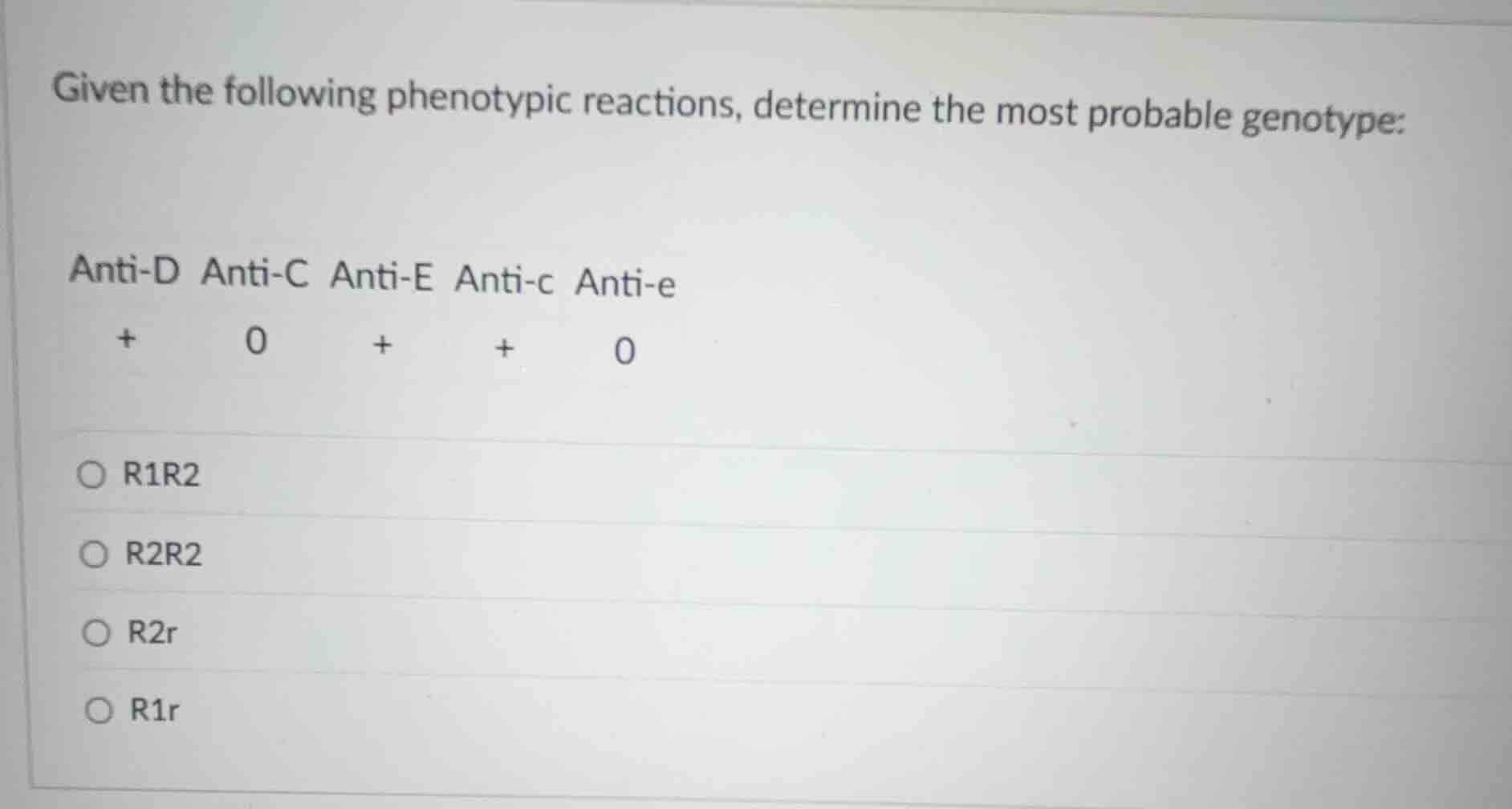
given the following phenotypic reactions, determine the most probable genotype:
anti-d anti-c anti-e anti-c anti-e
+ 0 + + 0
r1r2
r2r2
r2r
r1r
Identify the present and absent Rh antigens
Using the Rh Blood Group System knowledge point
- Anti-D: \(+\) (D antigen is present)
- Anti-C: \(0\) (C antigen is absent)
- Anti-E: \(+\) (E antigen is present)
- Anti-c: \(+\) (c antigen is present)
- Anti-e: \(0\) (e antigen is absent)
The phenotype is \(D+, C-, E+, c+, e-\), which is written as \(DcE\) or \(D.c.E.c.E\) (specifically, \(D+ C- E+ c+ e-\)).
Translate phenotype to Fisher-Race and Wiener haplotypes
Using the Wiener Nomenclature knowledge point
- Since \(D\) is present, the genotype must contain at least one \(D\) allele (\(R\)).
- Since \(C\) is absent and \(c\) is present, the individual is homozygous for \(c\) (\(cc\)).
- Since \(E\) is present and \(e\) is absent, the individual is homozygous for \(E\) (\(EE\)).
- Therefore, the complete Fisher-Race phenotype is \(DcE/DcE\) (or \(cDE/cDE\)).
- In Wiener nomenclature, the haplotype \(cDE\) is designated as \(R^2\) (or \(R2\)).
Determine the most probable genotype
Using the Rh Genotype Frequencies knowledge point
- The homozygous genotype \(R^2R^2\) (\(cDE/cDE\)) perfectly matches the phenotype \(D+, C-, E+, c+, e-\).
- Let's evaluate the given options:
- \(R^1R^2\) (\(CDe/cDE\)): would be positive for \(C\) and \(e\) (incorrect).
- \(R^2R^2\) (\(cDE/cDE\)): matches perfectly (correct).
- \(R^2r\) (\(cDE/cde\)): would be positive for \(e\) (incorrect).
- \(R^1r\) (\(CDe/cde\)): would be positive for \(C\) and \(e\), negative for \(E\) (incorrect).
- Note on \(r'r'\) (\(Cde/Cde\)): This genotype lacks the \(D\) antigen (Anti-D would be \(0\)) and lacks the \(E\) antigen, making it incorrect.

Snap & solve any problem in the app
Get step-by-step solutions on Sovi AI
Photo-based solutions with guided steps
Explore more problems and detailed explanations
- R1R2
- R2R2 (Correct answer)
- R2r
- R1r