QUESTION IMAGE
Question
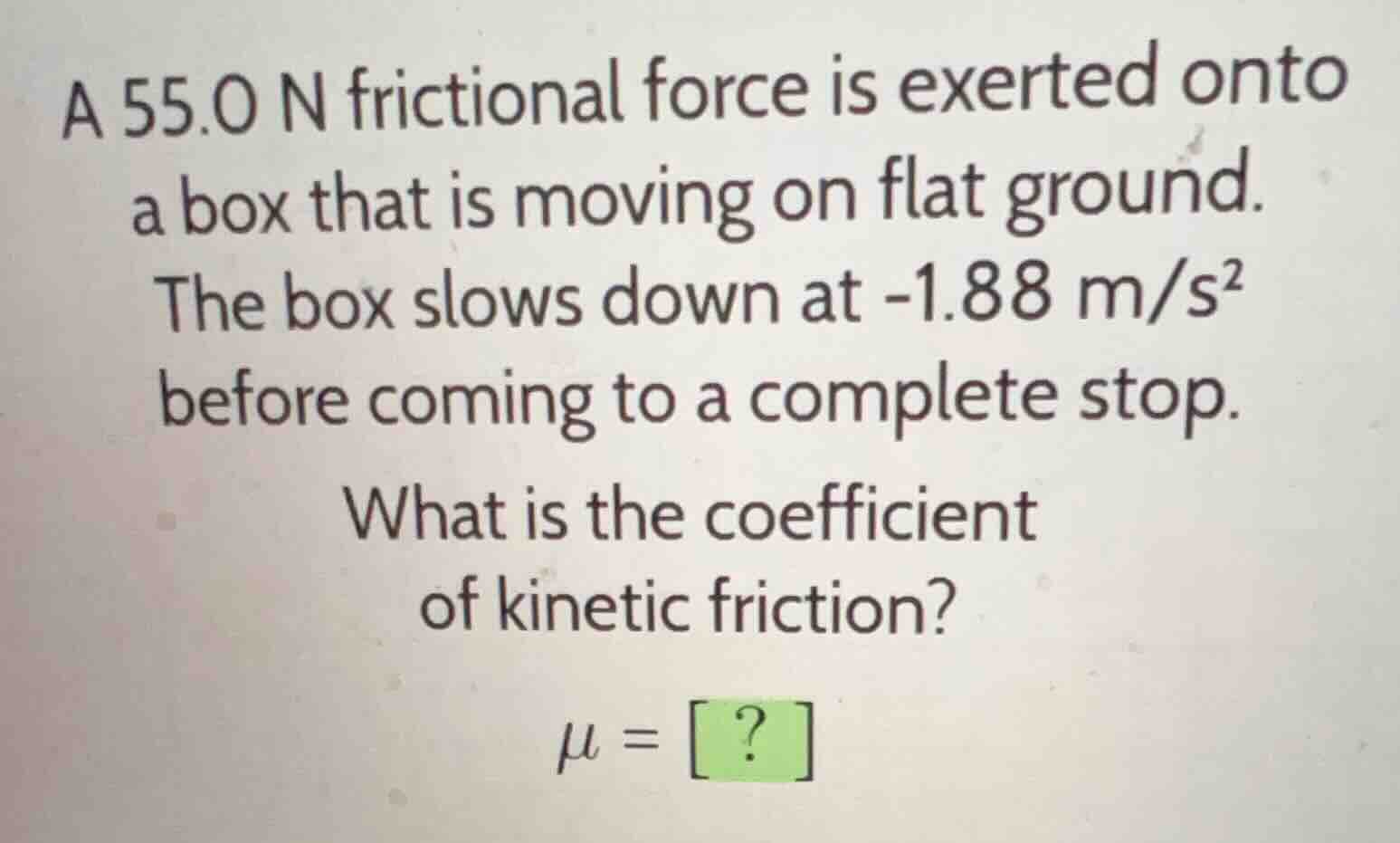
a \\(55.0\text{ n}\\) frictional force is exerted onto a box that is moving on flat ground. the box slows down at \\(-1.88\text{ m/s}^2\\) before coming to a complete stop. what is the coefficient of kinetic friction?
\\(\mu = ? \\)
⚡ Using: newton's laws of motion · 🆕 New: Friction and Coefficients
How rough surfaces resist sliding motion
Step 1: Find the mass of the box
The only horizontal force acting on the sliding box is the kinetic frictional force, which opposes the motion and causes the deceleration.
Using Newton's second law:
Given:
- Frictional force, \( F_f = 55.0\text{ N} \) (acting in the opposite direction of motion)
- Acceleration, \( a = -1.88\text{ m/s}^2 \)
Taking the magnitude of the force and acceleration to find the mass \( m \):
Step 2: Calculate the normal force
On flat ground, the normal force \( F_N \) supporting the box balances its weight:
Using the standard acceleration due to gravity \( g = 9.8\text{ m/s}^2 \) (or \( 9.81\text{ m/s}^2 \)):
Step 3: Calculate the coefficient of kinetic friction
The kinetic friction force is related to the normal force by:
Solve for the coefficient of kinetic friction \( \mu_k \):
(If using \( g = 9.81\text{ m/s}^2 \): \( F_N \approx 287.0\text{ N} \implies \mu_k \approx 0.192 \))

Snap & solve any problem in the app
Get step-by-step solutions on Sovi AI
Photo-based solutions with guided steps
Explore more problems and detailed explanations
0.192