QUESTION IMAGE
Question
- exploring emotions
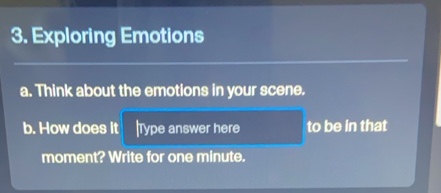
a. think about the emotions in your scene.
b. how does it feel to be in that moment? write for one minute.
🆕 New Concept Discovered: Sensory and Emotional Writing in Drama
Bringing a scene to life through internal feelings
Step 1: Understand the prompt
The prompt asks you to focus on a specific scene you are writing or analyzing. It has two parts:
- Identify the core emotions present in that scene (e.g., fear, excitement, anger, relief).
- Write a short, continuous reflection (for about one minute) describing what it physically and mentally feels like to experience that exact moment from a character's perspective.
Step 2: Choose a sample scenario
Since this is a creative writing prompt based on "your scene," we can use a common dramatic scenario as a helpful example to guide your own writing.
- Example Scene: A character is about to step onto a stage to give a major speech after overcoming a long struggle.
- Core Emotions: A mix of intense anxiety (stage fright) and quiet determination.
Step 3: Draft a one-minute sensory response
To write an effective response, focus on physical sensations (heart rate, breathing, temperature) and immediate thoughts.
- Drafting the response:
"It feels like a sudden cold weight settling in the pit of my stomach, making every breath feel shallow and sharp. The ambient noise of the crowd outside swells into a low, vibrating hum that vibrates right through the soles of my shoes. My hands are slightly damp, and my chest feels tight, but beneath the panic, there is a strange, quiet spark of readiness—like a spring wound up as tight as it can go, just waiting for the cue to release."

Snap & solve any problem in the app
Get step-by-step solutions on Sovi AI
Photo-based solutions with guided steps
Explore more problems and detailed explanations
To complete this exercise for your own scene, identify the main emotion your character is feeling and write a brief paragraph focusing on physical sensations.
Here is a template you can adapt based on the example above:
"It feels like a sudden cold weight settling in the pit of my stomach, making every breath feel shallow and sharp. The ambient noise of the crowd outside swells into a low, vibrating hum that vibrates right through the soles of my shoes. My hands are slightly damp, and my chest feels tight, but beneath the panic, there is a strange, quiet spark of readiness—like a spring wound up as tight as it can go, just waiting for the cue to release."