QUESTION IMAGE
Question
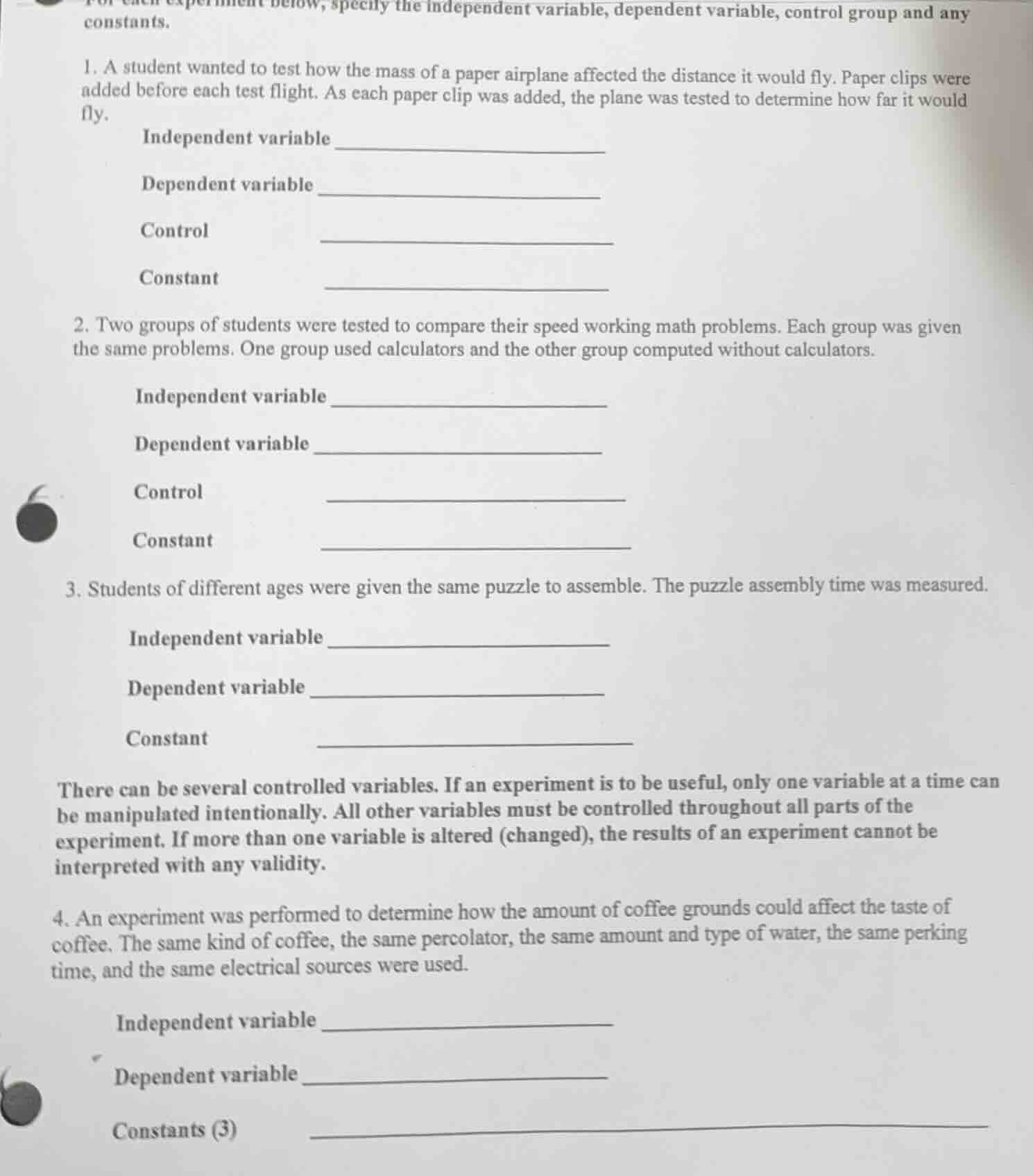
for each experiment below, specify the independent variable, dependent variable, control group and any constants.
- a student wanted to test how the mass of a paper airplane affected the distance it would fly. paper clips were added before each test flight. as each paper clip was added, the plane was tested to determine how far it would fly.
independent variable
dependent variable
control
constant
- two groups of students were tested to compare their speed working math problems. each group was given the same problems. one group used calculators and the other group computed without calculators.
independent variable
dependent variable
control
constant
- students of different ages were given the same puzzle to assemble. the puzzle assembly time was measured.
independent variable
dependent variable
constant
there can be several controlled variables. if an experiment is to be useful, only one variable at a time can be manipulated intentionally. all other variables must be controlled throughout all parts of the experiment. if more than one variable is altered (changed), the results of an experiment cannot be interpreted with any validity.
- an experiment was performed to determine how the amount of coffee grounds could affect the taste of coffee. the same kind of coffee, the same percolator, the same amount and type of water, the same perking time, and the same electrical sources were used.
independent variable
dependent variable
constants (3)
For each experiment, identify:
- Independent variable: The intentionally changed factor
- Dependent variable: The measured outcome
- Control group: The standard comparison group
- Constants: Unchanged factors across all tests

Snap & solve any problem in the app
Get step-by-step solutions on Sovi AI
Photo-based solutions with guided steps
Explore more problems and detailed explanations
1.
Independent variable: Mass of the paper airplane
Dependent variable: Flight distance of the plane
Control: Paper airplane with no paper clips
Constant: Same paper airplane design, launch method, test environment
2.
Independent variable: Use of calculators
Dependent variable: Speed of solving math problems
Control: Group solving without calculators
Constant: Same math problems, time allowed, testing environment
3.
Independent variable: Age of the students
Dependent variable: Puzzle assembly time
Constant: Same puzzle, assembly environment, instructions
4.
Independent variable: Amount of coffee grounds
Dependent variable: Taste of the coffee
Constants (3): Same kind of coffee, same percolator, same amount and type of water (or same perking time, same electrical source)