QUESTION IMAGE
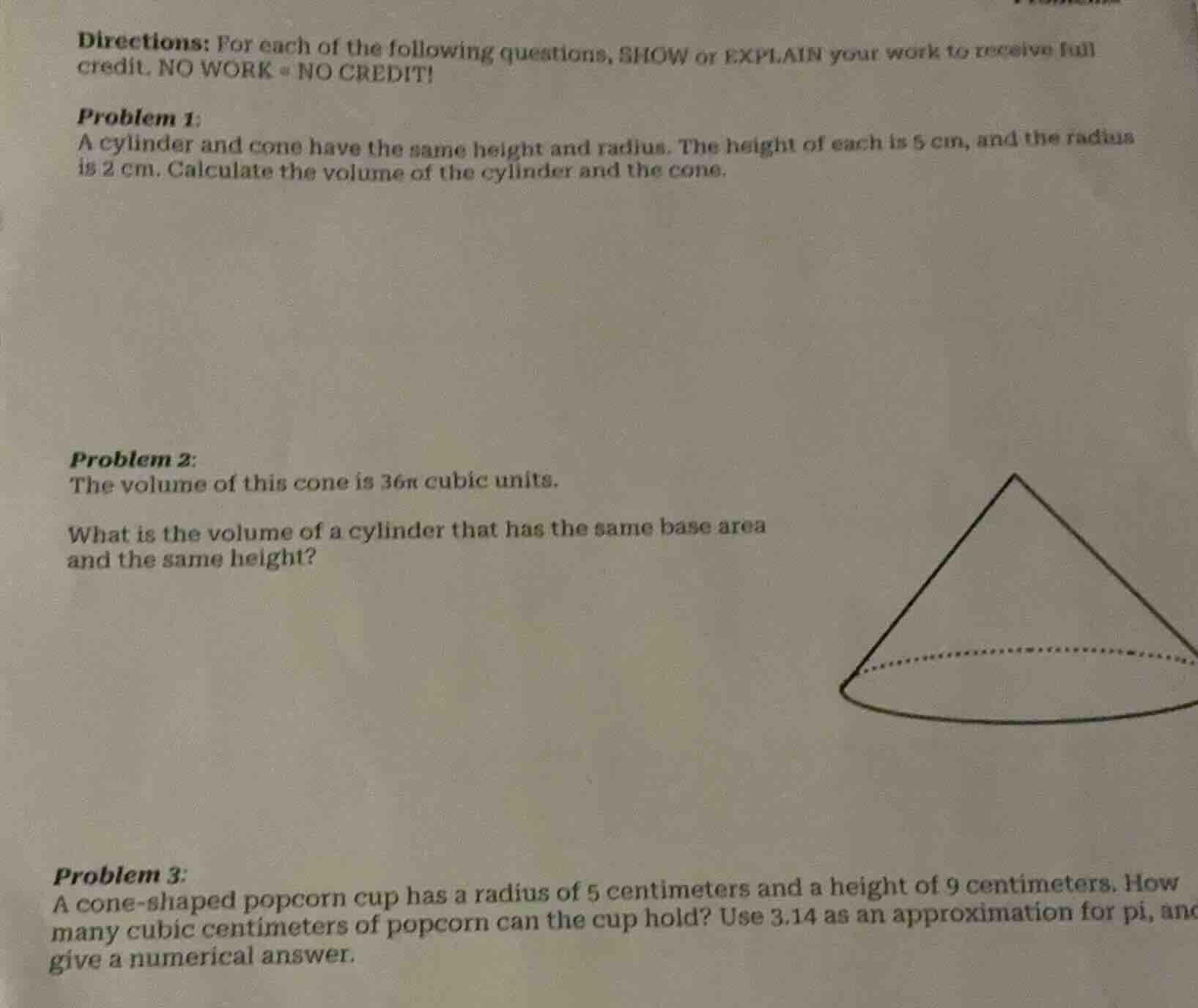
Question
directions: for each of the following questions, show or explain your work to receive full credit. no work = no credit!
problem 1:
a cylinder and cone have the same height and radius. the height of each is 5 cm, and the radius is 2 cm. calculate the volume of the cylinder and the cone.
problem 2:
the volume of this cone is 36π cubic units.
what is the volume of a cylinder that has the same base area and the same height?
problem 3:
a cone - shaped popcorn cup has a radius of 5 centimeters and a height of 9 centimeters. how many cubic centimeters of popcorn can the cup hold? use 3.14 as an approximation for pi, and give a numerical answer.
Problem 1
Step 1: Recall the formula for the volume of a cylinder
The formula for the volume of a cylinder is \( V_{cylinder} = \pi r^2 h \), where \( r \) is the radius and \( h \) is the height. Given \( r = 2 \, \text{cm} \) and \( h = 5 \, \text{cm} \).
Step 2: Recall the formula for the volume of a cone
The formula for the volume of a cone is \( V_{cone} = \frac{1}{3} \pi r^2 h \), with the same \( r = 2 \, \text{cm} \) and \( h = 5 \, \text{cm} \).
Step 1: Recall the relationship between the volume of a cone and a cylinder with the same base and height
The volume of a cone with the same base area (\( B \)) and height (\( h \)) as a cylinder is \( \frac{1}{3} \) of the volume of the cylinder. That is, \( V_{cone} = \frac{1}{3} V_{cylinder} \), so \( V_{cylinder} = 3 V_{cone} \).
Step 2: Calculate the volume of the cylinder
Given \( V_{cone} = 36\pi \) cubic units.
Step 1: Recall the formula for the volume of a cone
The formula for the volume of a cone is \( V = \frac{1}{3} \pi r^2 h \), where \( r = 5 \, \text{cm} \), \( h = 9 \, \text{cm} \), and \( \pi \approx 3.14 \).
Step 2: Simplify the expression
First, calculate \( (5)^2 = 25 \).
The \( \frac{1}{3} \) and \( 9 \) can be simplified: \( \frac{1}{3} \times 9 = 3 \).

Snap & solve any problem in the app
Get step-by-step solutions on Sovi AI
Photo-based solutions with guided steps
Explore more problems and detailed explanations
Volume of the cylinder: \( 20\pi \, \text{cm}^3 \) (or \( 62.8 \, \text{cm}^3 \)); Volume of the cone: \( \frac{20}{3}\pi \, \text{cm}^3 \) (or approximately \( 20.93 \, \text{cm}^3 \))