QUESTION IMAGE
Question
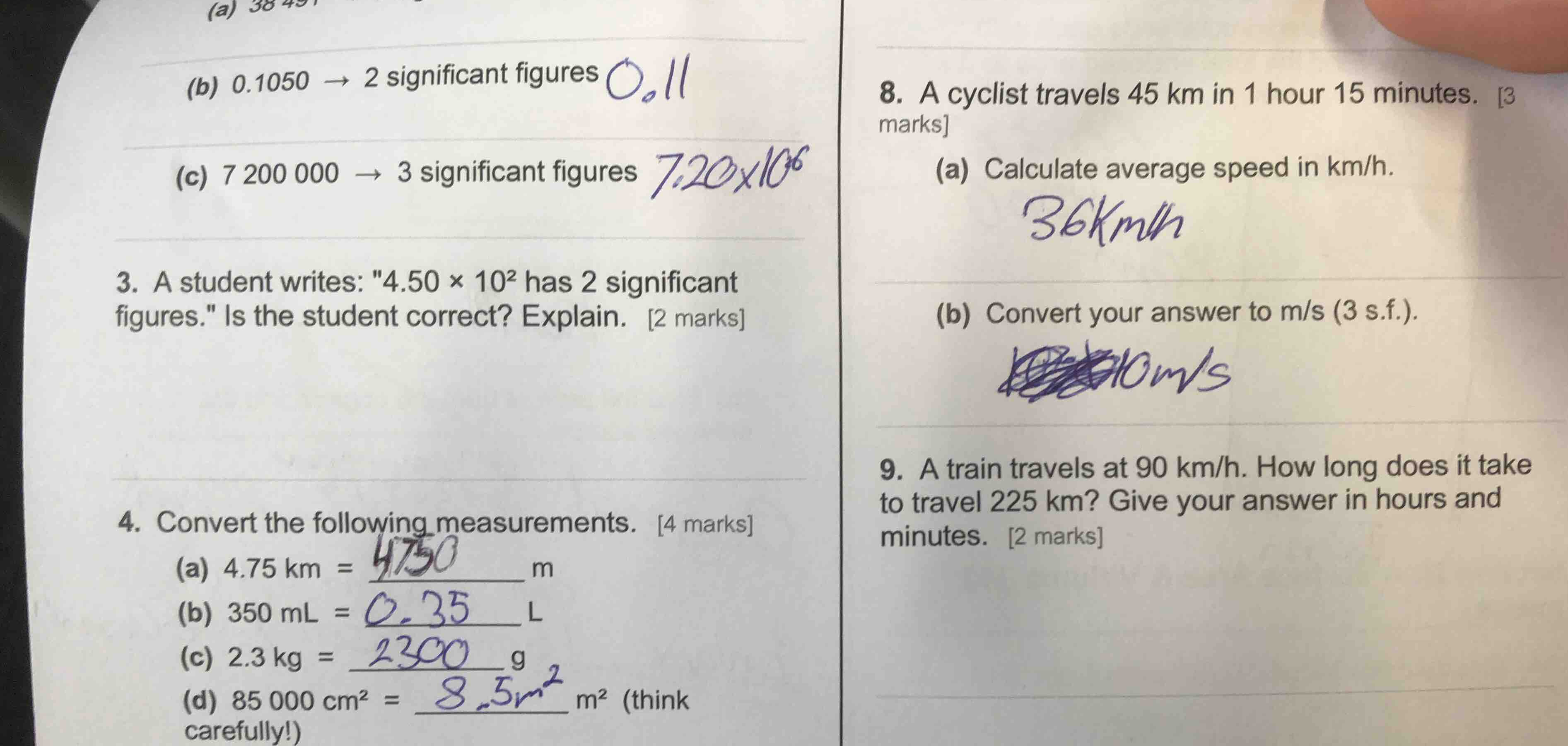
- a cyclist travels 45 km in 1 hour 15 minutes. 3 marks
(a) calculate average speed in km/h.
(b) convert your answer to m/s (3 s.f.).
- a train travels at 90 km/h. how long does it take to travel 225 km? give your answer in hours and minutes. 2 marks
<pre_analysis>
{
"quality": "clear",
"question_count": 5,
"skills_matched": [
"step_cot",
"explain_then_answer",
"tutor",
"mastery_adaptive_brevity"
],
"needs_drawing": false,
"concepts_used": [
"Significant Figures",
"Metric Conversion",
"Derived Units"
],
"new_concepts": [
"Speed Calculations",
"Unit Conversion Rates"
],
"current_concepts": [
"Significant Figures",
"Metric Conversion",
"Derived Units",
"Speed Calculations",
"Unit Conversion Rates"
]
}
</pre_analysis>
<reasoning>
Analyze student's claim on significant figures
Using the Significant Figures knowledge point
\[
\]
Convert metric units for measurements
Using the Metric Conversion knowledge point
\[
\]
Calculate average speed in km/h
Using the Derived Units knowledge point
\[
\]
Convert speed to m/s with 3 s.f.
Using the Derived Units and Significant Figures knowledge points
\[
\]
Calculate travel time in hours and minutes
We find the time taken for the train journey.
\[
\]
</reasoning>
<answer>
Question 3
No, the student is incorrect. In scientific notation, all digits in the coefficient are significant. The coefficient \(4.50\) has three significant figures (the \(4\), the \(5\), and the trailing zero after the decimal point). Therefore, \(4.50 \times 10^2\) has 3 significant figures.
Question 4
(a) \(4.75\text{ km} = 4750\text{ m}\)
(b) \(350\text{ mL} = 0.35\text{ L}\)
(c) \(2.3\text{ kg} = 2300\text{ g}\)
(d) \(85\,000\text{ cm}^2 = 8.5\text{ m}^2\)
Question 8
(a) \(36\text{ km/h}\)
(b) \(10.0\text{ m/s}\)
Question 9
2 hours and 30 minutes
</answer>
<post_analysis>
{
"subject": "Mathematics",
"question_type": "Multi-part",
"knowledge_point": [
"Mathematics",
"Algebra",
"Derived Units"
]
}
</post_analysis>
Snap & solve any problem in the app
Get step-by-step solutions on Sovi AI
Photo-based solutions with guided steps
Explore more problems and detailed explanations
<pre_analysis>
{
"quality": "clear",
"question_count": 5,
"skills_matched": [
"step_cot",
"explain_then_answer",
"tutor",
"mastery_adaptive_brevity"
],
"needs_drawing": false,
"concepts_used": [
"Significant Figures",
"Metric Conversion",
"Derived Units"
],
"new_concepts": [
"Speed Calculations",
"Unit Conversion Rates"
],
"current_concepts": [
"Significant Figures",
"Metric Conversion",
"Derived Units",
"Speed Calculations",
"Unit Conversion Rates"
]
}
</pre_analysis>
<reasoning>
Analyze student's claim on significant figures
Using the Significant Figures knowledge point
\[
\]
Convert metric units for measurements
Using the Metric Conversion knowledge point
\[
\]
Calculate average speed in km/h
Using the Derived Units knowledge point
\[
\]
Convert speed to m/s with 3 s.f.
Using the Derived Units and Significant Figures knowledge points
\[
\]
Calculate travel time in hours and minutes
We find the time taken for the train journey.
\[
\]
</reasoning>
<answer>
Question 3
No, the student is incorrect. In scientific notation, all digits in the coefficient are significant. The coefficient \(4.50\) has three significant figures (the \(4\), the \(5\), and the trailing zero after the decimal point). Therefore, \(4.50 \times 10^2\) has 3 significant figures.
Question 4
(a) \(4.75\text{ km} = 4750\text{ m}\)
(b) \(350\text{ mL} = 0.35\text{ L}\)
(c) \(2.3\text{ kg} = 2300\text{ g}\)
(d) \(85\,000\text{ cm}^2 = 8.5\text{ m}^2\)
Question 8
(a) \(36\text{ km/h}\)
(b) \(10.0\text{ m/s}\)
Question 9
2 hours and 30 minutes
</answer>
<post_analysis>
{
"subject": "Mathematics",
"question_type": "Multi-part",
"knowledge_point": [
"Mathematics",
"Algebra",
"Derived Units"
]
}
</post_analysis>