QUESTION IMAGE
Question
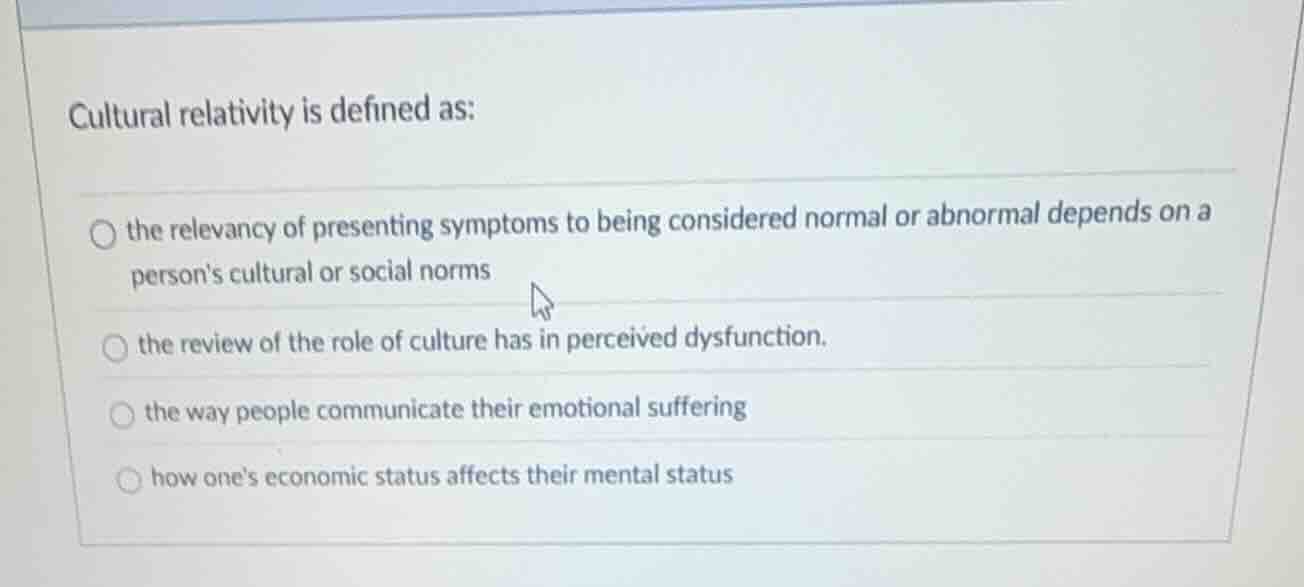
cultural relativity is defined as:
- the relevancy of presenting symptoms to being considered normal or abnormal depends on a persons cultural or social norms
- the review of the role of culture has in perceived dysfunction.
- the way people communicate their emotional suffering
- how ones economic status affects their mental status
🆕 New Concept Discovered: Cultural Relativism in Psychopathology
Behavior is judged relative to cultural norms.
Step 1: Define Cultural Relativity
In psychology and psychiatry, cultural relativity (or cultural relativism) is the principle that an individual's beliefs, values, and behaviors—including what is considered "normal" or "abnormal"—should be understood based on that person's own culture, rather than be judged against the criteria of another culture.
What this means is that a behavior or symptom that is considered abnormal or pathological in one society might be completely normal, expected, or even highly valued in another.
Step 2: Evaluate the Options
- Option 1: "the relevancy of presenting symptoms to being considered normal or abnormal depends on a person's cultural or social norms"
- This directly aligns with the definition of cultural relativity. It states that whether a symptom is viewed as normal or abnormal depends entirely on the individual's cultural context.
- Option 2: "the review of the role of culture has in perceived dysfunction"
- While related to cultural psychology, this describes an academic or clinical process (reviewing the role) rather than the definition of the concept of relativity itself.
- Option 3: "the way people communicate their emotional suffering"
- This refers to "idioms of distress," which is a different cultural concept.
- Option 4: "how one's economic status affects their mental status"
- This describes socioeconomic factors, not cultural relativity.

Snap & solve any problem in the app
Get step-by-step solutions on Sovi AI
Photo-based solutions with guided steps
Explore more problems and detailed explanations
the relevancy of presenting symptoms to being considered normal or abnormal depends on a person's cultural or social norms